Newcomb's Problem: Rules Split if the Predictor Tops 50.05%
Published · Puzzles, Charts & Dilemmas
Folded answers print open where the browser allows it; if one prints closed, open it at https://puzzleschartsanddilemmas.com/puzzles/newcombs-problem/ first.
Where it lands
Newcomb's problem offers a clear box holding $1,000 and an opaque box that holds $1,000,000 only if a reliable predictor expected you to take the opaque box alone. Expected value, figured with the chance that the prediction matches your choice, favors one box once that chance is above 50.05%, while the dominance rule favors both boxes, and philosophers still disagree about which rule should decide.
Sections on this sheet (5)
The physicist William Newcomb first posed the puzzle, and Robert Nozick published it under Newcomb's name in 1969. Nozick built it so that two rules of choice, each standard in decision theory, would point in opposite directions. One side says the people who take one box end up richer. The other says the problem simply rewards an irrational choice.
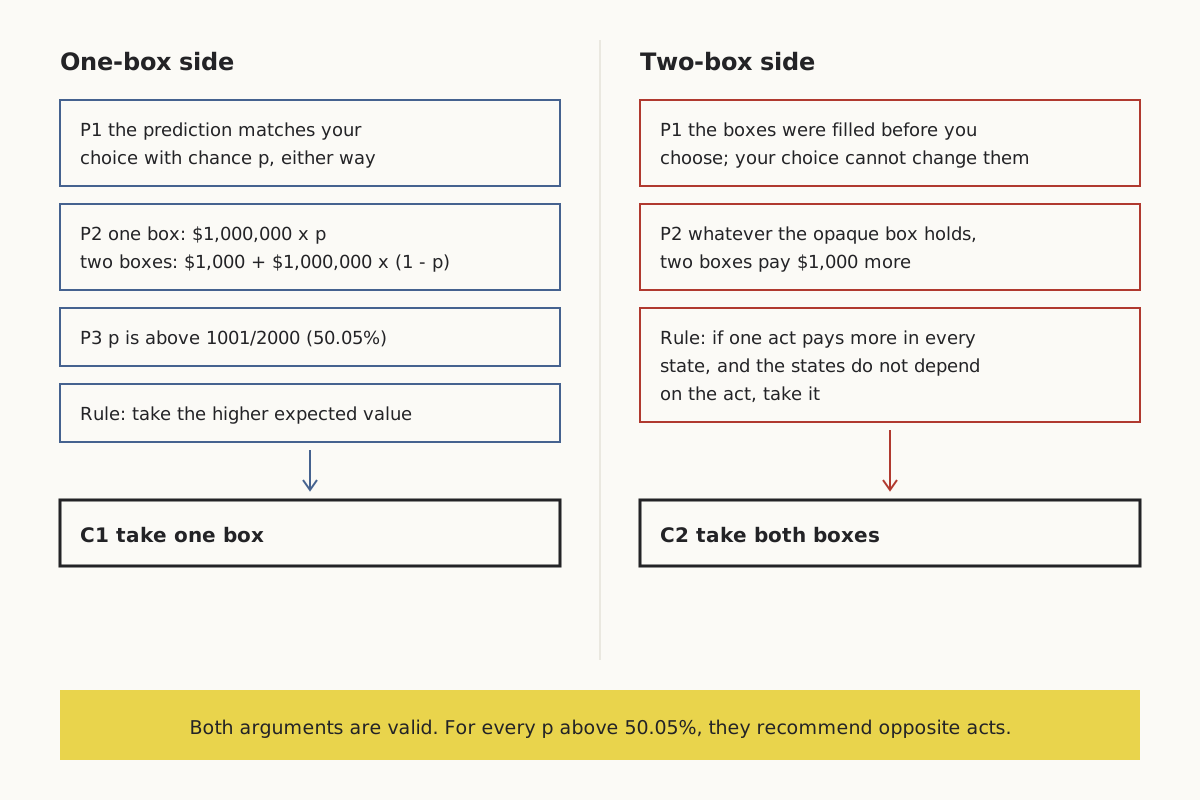
The two sides do not part over the arithmetic. They part one layer down, over which rule gets to use it. Here are both arguments in standard form.
In standard form:
- Premise 1:One-box side: the prediction matches your choice with chance p, whichever box you take.
- Premise 2:One-box side: so one box is expected to pay $1,000,000 × p, and two boxes $1,000 + $1,000,000 × (1 − p).
- Premise 3:One-box side: when p is above 1001/2000 (50.05%), one box has the higher expected value; take one box.
- Premise 4:Two-box side: the boxes were filled before you choose, and your choice cannot change what is in them.
- Premise 5:Two-box side: whatever the opaque box holds, two boxes pay $1,000 more; take both boxes.
- Therefore, conclusion:Both arguments are valid, and for any predictor right more than 50.05% of the time they give opposite answers. Which rule should govern is the open question, and philosophers still disagree.
An open tray and a closed box, and a hand that has not yet chosen.
Illustration: Puzzles, Charts & Dilemmas. Generated schematic illustration — not a photograph or historical record. Reuse: CC BY 4.0 (https://creativecommons.org/licenses/by/4.0/), to the extent Puzzles, Charts & Dilemmas holds rights in it.
The four outcomes
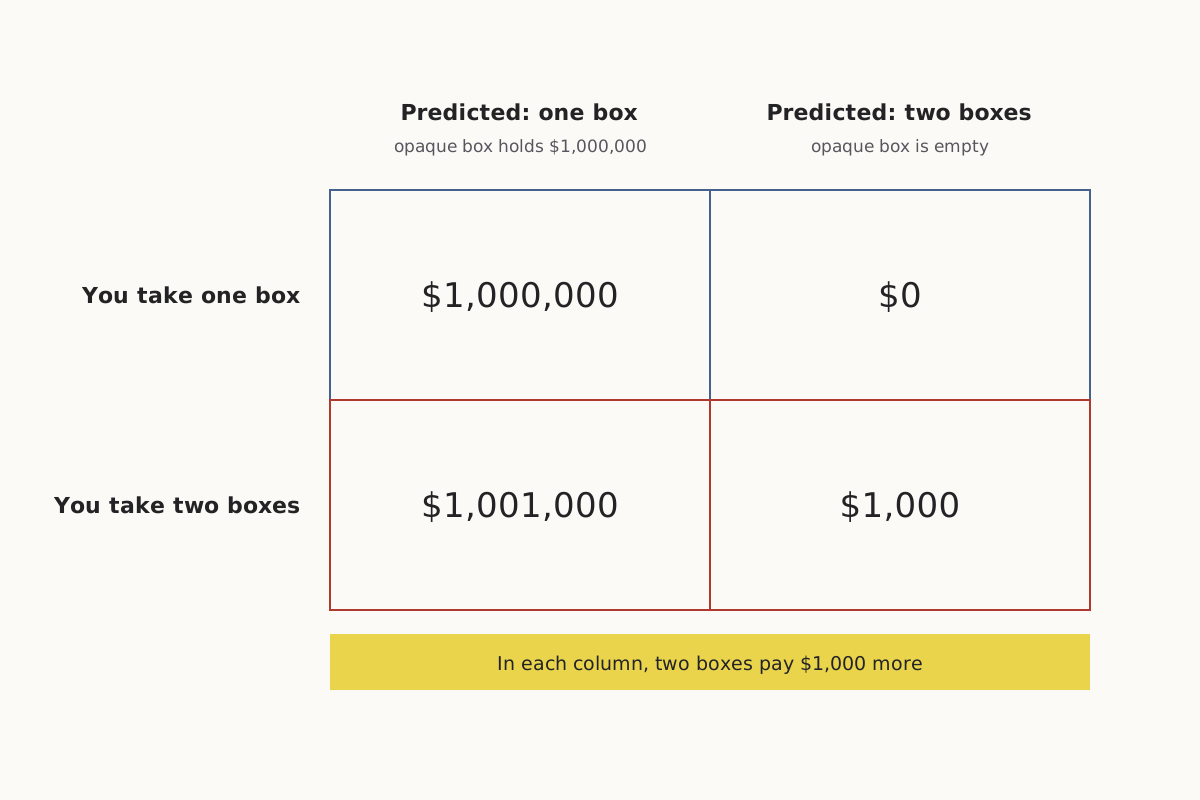
The setup, as the Stanford Encyclopedia of Philosophy (SEP) entry Causal Decision Theory lays it out, has two boxes. The clear one holds $1,000 that you can see. The opaque one holds either $1,000,000 or nothing, and that was settled earlier by a prediction of what you would do: a million if you were predicted to take only the opaque box, nothing if you were predicted to take both.
Wide figure: scroll it sideways, or open it full size.
The four outcomes, by what you take and what was predicted.
Diagram: Puzzles, Charts & Dilemmas, CC BY 4.0
Copy the full credit line
"The four outcomes of Newcomb's problem" by Puzzles, Charts & Dilemmas, https://puzzleschartsanddilemmas.com/puzzles/newcombs-problem/, licensed under CC BY 4.0 (https://creativecommons.org/licenses/by/4.0/).
| You take | Predicted: one box | Predicted: two boxes |
|---|---|---|
| One box | $1,000,000 | $0 |
| Two boxes | $1,001,000 | $1,000 |
The entry calls the prediction reliable and says you know every feature of the problem. It gives no number for how reliable, and neither does this page. We use p for the chance that the prediction matches your choice, so you can see what each rule says at any value you like.
Read the table down each column and two boxes always come out $1,000 ahead. Read it with a good predictor in mind and the likely cells change. A one-boxer probably lands top left, and a two-boxer probably lands bottom right. Both readings use the same four numbers.
The dollar amounts are only the setting. What matters is the ratio: the opaque box can hold a thousand times what the clear box holds. The choice is also made once, by you, with the boxes already filled. Nothing in the setup lets you watch other players first or change your mind after you see the contents.
The same four numbers can be laid out another way. The SEP entry relabels the columns as a right prediction and a wrong one. One box then pays $1,000,000 or $0, and two boxes pay $1,000 or $1,001,000, so neither row wins in both columns and dominance no longer applies. The entry holds that dominance still settles the problem, because it applies to the first, accurate layout.
The two arguments
The two-box argument uses dominance: if one act pays more than another in every possible state of the world, take it. Here the states are the two predictions. Whichever one was made, two boxes pay $1,000 more, so dominance says take both. The SEP entry adds the premise this needs: the prediction is already made, and your act cannot cause it.
The one-box argument uses expected value, the average payoff weighted by how likely each outcome is. It takes those chances given your choice. If you take one box, a reliable predictor probably foresaw that, so the box is probably full; if you take two, it is probably empty. Your choice is evidence about the prediction, even though it does not cause it.
Wide figure: scroll it sideways, or open it full size.
Each side's argument in standard form; both pass a validity check, and their conclusions clash.
Diagram: Puzzles, Charts & Dilemmas, CC BY 4.0
Copy the full credit line
"The two arguments of Newcomb's problem" by Puzzles, Charts & Dilemmas, https://puzzleschartsanddilemmas.com/puzzles/newcombs-problem/, licensed under CC BY 4.0 (https://creativecommons.org/licenses/by/4.0/).
| Step | One-box side | Two-box side |
|---|---|---|
| What the chances depend on | Your choice (it is evidence of the prediction) | Nothing you do now (the prediction is made) |
| Rule | Take the higher expected value | Take the act that pays more in every state |
| Key fact | Above p = 1001/2000, one box is expected to pay more | Two boxes pay $1,000 more in both columns |
| Conclusion | Take one box | Take both boxes |
We checked both arguments for validity, meaning that the conclusion cannot be false while the premises are true, and both pass. The one-box argument needs its premise about p: at p = 1/2 its conclusion fails. The two-box argument needs its premise that the contents do not depend on your act. If they did, at p = 9/10 two boxes would still pay $1,000 more in each column, yet one box would be expected to pay $900,000 against $101,000 for two.
Suppose the predictor were never wrong. The SEP entry reports that some theorists find one box plainly rational then, since the choice seems to shrink to $1,000,000 against $1,000. The entry calls this an oversimplification. On its account, a one-boxer would still have done better by taking both, because dominance still favors two boxes, and making the prediction certain does not change the character of the problem.
That last check is where the problem lives. Each side's key premise is a claim about which probabilities belong in the calculation, and a validity check cannot settle that. A knights and knaves puzzle is different: once its rules are written down, checking every assignment settles the answer. Here two people are pulling on the same knot from opposite ends, and each one thinks the knot is coming loose.
How reliable must the predictor be?
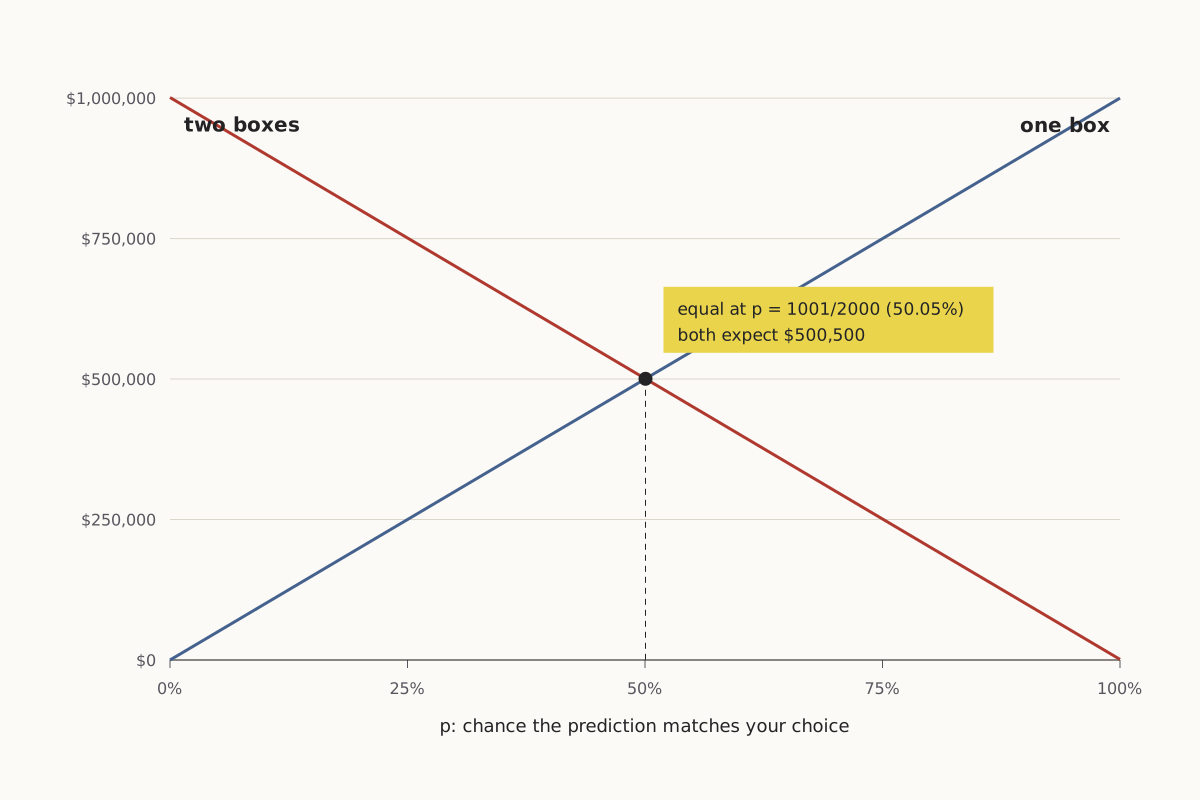
The one-box side does not need a perfect predictor. It needs one that beats a coin flip by a small margin, because the prize in the opaque box is a thousand times the prize in the clear box. The chart shows both expected values as the predictor gets better.
The formulas in P2 assume one more thing: the predictor is equally good at spotting one-boxers and two-boxers. Drop that, and say it is right about one-boxers with chance a and about two-boxers with chance b. One box then has the higher expected value exactly when a + b is greater than 1.001. We checked that condition over 10,201 pairs of values; a predictor that is right about 99% of one-boxers but only half of two-boxers clears it easily, at $990,000 against $501,000.
Wide figure: scroll it sideways, or open it full size.
Expected value of each choice against the chance that the prediction matches it; the lines cross at 50.05%.
Diagram: Puzzles, Charts & Dilemmas, CC BY 4.0
Copy the full credit line
"Expected value of one box and two boxes by predictor accuracy" by Puzzles, Charts & Dilemmas, https://puzzleschartsanddilemmas.com/puzzles/newcombs-problem/, licensed under CC BY 4.0 (https://creativecommons.org/licenses/by/4.0/).
| Chance the prediction matches your choice | One box (expected) | Two boxes (expected) | Higher on this rule |
|---|---|---|---|
| 50% | $500,000 | $501,000 | Two boxes |
| 50.05% | $500,500 | $500,500 | Equal |
| 60% | $600,000 | $401,000 | One box |
| 90% | $900,000 | $101,000 | One box |
| 99% | $990,000 | $11,000 | One box |
At 50%, a prediction no better than a coin flip, two boxes lead by exactly $1,000, the contents of the clear box. Each extra percentage point of accuracy moves the gap by $20,000 toward one box, which is why the crossing comes so soon after 50%.
Try it first: Using the two formulas in P2, at what value of p do one box and two boxes have the same expected value?
Show it worked through
Worked through
Set the two expected values equal: $1,000,000 × p = $1,000 + $1,000,000 × (1 − p). That gives $2,000,000 × p = $1,001,000, so p = 1001/2000, or exactly 50.05%. At that point each choice is expected to pay $500,500. We did this in exact fractions and then a second way, by summing over the four outcomes and narrowing in on the crossing point; both give 1001/2000.
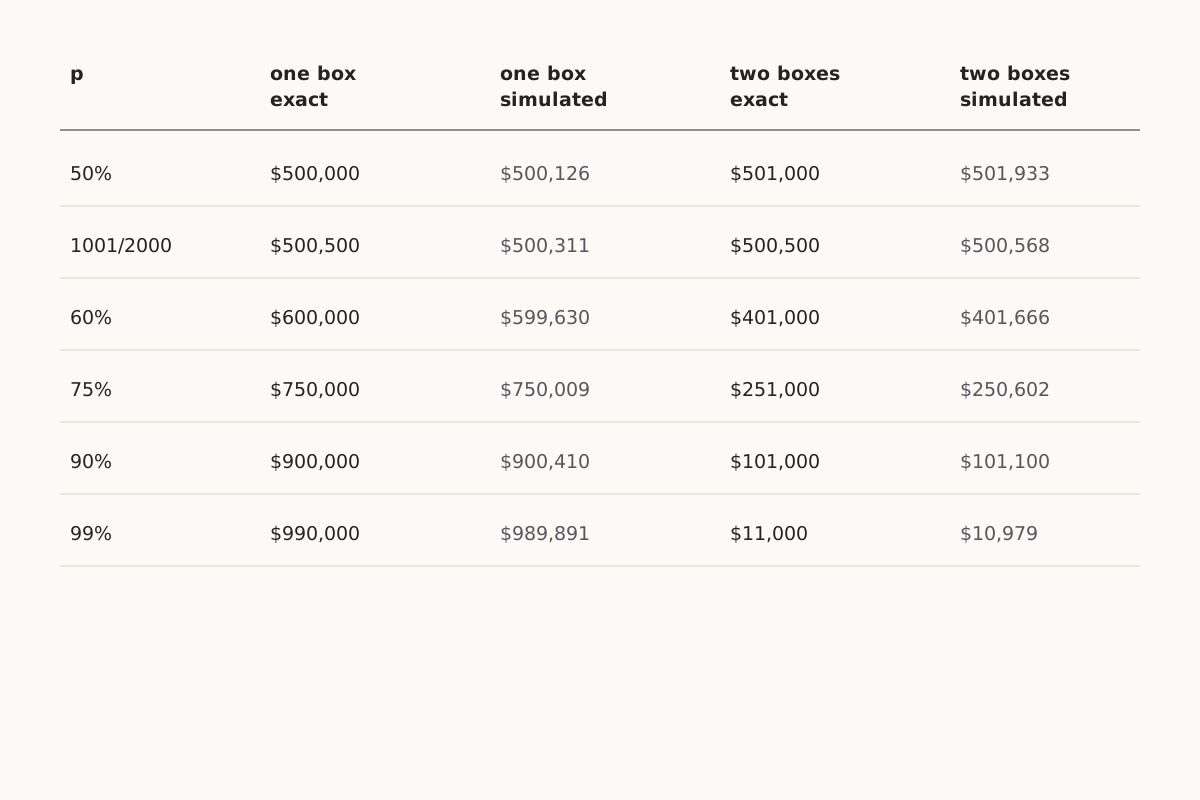
Wide figure: scroll it sideways, or open it full size.
Exact expected values next to the averages from 1,000,000 simulated rounds per choice.
Diagram: Puzzles, Charts & Dilemmas, CC BY 4.0
Copy the full credit line
"Exact and simulated expected values" by Puzzles, Charts & Dilemmas, https://puzzleschartsanddilemmas.com/puzzles/newcombs-problem/, licensed under CC BY 4.0 (https://creativecommons.org/licenses/by/4.0/).
| p | One box: exact | One box: simulated | Two boxes: exact | Two boxes: simulated |
|---|---|---|---|---|
| 50% | $500,000 | $500,126 | $501,000 | $501,933 |
| 1001/2000 | $500,500 | $500,311 | $500,500 | $500,568 |
| 60% | $600,000 | $599,630 | $401,000 | $401,666 |
| 75% | $750,000 | $750,009 | $251,000 | $250,602 |
| 90% | $900,000 | $900,410 | $101,000 | $101,100 |
| 99% | $990,000 | $989,891 | $11,000 | $10,979 |
We also ran a simulation of 1,000,000 rounds for each choice at six values of p. The largest gap between a simulated average and the exact value was 0.0933 percentage points of $1,000,000, well inside our tolerance of 0.5. At exactly 1001/2000 the two exact values are equal, so the small simulated gap there is noise.
One more check shows why the two-box side is unmoved. If the chance of a full box is the same whichever act you take, two boxes come out exactly $1,000 ahead at every chance we checked, from 0 to 1. The 50.05% figure exists only on the one-box reading of the chances.
Where the problem came from
The SEP entry credits William Newcomb with the problem and Nozick with putting it in print, in a 1969 essay in Essays in Honor of Carl G. Hempel (pp. 114–146). We have read only the bibliographic record of that essay, so this page quotes nothing from it. The timeline below lists the works the SEP entry connects to the problem.
The entry gives Newcomb himself a single line: a physicist who first formulated the problem. None of the sources read for this page says more about him or about how the problem reached Nozick, so this page does not either.
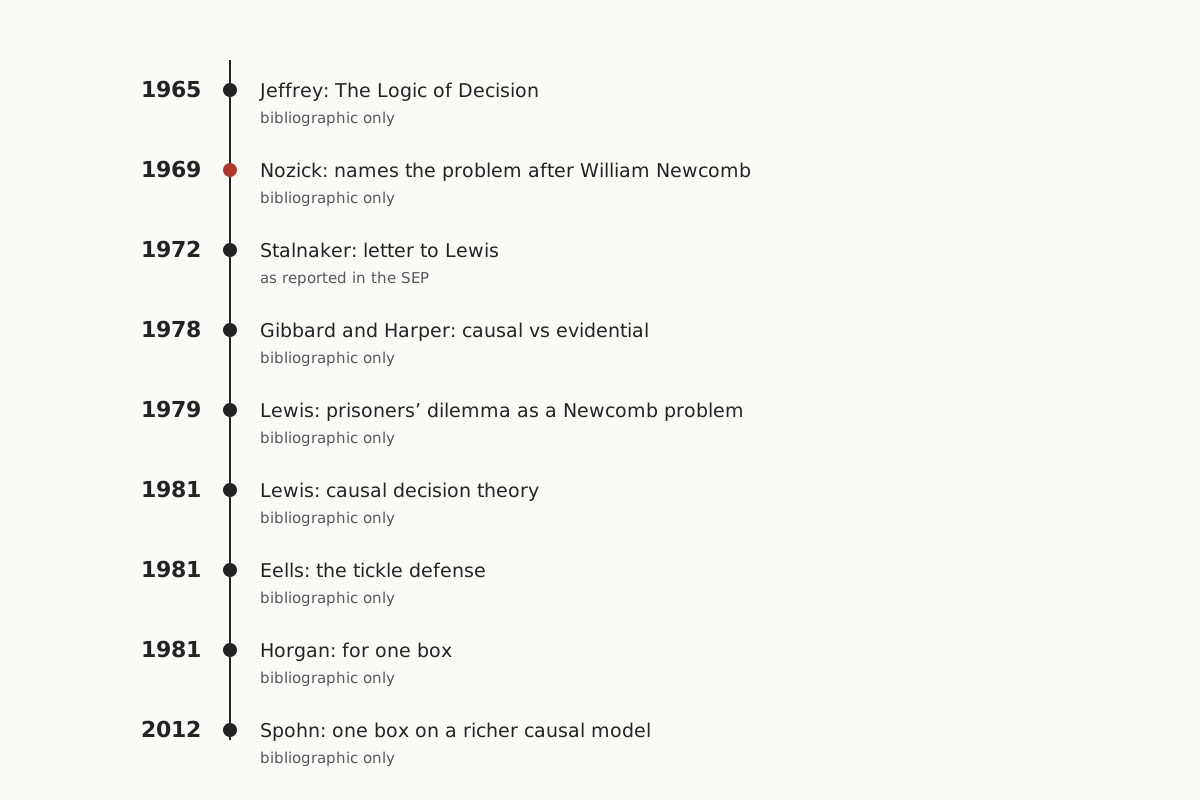
Wide figure: scroll it sideways, or open it full size.
Works on the problem as the SEP entry lists them; the 1972 letter is known only from the entry.
Diagram: Puzzles, Charts & Dilemmas, CC BY 4.0
Copy the full credit line
"Works on Newcomb's problem, 1965 to 2012" by Puzzles, Charts & Dilemmas, https://puzzleschartsanddilemmas.com/puzzles/newcombs-problem/, licensed under CC BY 4.0 (https://creativecommons.org/licenses/by/4.0/).
| Year | Work | What the SEP entry says it did |
|---|---|---|
| 1965 | Richard Jeffrey, The Logic of Decision | Decision rules that do not rely on causal relations |
| 1969 | Robert Nozick, essay in the Hempel volume | Sets dominance against expected value; names the problem |
| 1972 | Robert Stalnaker, letter to David Lewis | Figures expected value with the chances of what would happen if you acted, which favors two boxes |
| 1978 | Allan Gibbard and William Harper | Separate causal from evidential decision theory |
| 1979 | David Lewis, Philosophy and Public Affairs 8(3) | Treats a prisoner's dilemma with a like-minded twin as a Newcomb problem |
| 1981 | David Lewis, Australasian Journal of Philosophy 59(1) | A version of causal decision theory |
| 1981 | Ellery Eells | The tickle defense (row N4 below) |
| 1981 | Terry Horgan | Argues for one box |
| 2012 | Wolfgang Spohn | One box on a richer causal model (row N6 below) |
Stalnaker's suggestion, as the entry reports it, was to weight each outcome by the chance that it would follow if you did the act, not by the chance that it goes with the act. Your act does not cause the prediction, so those chances are the same for both acts, and expected value then agrees with dominance. Allan Gibbard and William Harper made the idea public in 1978 and drew the line between the two sides: causal decision theory and evidential decision theory.
The entry also argues that the problem does not need a mind reader. Its essential feature is a worse act that goes with a good state it does not cause. In the entry's medical version, a condition and an attractive habit share a common cause, so the habit is a sign of the condition without causing it. Dominance then favors the habit, while expected value figured on the habit counts against it.
The entry reports that Gibbard and Harper (1978) and Lewis (1979) made the same point about a prisoner's dilemma between two players who think alike. For each player, cooperating is a sign of the other's cooperation but not a cause of it.
Positions side by side
None of these positions is treated here as a wrong answer. Each row names the rule it relies on, the premise doing the work, and where the SEP entry discusses it. The works named in the rows were read at the bibliographic level only.
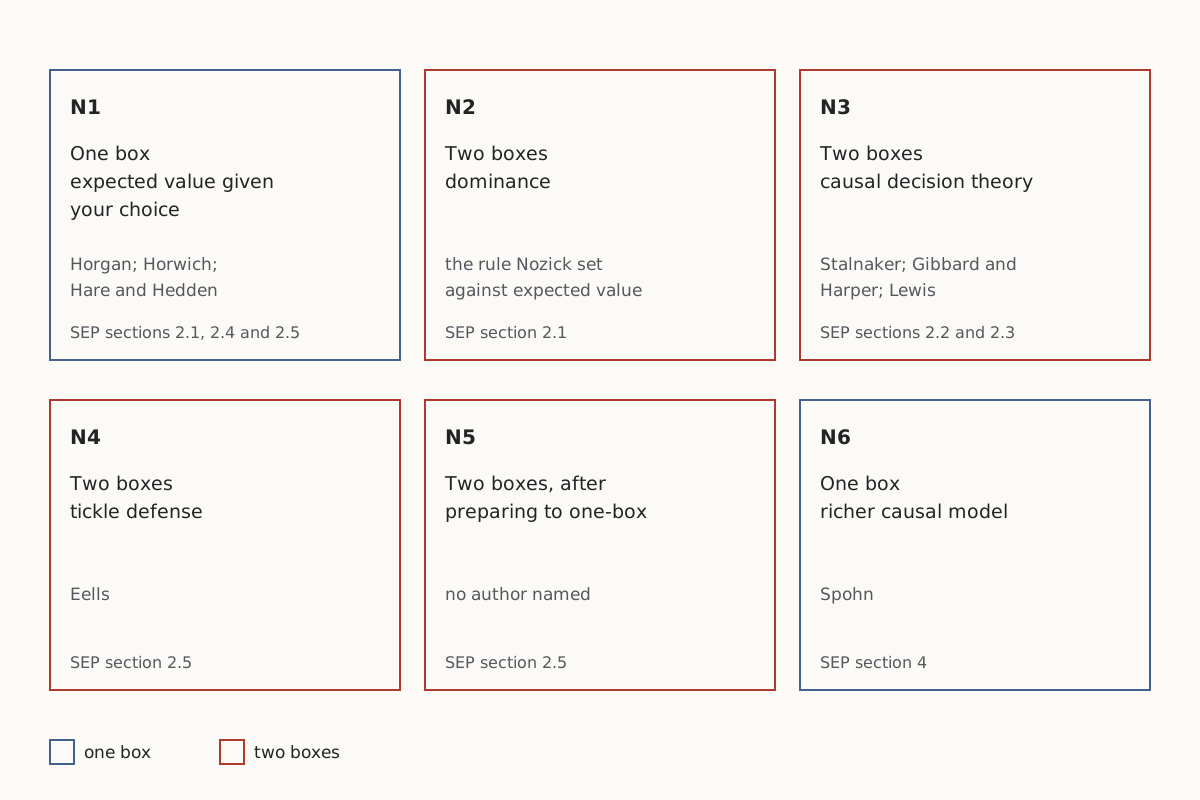
Wide figure: scroll it sideways, or open it full size.
Six positions the SEP entry describes, outlined by the box each one takes.
Diagram: Puzzles, Charts & Dilemmas, CC BY 4.0
Copy the full credit line
"Six positions on Newcomb's problem" by Puzzles, Charts & Dilemmas, https://puzzleschartsanddilemmas.com/puzzles/newcombs-problem/, licensed under CC BY 4.0 (https://creativecommons.org/licenses/by/4.0/).
| Position | Logic or decision rule | Core premise | Source |
|---|---|---|---|
| N1. One box | Expected value with chances given your choice (evidential decision theory) | Your choice is evidence of the prediction, so one-boxers can expect to end up richer | SEP, Causal Decision Theory, §§2.1, 2.5 (Horgan 1981, Horwich 1987, Hare and Hedden 2016; theory from Jeffrey 1965, §2.4) |
| N2. Two boxes by dominance | Take the act that pays more in every state | Whatever was predicted, two boxes pay $1,000 more | SEP, §2.1; Nozick 1969, pp. 114–146 (bibliographic record) |
| N3. Two boxes by causal decision theory | Expected value with chances that track what your act can cause | Your act cannot cause the prediction, so the chance of a full box is the same either way | SEP, §§2.2–2.3 (Stalnaker 1972 letter; Gibbard and Harper 1978; Lewis 1981, Australasian J. Phil. 59(1): 5–30) |
| N4. Two boxes by the tickle defense | Evidential decision theory, after you take your own beliefs and desires into account | Once you know your beliefs and desires, the choice itself adds no evidence about the prediction | SEP, §2.5 (Eells 1981, 1982) |
| N5. Prepare to one-box, still take two | Causal decision theory, judging the act in its circumstances | A habit of one-boxing can be rational to build in advance, though two-boxing is rational once the boxes are filled | SEP, §2.5 (no author named) |
| N6. One box by a richer causal model | Causal decision theory on a model that separates deciding from doing | With decision and execution modeled apart, causal decision theory itself says one box | SEP, §4 (Spohn 2012) |
Positions (CSV) (file notes: source, version and license (JSON)) Data: Paul Weirich, Causal Decision Theory, Stanford Encyclopedia of Philosophy (substantive revision 2024-10-24), https://plato.stanford.edu/entries/decision-causal/ (facts paraphrased)
The rows do not split neatly into two camps. N4 is an evidential theory that takes two boxes, and N6 is a causal theory that takes one. The SEP entry also reports that the most common objection to causal decision theory is that it takes two boxes here, and that causal decision theorists reply that the problem rewards irrationality. Philosophers still disagree, and this page does not pick a row.
N4 shows how much rests on what you know about yourself. If your beliefs and desires drive your choice, and you can see them, then the choice adds nothing to what they already tell you about the prediction. Evidential decision theory then also says take two. The entry notes the limits of that defense: some people may not choose this way or lack this self-knowledge, and Lewis in 1981 and John Pollock in 2010 argue that evidential decision theory may then advise them wrongly.
N5 grants something to each side. Before the boxes are filled, the entry says, it can be rational to become the kind of person who takes one box, since that disposition is what the predictor reads. Once the boxes are filled, causal decision theory still judges two-boxing the rational act. On this view, a two-boxer who leaves with $1,000 may have prepared badly, yet still chose well given where they stood.
In the 2020 PhilPapers Survey of philosophers, 418 of the philosophers who answered this question (39.0%) accepted or leaned toward two boxes, 334 (31.2%) one box, and 323 (30.2%) gave another answer (Bourget and Chalmers 2023, Philosophers' Imprint 23:11). They were professional philosophers, not a sample of the public, and no answer had a majority.
Push back:
The strongest objection is to this page's title: calling both rules standard and leaving them tied may be too easy. A causal decision theorist does not reject expected value; figured with chances that track what your act can cause, it agrees with dominance. A one-boxer can reply that dominance applies only when the states do not go with your choice, the point in dispute. On this view there is one rule, expected value, and two candidate sets of chances; each side says the other picked the wrong set.
- Prisoner's dilemma: David Lewis titled a 1979 paper “Prisoners’ Dilemma Is a Newcomb Problem”; the dilemma he meant is here.
- Unexpected hanging paradox: Another puzzle where a claim made in advance about what you will know tangles with your own reasoning.
Sources
- Paul Weirich, “Causal Decision Theory,” Stanford Encyclopedia of Philosophy (first published 2008-10-25; substantive revision 2024-10-24). https://plato.stanford.edu/entries/decision-causal/ Read: opening summary, sections 2.1 to 2.5, the passages on Newcomb's problem in sections 3.2, 3.6 and 4, and bibliography.
- Robert Nozick, “Newcomb's Problem and Two Principles of Choice,” in Nicholas Rescher (ed.), Essays in Honor of Carl G. Hempel (Dordrecht: Reidel, 1969), pp. 114–146. doi:10.1007/978-94-017-1466-2_7. https://doi.org/10.1007/978-94-017-1466-2_7 Read: bibliographic record only.
- David Lewis, “Prisoners’ Dilemma Is a Newcomb Problem,” Philosophy and Public Affairs 8(3) (1979): 235–240. https://plato.stanford.edu/entries/decision-causal/#Bib Read: bibliographic record only; the title is spelled as in the records of the 1985 and 1987 reprints.
- David Lewis, “Causal Decision Theory,” Australasian Journal of Philosophy 59(1) (1981): 5–30. doi:10.1080/00048408112340011. https://doi.org/10.1080/00048408112340011 Read: bibliographic record only.
- David Bourget and David J. Chalmers, “Philosophers on Philosophy: The 2020 PhilPapers Survey,” Philosophers' Imprint 23: 11 (2023), 1–53. doi:10.3998/phimp.2109. https://journals.publishing.umich.edu/phimp/article/id/2109/ Read: methods section and Table 1, rows Experience machine (would you enter?) and Newcomb's problem.
Downloads: Expected value by predictor accuracy (CSV) (file notes: source, version and license (JSON)) · Exact values and simulation (JSON) (file notes: source, version and license (JSON)) · Argument validity (JSON) (file notes: source, version and license (JSON)) · Source timeline (CSV) (file notes: source, version and license (JSON)) Data: Paul Weirich, Causal Decision Theory, Stanford Encyclopedia of Philosophy (substantive revision 2024-10-24), https://plato.stanford.edu/entries/decision-causal/ (facts paraphrased)
Cite this page
Puzzles, Charts & Dilemmas. “Newcomb's Problem: Rules Split if the Predictor Tops 50.05%.” Puzzles, Charts & Dilemmas. Published 2026-10-31. https://puzzleschartsanddilemmas.com/puzzles/newcombs-problem/. Accessed: add the date you read it.
Dates are given as year-month-day. 31 October 2026 is the latest substantive revision.
River Crossing Puzzle: Under Its Rules, Two Shortest Routes
Picture credit
Illustration: Puzzles, Charts & Dilemmas. Generated schematic illustration — not a photograph or historical record. Reuse: CC BY 4.0 (https://creativecommons.org/licenses/by/4.0/), to the extent Puzzles, Charts & Dilemmas holds rights in it.
Knights and Knaves: 108 of 256 Puzzles Have a Single Answer
Picture credit
Illustration: Puzzles, Charts & Dilemmas. Generated schematic illustration — not a photograph or historical record. Reuse: CC BY 4.0 (https://creativecommons.org/licenses/by/4.0/), to the extent Puzzles, Charts & Dilemmas holds rights in it.
Tower of Hanoi: 8 Disks Need 255 Moves on Three Pegs
Picture credit
Illustration: Puzzles, Charts & Dilemmas. Generated schematic illustration — not a photograph or historical record. Reuse: CC BY 4.0 (https://creativecommons.org/licenses/by/4.0/), to the extent Puzzles, Charts & Dilemmas holds rights in it.