Unexpected Hanging Paradox: The Proof Fails, but Where?
Published · Puzzles, Charts & Dilemmas
Folded answers print open where the browser allows it; if one prints closed, open it at https://puzzleschartsanddilemmas.com/puzzles/unexpected-hanging-paradox/ first.
Where it lands
The unexpected hanging paradox, also called the surprise test paradox, is a student's proof that a test announced as a surprise for next week cannot happen, followed by a test that does surprise him. If that test can come, some premise or step of the proof fails, and philosophers still disagree about which; six diagnoses are set side by side below with their sources.
Sections on this sheet (6)
In 1948, the philosophy journal Mind printed D. J. O'Connor's two-page note on a surprise announced in advance. The Stanford Encyclopedia of Philosophy (SEP) entry Epistemic Paradoxes calls it the first published reaction of the twentieth century, and says it sided with the student: the announcement itself was the trouble.
Later replies blamed other things, from what the student can know to what he will still believe on Thursday. Whether surprise tests happen is not in dispute. The disagreement is over which premise or step of the proof gives way, and that is easier to see with the proof written out in standard form.
In standard form: (the student's argument, after the SEP entry, section 1)
- Premise 1:The class meets on Monday, Wednesday and Friday next week, and the test will be on one of those days.
- Premise 2:The test will be a surprise: the student cannot know, before the day, that the test is that day.
- Premise 3:Not Friday. If no test had come by Wednesday's class, on Thursday the student would know it was Friday.
- Premise 4:Not Wednesday, since with Friday gone the student would know on Tuesday. Not Monday, by the same step on Sunday.
- Premise 5:So, the student concludes, no surprise test is possible.
- Therefore, conclusion:The test then comes on Wednesday, and it is a surprise. So a premise or a step of the proof fails, and philosophers still disagree about which.
Three identical closed doors, one for each class day.
Illustration: Puzzles, Charts & Dilemmas. Generated schematic illustration — not a photograph or historical record. Reuse: CC BY 4.0 (https://creativecommons.org/licenses/by/4.0/), to the extent Puzzles, Charts & Dilemmas holds rights in it.
The student's proof
The SEP entry tells the story with a teacher who announces a surprise test for next week, and it fixes what surprise means: the students cannot know in advance on which day the test will be given. Surprise is defined by what can be known. The entry therefore files the puzzle under epistemic paradoxes, riddles that turn on the concept of knowledge.
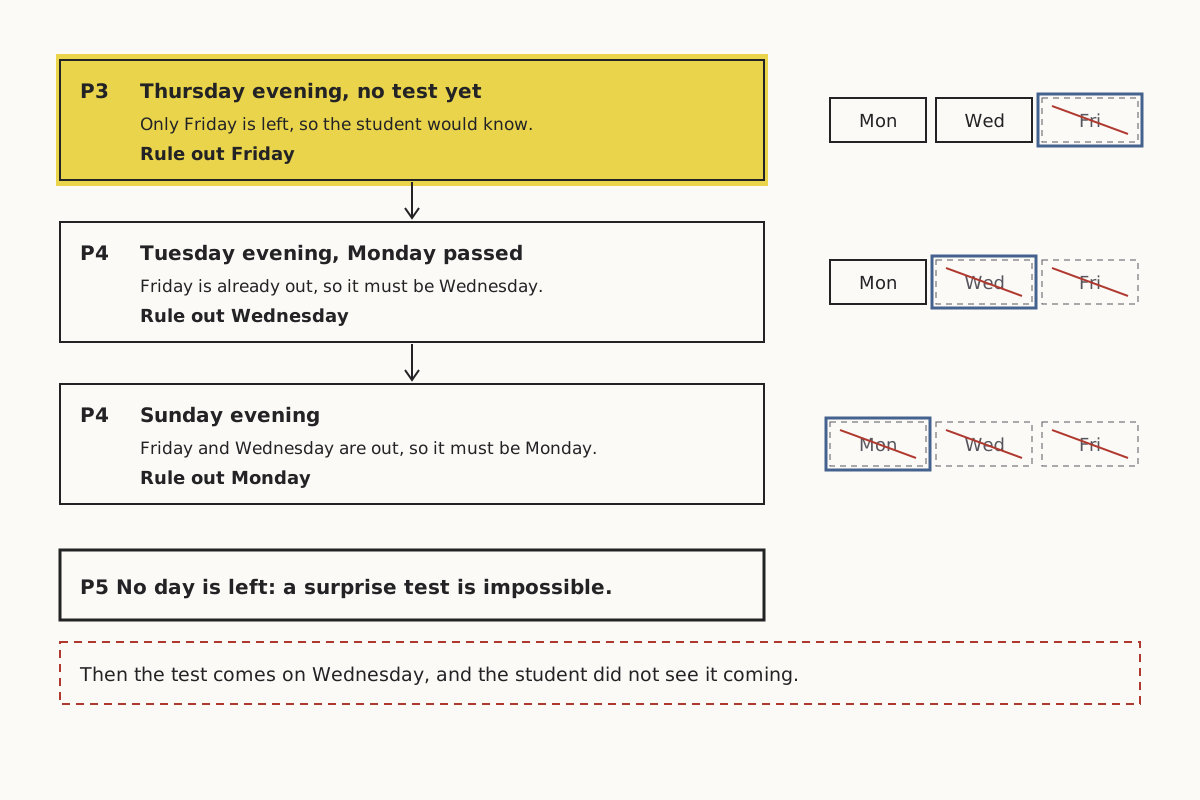
The student's objection runs backward from the end of the week. Friday goes first: a Friday test would be predictable by Thursday. Wednesday goes next, because on Tuesday the student remembers Monday's empty class and has already ruled out Friday. Monday goes last, ruled out on Sunday by the two earlier steps.
Wide figure: scroll it sideways, or open it full size.
The student's elimination, one class day at a time, and the Wednesday test that follows.
Diagram: Puzzles, Charts & Dilemmas, CC BY 4.0
Copy the full credit line
"The student's elimination argument in the surprise test paradox" by Puzzles, Charts & Dilemmas, https://puzzleschartsanddilemmas.com/puzzles/unexpected-hanging-paradox/, licensed under CC BY 4.0 (https://creativecommons.org/licenses/by/4.0/).
| Evening | What the student knows then | Day ruled out |
|---|---|---|
| Thursday | No test on Monday or Wednesday; only Friday is left | Friday (P3) |
| Tuesday | No test on Monday; Friday is already out | Wednesday (P4) |
| Sunday | Friday and Wednesday are already out | Monday (P4) |
Against the proof stands something plainer. As the SEP entry puts it, common sense says a surprise test is possible even after advance warning that one is coming. Either answer would settle the matter if the other were not so well supported, and that standoff is what makes this a paradox rather than a mistake waiting to be found. The proof even helps the teacher: as the entry points out, a student who believes his own conclusion expects no test at all, so whichever day it comes, it surprises him.
The announcement is a claim, made in advance, about what the student will know, and every step of the proof pulls on it. In knot terms, it is a rope end threaded back through its own knot. Each diagnosis below has to say what the student can do with that claim on each evening.
An announcement that defeats itself
O'Connor's reaction, as the SEP entry reports it, was to accept the student's elimination and turn on the teacher. Had the teacher said nothing, a surprise test would have been possible. Announcing it is what spoiled it.
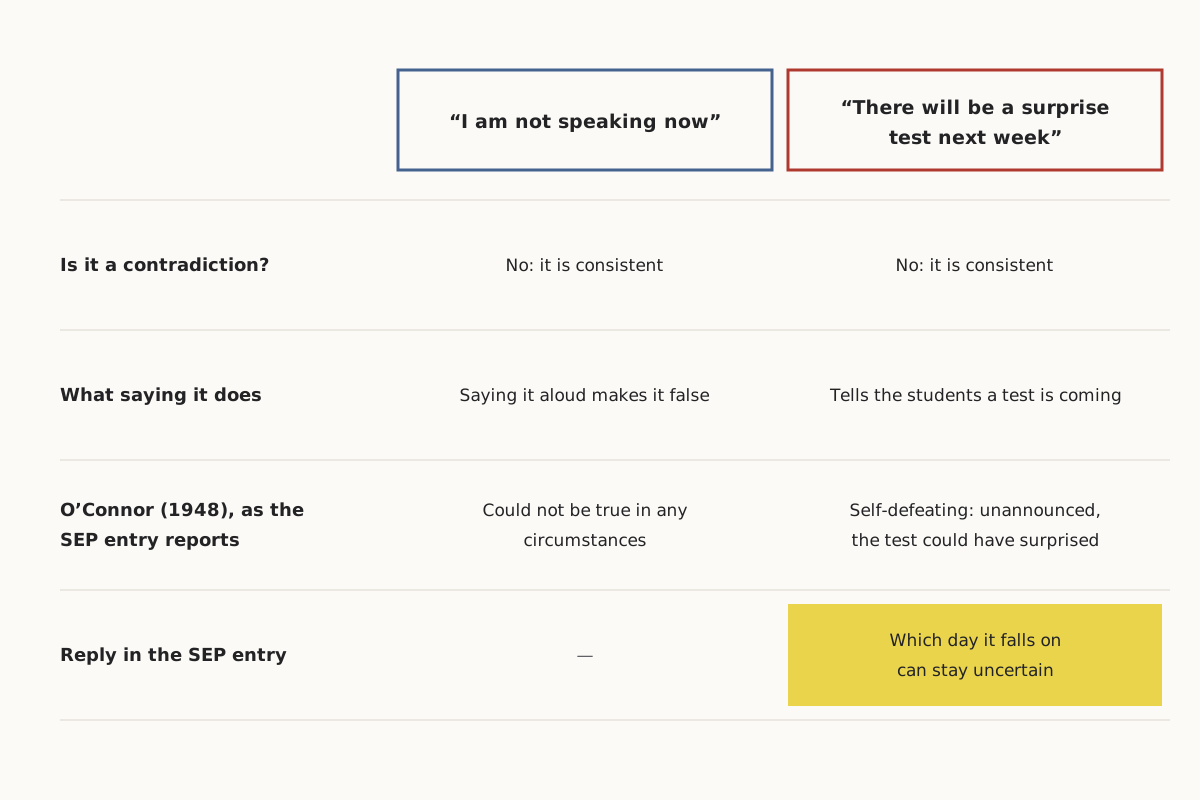
He compared the announcement to a sentence such as “I am not speaking now.” That sentence contains no contradiction, yet in the words the entry quotes from O'Connor's page 358, it “could not conceivably be true in any circumstances.” L. Jonathan Cohen agreed in 1950 and called the announcement a pragmatic paradox: a statement made false by its own utterance.
Wide figure: scroll it sideways, or open it full size.
O'Connor's comparison, and the reply in the SEP entry.
Diagram: Puzzles, Charts & Dilemmas, CC BY 4.0
Copy the full credit line
"O'Connor's comparison of the announcement with “I am not speaking now”" by Puzzles, Charts & Dilemmas, https://puzzleschartsanddilemmas.com/puzzles/unexpected-hanging-paradox/, licensed under CC BY 4.0 (https://creativecommons.org/licenses/by/4.0/).
Data: Roy Sorensen, Epistemic Paradoxes, Stanford Encyclopedia of Philosophy (substantive revision 2022-03-03), https://plato.stanford.edu/entries/epistemic-paradoxes/ (facts paraphrased, no text reproduced)
| Question | “I am not speaking now” | “There will be a surprise test next week” |
|---|---|---|
| Is it a contradiction? | No | No |
| What saying it does | Makes it false | Tells the students a test is coming |
| O'Connor (1948), as the SEP reports | Could not be true when said | Self-defeating: unannounced, the test could have surprised |
| Reply in the SEP entry | — | Which day it falls on can stay uncertain |
The entry calls Cohen's classification too monolithic. The announcement does give something away: a test is coming. But it leaves open which day, and a student who knows there is a test he cannot place is in a different state from one who never heard the news.
The same kind of sentence drives knights and knaves puzzles, where a line such as “I am a knave” can be said by neither a knight nor a knave. There, whether a sentence can be true when spoken depends on who speaks; in the surprise test, on O'Connor's reading, it depends on whether it is spoken at all.
Can the teacher pick the day at random?
One answer, which the SEP entry attributes to some game theorists, is to let chance pick the day. A teacher could leave every class to chance, but then she must prepare a quiz for each one and accept a week with too many quizzes or too few. The cheaper plan is to draw a single day in secret, and the entry shows how quickly that plan runs back into the student's argument.
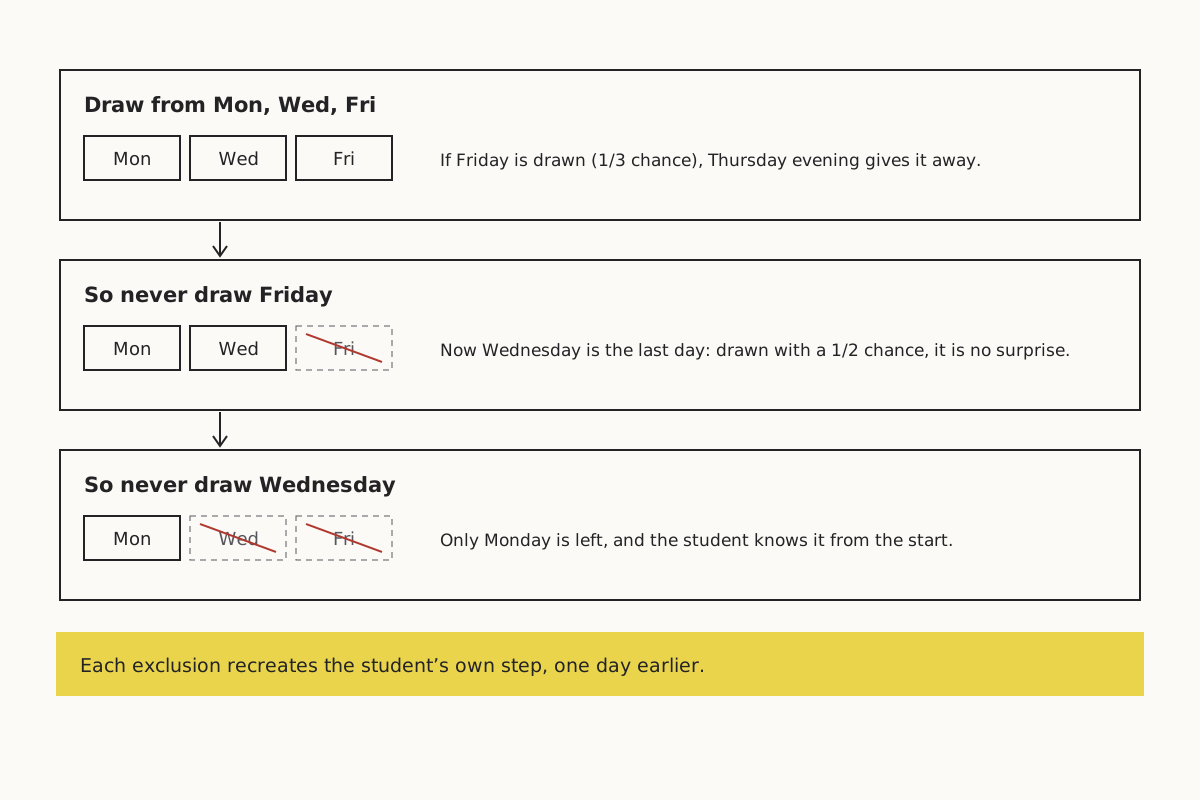
If the teacher draws one of the three class days, Friday comes up one time in three, and a Friday test is no surprise to a student who knows a test is coming. So the teacher must never draw Friday. The student can follow that reasoning too, and now Wednesday is the last possible day.
Wide figure: scroll it sideways, or open it full size.
The random-day plan, and how each exclusion repeats the student's step one day earlier.
Diagram: Puzzles, Charts & Dilemmas, CC BY 4.0
Copy the full credit line
"The random-day plan in the surprise test paradox" by Puzzles, Charts & Dilemmas, https://puzzleschartsanddilemmas.com/puzzles/unexpected-hanging-paradox/, licensed under CC BY 4.0 (https://creativecommons.org/licenses/by/4.0/).
Data: Roy Sorensen, Epistemic Paradoxes, Stanford Encyclopedia of Philosophy (substantive revision 2022-03-03), https://plato.stanford.edu/entries/epistemic-paradoxes/ (facts paraphrased, no text reproduced)
| Days the teacher may draw | Chance the drawn day is no surprise | Why |
|---|---|---|
| Monday, Wednesday, Friday | 1/3 | A Friday test is known by Thursday |
| Monday, Wednesday | 1/2 | Wednesday is now the last day |
| Monday | 1 | Only one day is left |
The entry also adapts a thought experiment from Michael Scriven's 1964 chapter on predicting human behavior. A Predictor with all the data tries to forecast an Avoider, who has the same data and wants only to avoid being forecast. Put the teacher in the Avoider's place and she seems bound to win. David Lewis and Jane Richardson objected in 1966 that the two cannot both have enough time to finish against each other, so the entry concludes that this idealization does not disarm the student.
A two-day week
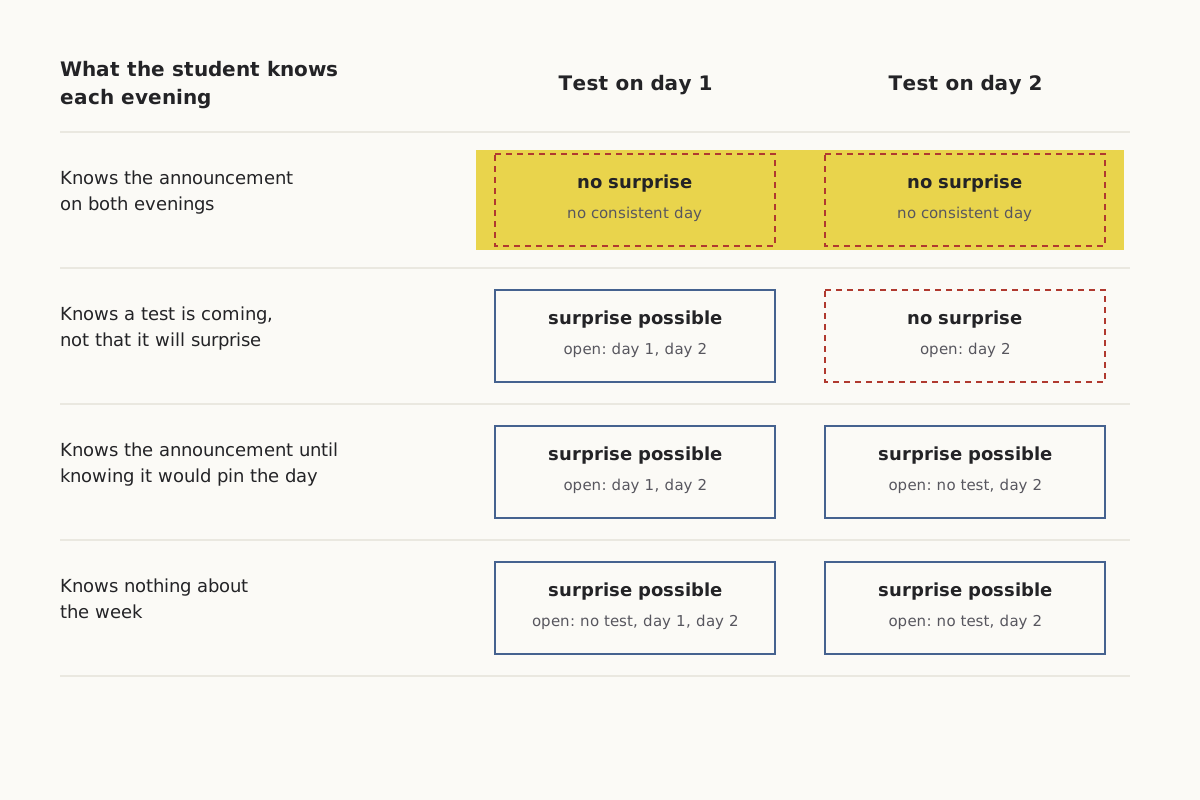
Shrink the week to two class days, and the question gets small enough to check in full. On the evening before each day, either the student can rule out every day but one or he cannot. A test is a surprise when he cannot. What he can rule out depends on what he knows, and four readings of the story differ only there.
Try it first: Of P2, P3 and P4, which do you trust least, and once you drop it, can a two-day week still hold a surprise test?
Show it worked through
Worked through
We checked every possible set of test days under each of four readings of what the student knows, and reached the same answer a second way, by starting with both days and striking days until nothing changed.
Wide figure: scroll it sideways, or open it full size.
Which day of a two-day week can hold a surprise test, under four readings of what the student knows each evening.
Diagram: Puzzles, Charts & Dilemmas, CC BY 4.0
Copy the full credit line
"Surprise test days in a two-day week under four readings" by Puzzles, Charts & Dilemmas, https://puzzleschartsanddilemmas.com/puzzles/unexpected-hanging-paradox/, licensed under CC BY 4.0 (https://creativecommons.org/licenses/by/4.0/).
| What the student knows each evening | Test on day 1 | Test on day 2 |
|---|---|---|
| The announcement, on both evenings | No consistent day | No consistent day |
| Only that a test is coming | Surprise possible | No surprise |
| The announcement, until knowing it would pin the day | Surprise possible | Surprise possible |
| Nothing about the week | Surprise possible | Surprise possible |
On the first reading the student's proof is valid: no day can make the announcement true while he goes on knowing it. That is the reading Quine's diagnosis (row U3 below) treats as a reductio, an argument that refutes its own starting assumption, here the assumption that the student knows the announcement.
The second reading keeps the last-day step, but the next step back fails, because that step uses the surprise clause as something known. The third reading is our two-day model of the idea in rows U5 and U6: knowledge of the announcement gives way on the last evening, so even a last-day test can surprise. In the three-day week the pattern holds: no day on the first reading, Monday or Wednesday on the second, any day on the third and fourth.
The fourth reading shows the price of the easy way out. If the student knows nothing, every day surprises him, but the announcement has then told him nothing either. The SEP entry contrasts exactly this uninformed student with one who knows a test is coming and cannot place it.
The check settles validity only. It shows which reading the proof needs, not which reading is right.
Positions side by side
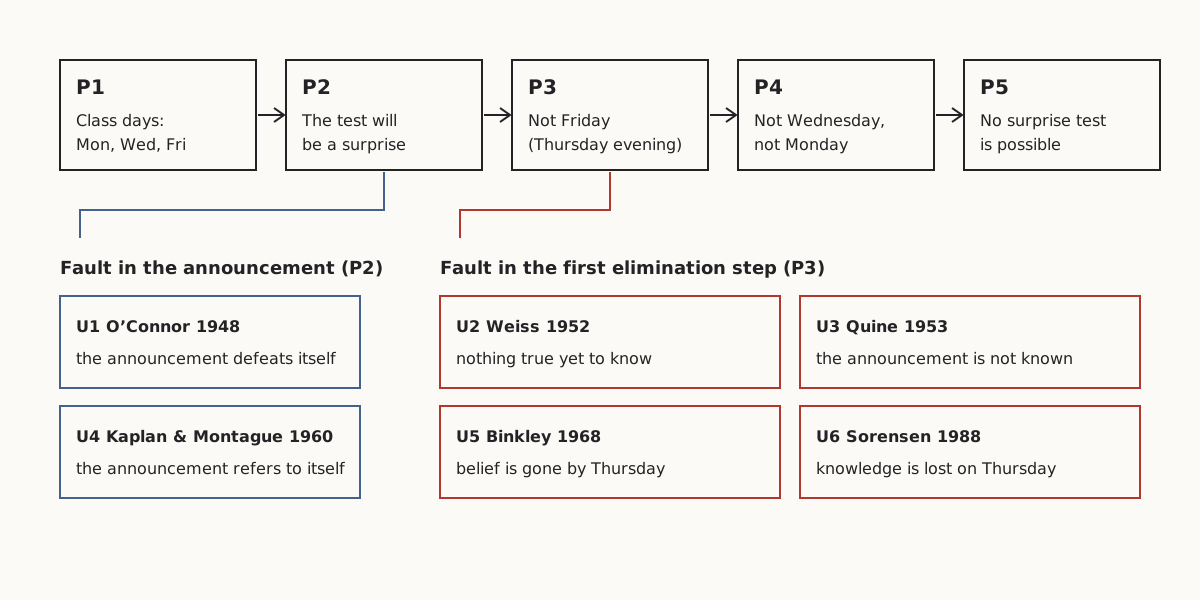
None of these positions is treated here as a wrong answer. Each row names the principle it relies on, the premise doing the work, and the section of the SEP entry that describes it; the works named in the rows were read at the bibliographic level or not at all.
Wide figure: scroll it sideways, or open it full size.
Where each of six positions places the fault in the student's proof.
Diagram: Puzzles, Charts & Dilemmas, CC BY 4.0
Copy the full credit line
"Where six positions place the fault in the surprise test proof" by Puzzles, Charts & Dilemmas, https://puzzleschartsanddilemmas.com/puzzles/unexpected-hanging-paradox/, licensed under CC BY 4.0 (https://creativecommons.org/licenses/by/4.0/).
Data: Roy Sorensen, Epistemic Paradoxes, Stanford Encyclopedia of Philosophy (substantive revision 2022-03-03), https://plato.stanford.edu/entries/epistemic-paradoxes/ (facts paraphrased, no text reproduced)
| Position | Logic or decision rule | Core premise | Source |
|---|---|---|---|
| U1. The announcement defeats itself | A pragmatic paradox, like “I am not speaking now” | The elimination is right; unannounced, the test could have surprised | SEP, Epistemic Paradoxes, §1.1 (O'Connor 1948, Mind 57(227): 358–359; Cohen 1950) |
| U2. Nothing yet to know | Truth-value gaps for predictions about free acts | The announcement is not true before the test, so it cannot be known in advance | SEP, §1.3 (Weiss 1952, Mind 61(242)) |
| U3. The student does not know the announcement | Classical logic kept; the proof is a reductio of the student's knowing it | Without that knowledge, a test on any day would be unforeseen | SEP, §§1.3, 2 (Quine 1953, Mind 62(245): 65–67) |
| U4. The announcement refers to itself | Self-reference, as in the knower paradox | The announcement is equivalent to a statement about whether it is itself known | SEP, §5.1 (Kaplan and Montague 1960) |
| U5. Belief cannot last until Thursday | A logic of belief with a reflection principle: believe what you will later believe | On Thursday the student would not believe the announcement, so even a last-day test would surprise | SEP, §§5.3, 5.4 (Binkley 1968) |
| U6. Knowledge is lost on Thursday | Blindspots: consistent statements one particular person cannot know | On Thursday the Friday clause is a blindspot for the students, though not for the teacher's colleagues | SEP, §5.4 (Sorensen 1988, pp. 328–343) |
Positions (CSV) (file notes: source, version and license (JSON)) Data: Roy Sorensen, Epistemic Paradoxes, Stanford Encyclopedia of Philosophy (substantive revision 2022-03-03), https://plato.stanford.edu/entries/epistemic-paradoxes/ (facts paraphrased, no text reproduced)
The faults fall in two places. U1 and U4 put it in P2, the announcement, and U2, U3, U5 and U6 put it in P3, the first elimination step. Philosophers still disagree, and this page does not pick a row.
Kaplan and Montague (U4) argued that with no days left, the announcement amounts to “This sentence is known to be false,” a sentence built like the liar sentence “This sentence is false.” The SEP entry reports an objection to a related reading, surprise as unprovability: it changes the topic, so the puzzle stops being about knowledge.
Weiss (U2) and Quine (U3) agree that the student does not know the announcement in advance, and part over why. For Weiss, a prediction about what the teacher will freely do is not yet true, so there is nothing to know. Quine, as the SEP entry reports, rejected that route because it gives up the law of bivalence, the rule that every statement is true or false. The entry answers Quine with common sense: the announcement seems to inform students the way a teacher's other stated plans do.
Binkley (U5) models the student as an ideal reasoner who is perfectly consistent, believes everything his beliefs imply and never forgets. On Thursday such a student could not keep believing the announcement, and Binkley spreads that doubt back to the start of the week. The SEP entry accepts his account of Thursday but questions the spreading: the student really is informed on Sunday, and Thursday's doubt belongs to a future self who exists only if no test has come.
U6 is the entry author's own view. On this view the announcement does inform the students at the start, and they lose that knowledge on Thursday without forgetting anything. The teacher's colleagues, who are not the ones to be surprised, could still work out a Friday test. The entry notes the cost: what you can know comes to depend on who you are and when you ask.
Where the puzzle came from
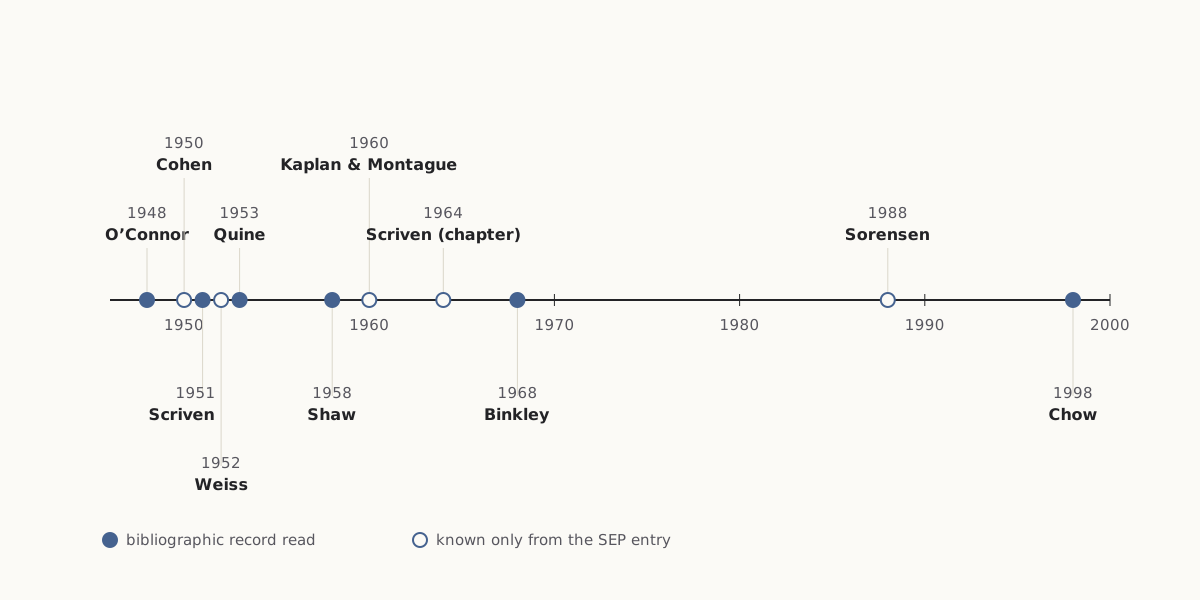
The SEP entry says the backward elimination behind the paradox can be discerned in German folktales dating back to 1756, citing Sorensen's 2003 essay. For the twentieth century, the entry names O'Connor's 1948 note as the first published reaction. The timeline lists the works this page names. None was read in full, and six were checked against their bibliographic records.
Wide figure: scroll it sideways, or open it full size.
Works on the paradox named on this page; filled dots mark the ones whose bibliographic records were read.
Diagram: Puzzles, Charts & Dilemmas, CC BY 4.0
Copy the full credit line
"Works on the unexpected hanging paradox, 1948 to 1998" by Puzzles, Charts & Dilemmas, https://puzzleschartsanddilemmas.com/puzzles/unexpected-hanging-paradox/, licensed under CC BY 4.0 (https://creativecommons.org/licenses/by/4.0/).
Data: Roy Sorensen, Epistemic Paradoxes, Stanford Encyclopedia of Philosophy (substantive revision 2022-03-03), https://plato.stanford.edu/entries/epistemic-paradoxes/ (facts paraphrased, no text reproduced)
| Year | Work | What this page says about it |
|---|---|---|
| 1948 | D. J. O'Connor, “Pragmatic Paradoxes,” Mind 57(227): 358–359 | First published reaction of the century, per the SEP |
| 1950 | L. Jonathan Cohen | Called the announcement a pragmatic paradox (known only from the SEP) |
| 1951 | M. Scriven, “Paradoxical Announcements,” Mind 60(239): 403–407 | Bibliographic record only |
| 1952 | Paul Weiss, “The Prediction Paradox,” Mind 61(242): 265–269 | The announcement is not yet true |
| 1953 | W. V. O. Quine, “On a So-called Paradox,” Mind 62(245): 65–67 | The student does not know the announcement |
| 1958 | R. Shaw, “The Paradox of the Unexpected Examination,” Mind 67(267): 382–384 | Bibliographic record only |
| 1960 | David Kaplan and Richard Montague, “A Paradox Regained” | The announcement refers to itself |
| 1964 | Michael Scriven, chapter in Scientific Psychology | Predictor and Avoider |
| 1968 | Robert Binkley, “The Surprise Examination in Modal Logic,” Journal of Philosophy 65(5): 127–136 | Belief cannot last until Thursday |
| 1988 | Roy Sorensen, Blindspots | Knowledge is lost on Thursday |
| 1998 | Timothy Y. Chow, American Mathematical Monthly 105(1): 41–51 | Title gives both names |
The paradox has two names, and the title of Timothy Chow's 1998 paper in the American Mathematical Monthly uses both: “The Surprise Examination or Unexpected Hanging Paradox.” That title treats them as one paradox. The SEP entry calls it the surprise test paradox and tells it with a teacher and students, and this page does the same.
In the other telling, the event that must come as a surprise is a hanging instead of a test. Nothing in the proof depends on which: the steps use only the days, the announcement and what the listener can know each evening. R. Shaw's 1958 note in Mind, known here only from its bibliographic record, has a third name in its title, the unexpected examination.
The list has two Scriven entries, and they are different works. The 1951 note by M. Scriven in Mind appears here only from its bibliographic record, and the SEP entry does not discuss it. The 1964 chapter by Michael Scriven is the source of the Predictor and Avoider thought experiment that the entry adapts.
Push back:
The strongest objection is that nothing is left to diagnose. Define surprise precisely, it runs, and the case closes: either the announcement cannot be true once made, as O'Connor held, or the student cannot treat it as known, as Quine held. The SEP entry notes that some withhold the label paradox, finding only irony in a self-defeating prediction. The reply is that each closure costs something: O'Connor's ignores that the announcement still tells students a test is coming, and Quine's denies them what common sense says they learn.
- Newcomb's problem: Another puzzle where your reasoning and someone else's prediction lock together.
- Ship of Theseus: A ship repaired one plank at a time, beside an argument that rules out one day at a time.
Sources
- Roy Sorensen, “Epistemic Paradoxes,” Stanford Encyclopedia of Philosophy (first published 2006-06-21; substantive revision 2022-03-03). https://plato.stanford.edu/entries/epistemic-paradoxes/ Read: opening summary, sections 1 to 2, the opening of section 5, sections 5.1, 5.3 and 5.4, and bibliography.
- D. J. O'Connor, “Pragmatic Paradoxes,” Mind 57(227) (1948): 358–359. doi:10.1093/mind/lvii.227.358. https://doi.org/10.1093/mind/lvii.227.358 Read: bibliographic record only; the position and the short quoted phrase are taken from the SEP entry Epistemic Paradoxes.
- W. V. Quine, “On a So-called Paradox,” Mind 62(245) (1953): 65–67. doi:10.1093/mind/lxii.245.65. https://doi.org/10.1093/mind/lxii.245.65 Read: bibliographic record only; the position is taken from the SEP entry Epistemic Paradoxes.
- Timothy Y. Chow, “The Surprise Examination or Unexpected Hanging Paradox,” American Mathematical Monthly 105(1) (1998): 41–51. doi:10.1080/00029890.1998.12004847. https://doi.org/10.1080/00029890.1998.12004847 Read: bibliographic record only.
- M. Scriven, “Paradoxical Announcements,” Mind 60(239) (1951): 403–407. doi:10.1093/mind/lx.239.403. https://doi.org/10.1093/mind/lx.239.403 Read: bibliographic record only; not the 1964 Scriven chapter discussed in the SEP entry.
- R. Shaw, “The Paradox of the Unexpected Examination,” Mind 67(267) (1958): 382–384. doi:10.1093/mind/lxvii.267.382. https://doi.org/10.1093/mind/lxvii.267.382 Read: bibliographic record only.
- Robert Binkley, “The Surprise Examination in Modal Logic,” Journal of Philosophy 65(5) (1968): 127–136. doi:10.2307/2024556. https://doi.org/10.2307/2024556 Read: bibliographic record only; the position is taken from the SEP entry Epistemic Paradoxes.
Downloads: Two-day and three-day check (JSON) (file notes: source, version and license (JSON)) · Source timeline (CSV) (file notes: source, version and license (JSON)) Data: Roy Sorensen, Epistemic Paradoxes, Stanford Encyclopedia of Philosophy (substantive revision 2022-03-03), https://plato.stanford.edu/entries/epistemic-paradoxes/ (facts paraphrased, no text reproduced)
Cite this page
Puzzles, Charts & Dilemmas. “Unexpected Hanging Paradox: The Proof Fails, but Where?.” Puzzles, Charts & Dilemmas. Published 2026-10-31. https://puzzleschartsanddilemmas.com/puzzles/unexpected-hanging-paradox/. Accessed: add the date you read it.
Dates are given as year-month-day. 31 October 2026 is the latest substantive revision.
River Crossing Puzzle: Under Its Rules, Two Shortest Routes
Picture credit
Illustration: Puzzles, Charts & Dilemmas. Generated schematic illustration — not a photograph or historical record. Reuse: CC BY 4.0 (https://creativecommons.org/licenses/by/4.0/), to the extent Puzzles, Charts & Dilemmas holds rights in it.
Knights and Knaves: 108 of 256 Puzzles Have a Single Answer
Picture credit
Illustration: Puzzles, Charts & Dilemmas. Generated schematic illustration — not a photograph or historical record. Reuse: CC BY 4.0 (https://creativecommons.org/licenses/by/4.0/), to the extent Puzzles, Charts & Dilemmas holds rights in it.
Newcomb's Problem: Rules Split if the Predictor Tops 50.05%
Picture credit
Illustration: Puzzles, Charts & Dilemmas. Generated schematic illustration — not a photograph or historical record. Reuse: CC BY 4.0 (https://creativecommons.org/licenses/by/4.0/), to the extent Puzzles, Charts & Dilemmas holds rights in it.