Ship of Theseus: Plutarch's Version Had Only One Ship
Published · Puzzles, Charts & Dilemmas
Folded answers print open where the browser allows it; if one prints closed, open it at https://puzzleschartsanddilemmas.com/thought-experiments/ship-of-theseus/ first.
Where it lands
Plutarch's Ship of Theseus is one ship whose old timbers were replaced over time, and his philosophers split on whether it stayed the same ship. The rival ship rebuilt from the old planks appears in Thomas Hobbes's De Corpore (1655), where Hobbes's rule makes the fully repaired ship “numerically another ship”; philosophers still disagree.
Sections on this sheet (6)
Plutarch's Life of Theseus describes one ship and one argument about it. According to Plutarch, Athens preserved the hero's thirty-oared galley by removing old timbers and fitting “new and sound ones” in their places, and the philosophers divided over whether the repaired vessel remained the same ship. That is the Ship of Theseus as Plutarch records it: an object whose parts are replaced over time, and the question of whether it survives as the same object.
The version retold today adds a second ship, assembled from the discarded planks, and asks which of the two is the original, which invites you to pick a side. The difficulty sits one layer down, because the rebuilt ship does not appear in Plutarch at all. It appears in Thomas Hobbes's De Corpore (1655), where Hobbes uses it to knock down a theory of identity and then gives his own answer. Here is his argument in standard form.
In standard form: (Hobbes, De Corpore, Part II, ch. 11, §7)
- Premise 1:Form view: a ship stays numerically the same while its form continues, even after every plank has been changed.
- Premise 2:So the repaired ship, with none of its first planks, is the original ship.
- Premise 3:Someone keeps each old plank as it comes out and puts them together again “in the same order.” That ship is, “without doubt,” the original too.
- Premise 4:The repaired ship and the rebuilt ship exist at the same time, as two ships.
- Premise 5:Two ships cannot be numerically one ship.
- Therefore, conclusion:The form view fails as a general rule. Identity is “not always to be taken either from matter alone, or from form alone.” First ask what the name picks out.
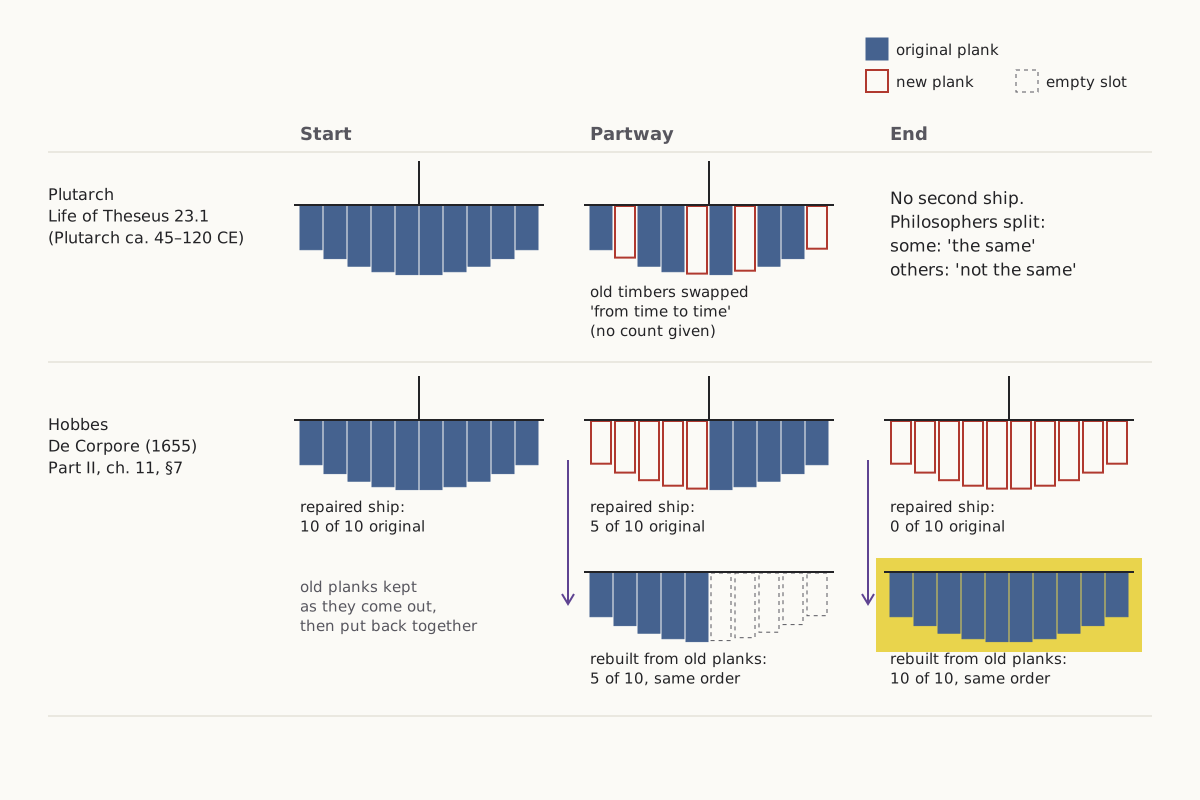
Wide figure: scroll it sideways, or open it full size.
One ship in Plutarch, two in Hobbes. The 10-plank ship is a model; neither text gives a plank count.
Diagram: Puzzles, Charts & Dilemmas, CC BY 4.0
Copy the full credit line
"One ship in Plutarch, two in Hobbes" by Puzzles, Charts & Dilemmas, https://puzzleschartsanddilemmas.com/thought-experiments/ship-of-theseus/, licensed under CC BY 4.0 (https://creativecommons.org/licenses/by/4.0/).
What did Plutarch actually write about the Ship of Theseus?
Plutarch's entire account is one short passage, section 23.1 of his Life of Theseus, quoted here in Bernadotte Perrin's 1914 Loeb translation:
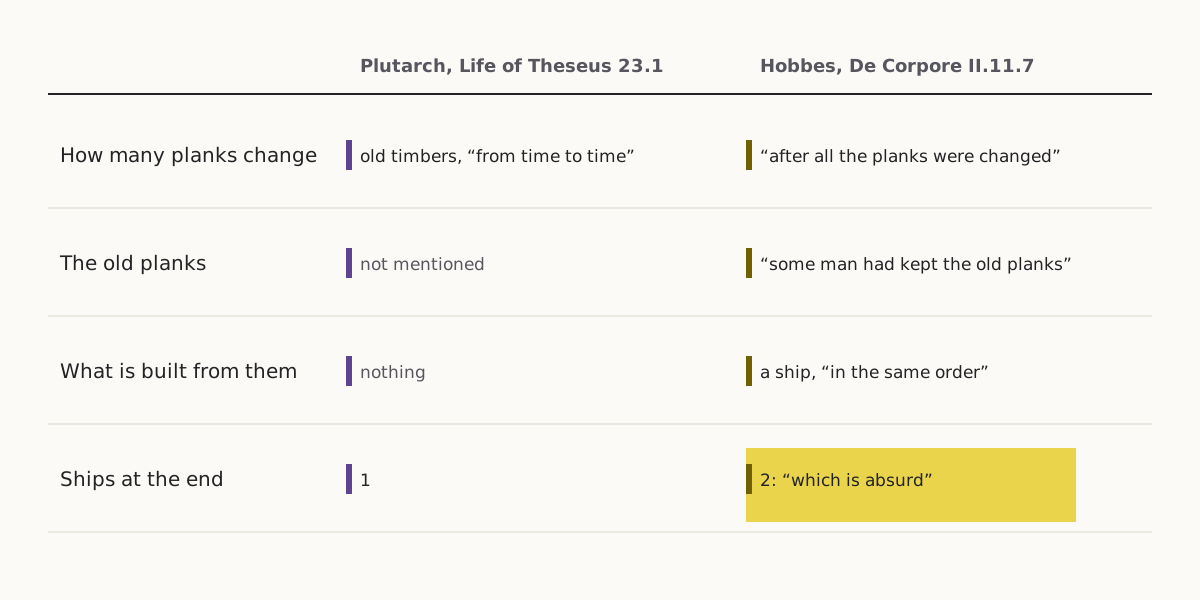
The ship on which Theseus sailed with the youths and returned in safety, the thirty-oared galley, was preserved by the Athenians down to the time of Demetrius Phalereus. They took away the old timbers from time to time, and put new and sound ones in their places, so that the vessel became a standing illustration for the philosophers in the mooted question of growth, some declaring that it remained the same, others that it was not the same vessel.
Read it for what is missing. The passage describes a single ship, gives no count of timbers, and never says that every timber was replaced. We compared the Greek text and two other public-domain translations (Arthur Hugh Clough's edition and George Long's), and none of them says “all.” Nobody keeps the old planks, and nobody builds anything from them.
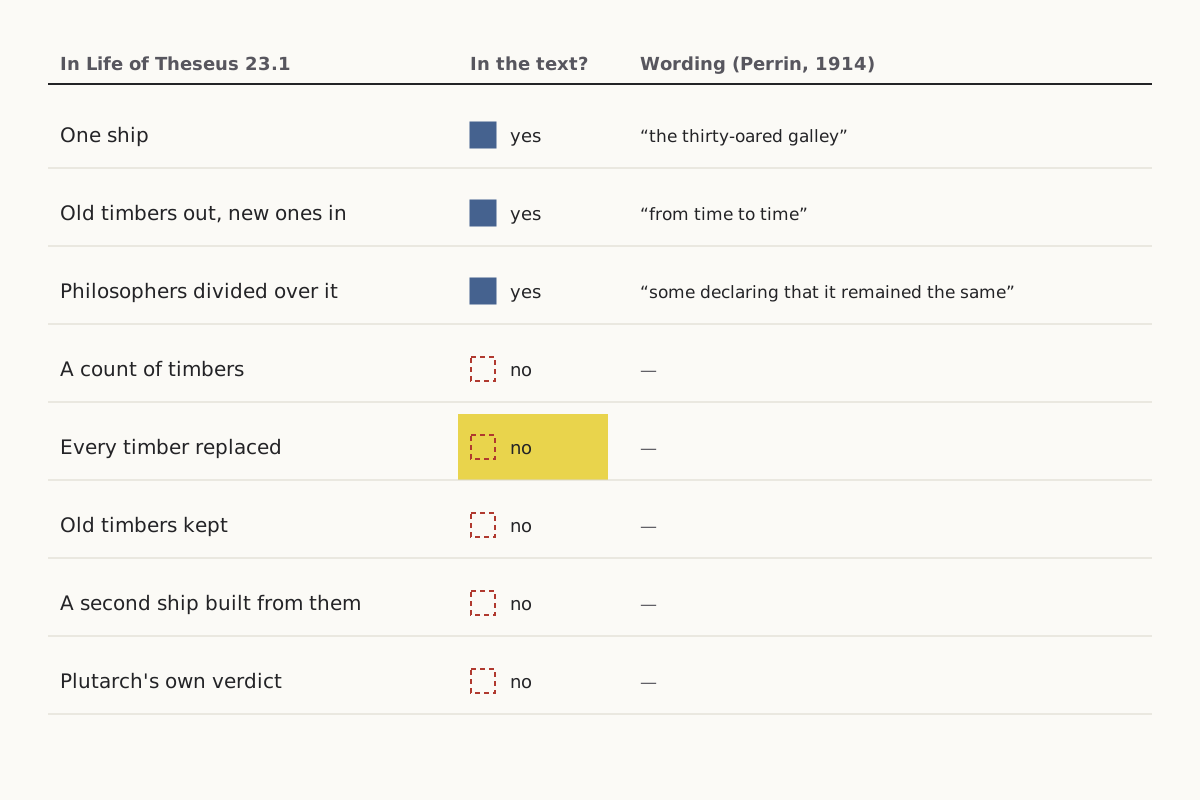
Wide figure: scroll it sideways, or open it full size.
What Plutarch's passage contains and what it leaves out, in Perrin's 1914 translation.
Diagram: Puzzles, Charts & Dilemmas, CC BY 4.0
Copy the full credit line
"What Plutarch's Life of Theseus 23.1 says and leaves out" by Puzzles, Charts & Dilemmas, https://puzzleschartsanddilemmas.com/thought-experiments/ship-of-theseus/, licensed under CC BY 4.0 (https://creativecommons.org/licenses/by/4.0/).
| In Life of Theseus 23.1 | In the text? | Wording (Perrin, 1914) |
|---|---|---|
| One ship | Yes | “the thirty-oared galley” |
| Old timbers taken out, new ones put in | Yes | “from time to time” |
| Philosophers divided over it | Yes | “some declaring that it remained the same, others that it was not the same vessel” |
| A count of timbers | No | — |
| Every timber replaced | No | — |
| Old timbers kept | No | — |
| A second ship built from them | No | — |
| Plutarch's own verdict | No | — |
Plutarch does not settle the dispute. He reports the two camps and moves on to the Oschophoria festival. His phrase for the debate is ton auxomenon logon, literally “the growing argument,” which Perrin renders as “the mooted question of growth.” The SEP entry on material constitution opens its list of related puzzles with a comic scene by the playwright Epicharmus, in which a debtor argues that he is no longer the man who borrowed the money.
The dates deserve attention, too. The Loeb editor places Demetrius of Phalerum's government of Athens at 317–307 BCE, while Plutarch lived roughly 45–120 CE, about three and a half centuries afterward. Plutarch says the ship was kept “down to the time of” Demetrius; he does not claim that it survived into his own lifetime, and he does not claim to have seen it.
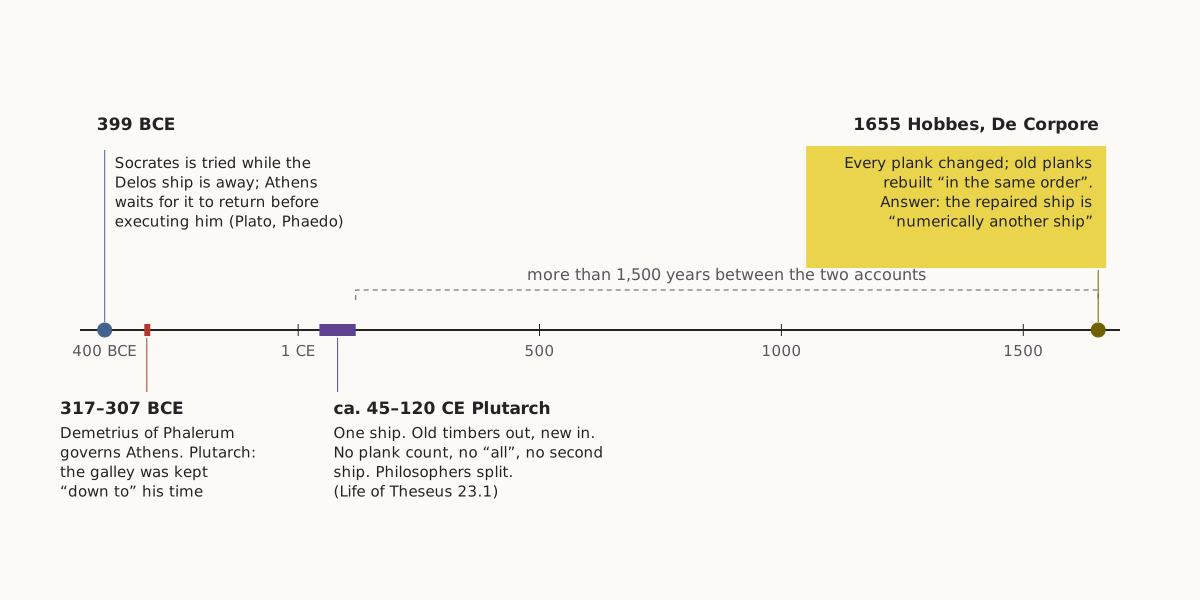
Wide figure: scroll it sideways, or open it full size.
Which account says what, and when. Dates and sources for each point are in the source-timeline CSV under Sources.
Diagram: Puzzles, Charts & Dilemmas, CC BY 4.0
Copy the full credit line
"Ship of Theseus source timeline" by Puzzles, Charts & Dilemmas, https://puzzleschartsanddilemmas.com/thought-experiments/ship-of-theseus/, licensed under CC BY 4.0 (https://creativecommons.org/licenses/by/4.0/).
The ship that held up an execution
Plato's Phaedo assigns a ship connected with Theseus an earlier and darker responsibility. In the dialogue, Phaedo explains that Athens sends a ship to Delos every year, “the ship in which, according to Athenian tradition, Theseus went to Crete when he took with him the fourteen youths,” and that while it is away “the city is not allowed to be polluted by public executions.”
The ship's stern had been ceremonially crowned the day before Socrates was tried, so, in Benjamin Jowett's translation, Socrates “lay in prison and was not put to death until long after he was condemned.” The SEP entry on Socrates dates the trial to 399 BCE, during the month of Thargelion (May–June).
Plato says nothing about repairs, although the Loeb editor's note on Plutarch's passage directs readers to this page of the Phaedo. Neither text tells us whether the Delos ship of 399 BCE and Plutarch's galley consisted of the same timbers. That, after all, is precisely the question.
Where did the second ship come from?
The rebuilt ship appears in De Corpore by Thomas Hobbes (1588–1679), the first section of his Elements of Philosophy, published in 1655. Chapter 11 is titled “Of Identity and Difference,” and its seventh section addresses what Hobbes calls “a great controversy among philosophers about the beginning of individuation,” meaning the problem of what makes a body the same body at two different times.
Hobbes identifies three competing answers. Some philosophers locate identity in “the unity of matter,” others in “the unity of form,” and one in “the unity of the aggregate of all the accidents together,” which means the complete collection of a thing's properties. He then rejects each of them in turn.
Against the matter view, he argues that the man who sins and the man who is punished would not be the same man, since the body is always changing. Accepting that, he says, “were to confound all civil rights.” Against the aggregate view, he observes that “a man standing would not be the same he was sitting.” Against the form view, he introduces the ship, here in the English translation printed in Molesworth's 1839 edition:
For if, for example, that ship of Theseus, concerning the difference whereof made by continual reparation in taking out the old planks and putting in new, the sophisters of Athens were wont to dispute, were, after all the planks were changed, the same numerical ship it was at the beginning; and if some man had kept the old planks as they were taken out, and by putting them afterwards together in the same order, had again made a ship of them, this, without doubt, had also been the same numerical ship with that which was at the beginning; and so there would have been two ships numerically the same, which is absurd.
Three details in that sentence are not in Plutarch's passage: “after all the planks were changed,” the person who saves the old planks, and the rebuild “in the same order.” The second ship is a reductio, an argument that accepts a position for the moment in order to show that it leads somewhere impossible. Plutarch left one loose strand; Hobbes deliberately tied a second strand to it, to show which knot slips.
The SEP's entry on material constitution credits this custodian scenario to Hobbes, and its entry on identity over time names the two vessels Replacement (the repaired ship) and Reassembly (the rebuilt one). We use those names from here on. The material-constitution entry also describes Plutarch's ship as one “whose parts were all gradually replaced,” which goes beyond the Greek and the three translations we read; we follow the primary text.
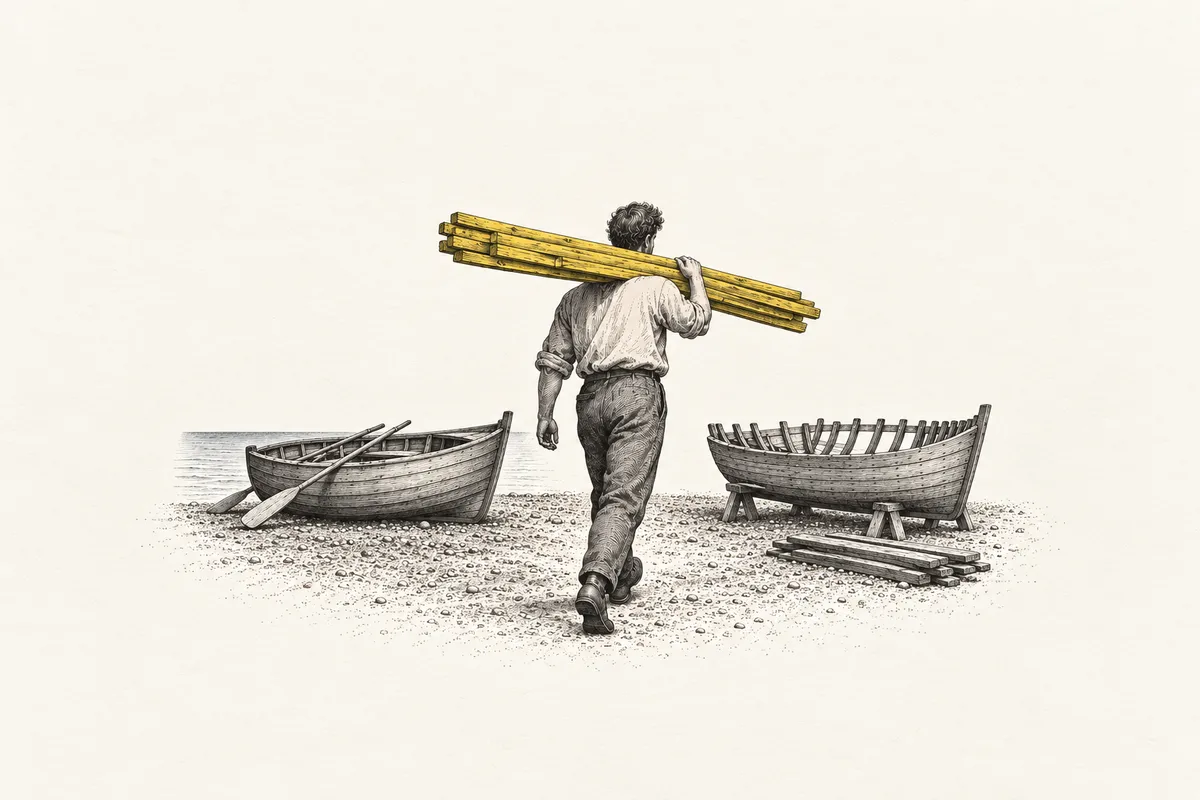
The rebuilt ship as Hobbes sets it up: someone keeps the old planks and puts them together again.
Illustration: Puzzles, Charts & Dilemmas. Generated schematic illustration — not a photograph or historical record. Reuse: CC BY 4.0 (https://creativecommons.org/licenses/by/4.0/), to the extent Puzzles, Charts & Dilemmas holds rights in it.
Wide figure: scroll it sideways, or open it full size.
Hobbes's sentence next to Plutarch's passage: the three details that are not in Plutarch, and the second ship they produce.
Diagram: Puzzles, Charts & Dilemmas, CC BY 4.0
Copy the full credit line
"Three details in Hobbes's sentence that are not in Plutarch" by Puzzles, Charts & Dilemmas, https://puzzleschartsanddilemmas.com/thought-experiments/ship-of-theseus/, licensed under CC BY 4.0 (https://creativecommons.org/licenses/by/4.0/).
Try it first: Hobbes has just rejected matter alone, form alone, and the “aggregate of all the accidents together.” Does he end up calling the fully repaired ship the original?
Show it worked through
Worked through
No. His next move is to ask which name is being used. For the word “ship,” his rule makes the fully repaired ship “numerically another ship.” He never says in so many words which ship is Theseus'; the section below quotes what he does say.
What did Hobbes conclude about the repaired ship?
He gave a verdict on the repaired ship, and it starts in the paragraph immediately following the ship: “But we must consider by what name anything is called, when we inquire concerning the identity of it.” Asking whether Socrates is the same man, Hobbes explains, differs from asking whether he is the same body; an old man's body cannot be the body he had as an infant, “yet, nevertheless, he may be the same man.”
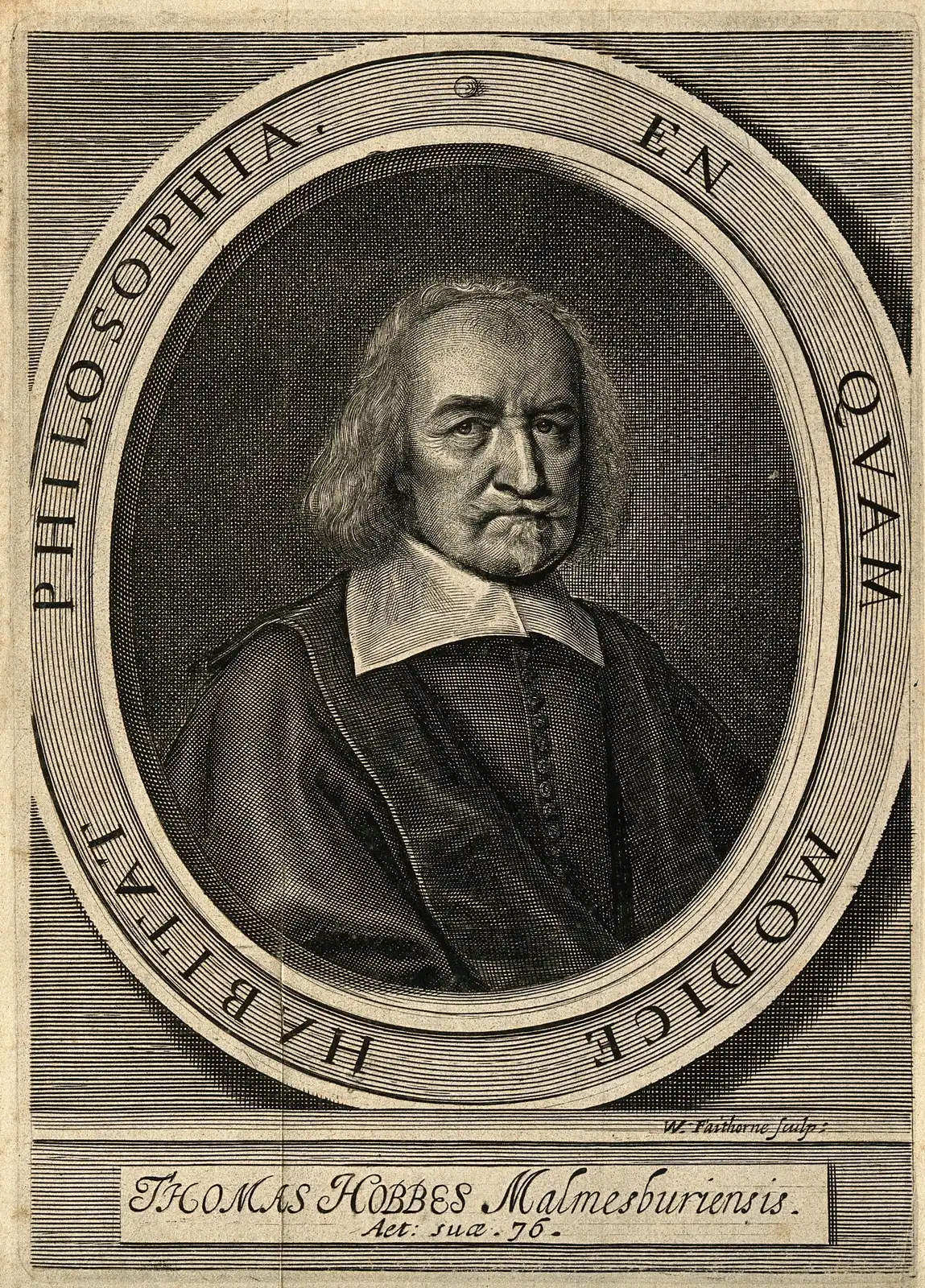
Thomas Hobbes, line engraving by William Faithorne, 1668.
"Thomas Hobbes (1588-1679)" by William Faithorne — https://commons.wikimedia.org/wiki/File:Thomas_Hobbes._Line_engraving_by_W._Faithorne,_1668._Wellcome_V0002798.jpg — CC BY 4.0 (https://creativecommons.org/licenses/by/4.0/)
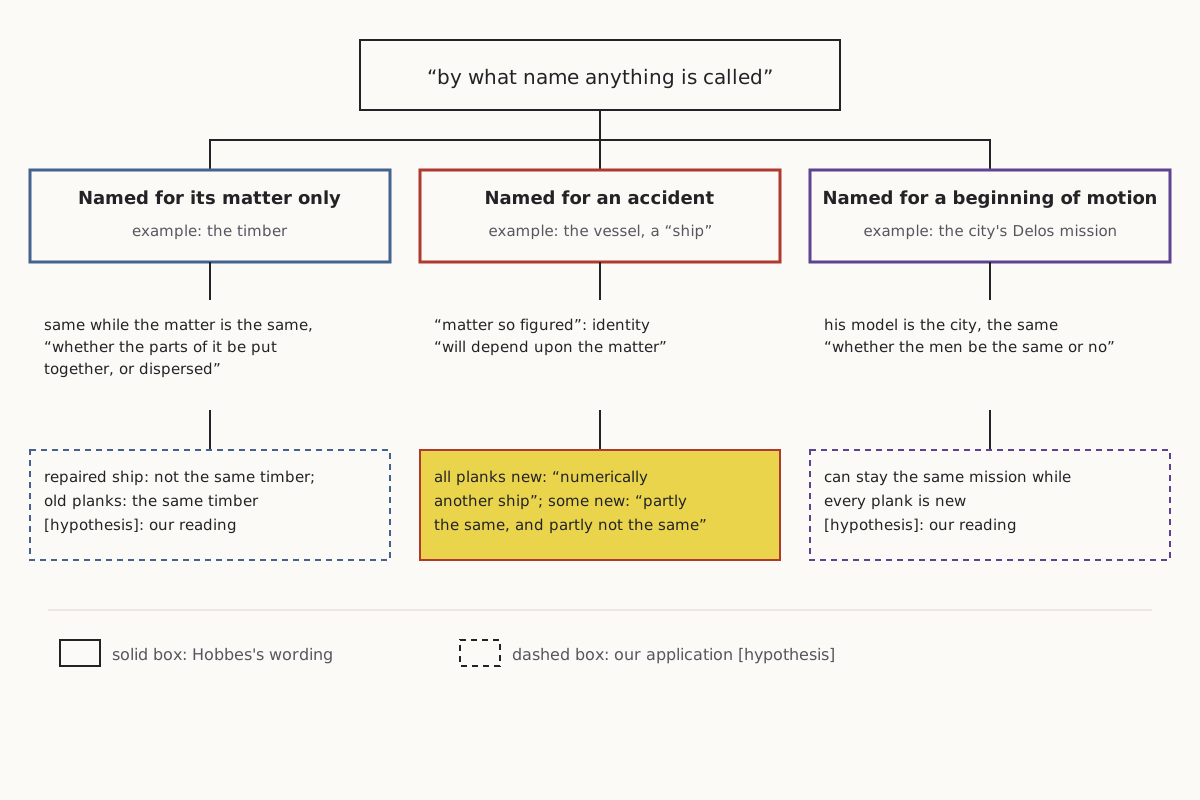
Hobbes then sorts names into three kinds. When a name is given for matter alone, the thing remains the same as long as the matter does, so that “the water, which was in the sea, is the same which is afterwards in the cloud.” When a name is given for a form that is a “beginning of motion,” the thing lasts as long as that motion continues.
On that second rule, a man remains the same man throughout his life, and a river remains the same river if it “flows from one and the same fountain,” whatever water it happens to carry. Likewise, a city remains the same city if its “acts proceed continually from the same institution, whether the men be the same or no.”
“Ship” belongs to the third kind, names given for “some accident,” meaning a property such as shape, and for these, Hobbes says, identity “will depend upon the matter”:
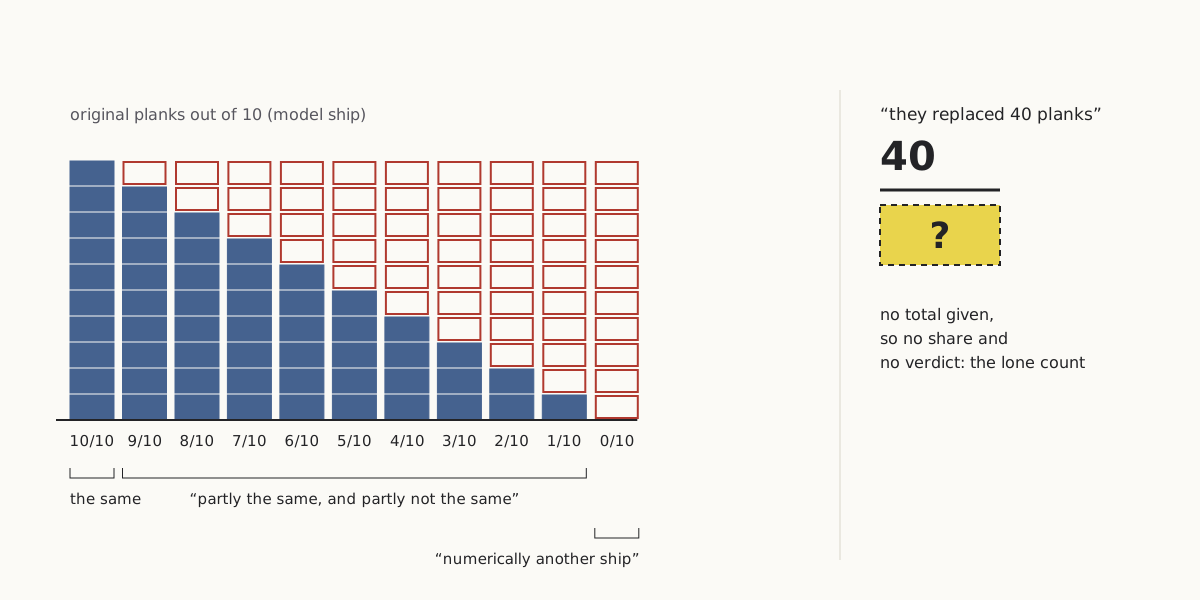
so that a ship, which signifies matter so figured, will be the same as long as the matter remains the same; but if no part of the matter be the same, then it is numerically another ship; and if part of the matter remain and part be changed, then the ship will be partly the same, and partly not the same.
Hobbes's verdict on Replacement is therefore explicit. It is numerically another ship, and halfway through the repairs it is partly the same. His sentence never mentions Reassembly. Still, a literal reading of the rule favors it, since Reassembly contains the same matter assembled in the same figure; that final step is our interpretation, not his wording.
The most useful contrast sits inside a single paragraph. On Hobbes's rule, Athens survives a complete turnover of its citizens, because “city” names an institution, while the city's ship does not survive a complete turnover of its timbers, because “ship” names matter with a particular shape.
Wide figure: scroll it sideways, or open it full size.
Hobbes's three kinds of name, applied to the timber, the vessel and the city's Delos mission; only the vessel verdict is his wording.
Diagram: Puzzles, Charts & Dilemmas, CC BY 4.0
Copy the full credit line
"Hobbes's rule: ask which name" by Puzzles, Charts & Dilemmas, https://puzzleschartsanddilemmas.com/thought-experiments/ship-of-theseus/, licensed under CC BY 4.0 (https://creativecommons.org/licenses/by/4.0/).
Why “partly the same” needs a denominator
Hobbes's middle verdict is a fraction in disguise. “Partly the same” refers to some share of the original matter, and a share needs a total. Plutarch never counts the timbers, so a figure such as “they replaced 40 planks” would be the lone count, a number with nothing to divide it by. So our diagram uses a clearly labeled 10-plank model instead of inventing a count for the real galley.
Wide figure: scroll it sideways, or open it full size.
With a total of 10 planks, every share has a verdict under Hobbes's rule; a bare count of 40 has none.
Diagram: Puzzles, Charts & Dilemmas, CC BY 4.0
Copy the full credit line
"Why “partly the same” needs a denominator" by Puzzles, Charts & Dilemmas, https://puzzleschartsanddilemmas.com/thought-experiments/ship-of-theseus/, licensed under CC BY 4.0 (https://creativecommons.org/licenses/by/4.0/).
Our variants: what each rule says about each ship
We ran eight versions of the story through Hobbes's rule for “ship,” which ties identity to the matter, and through the two other views he names: form, and the aggregate of all properties. Rows V1 to V4 come from Plutarch and Hobbes, while V5 to V8 are our own variants, and every cell in the CSV is marked either as Hobbes's explicit wording or as our application of it, tagged [hypothesis].
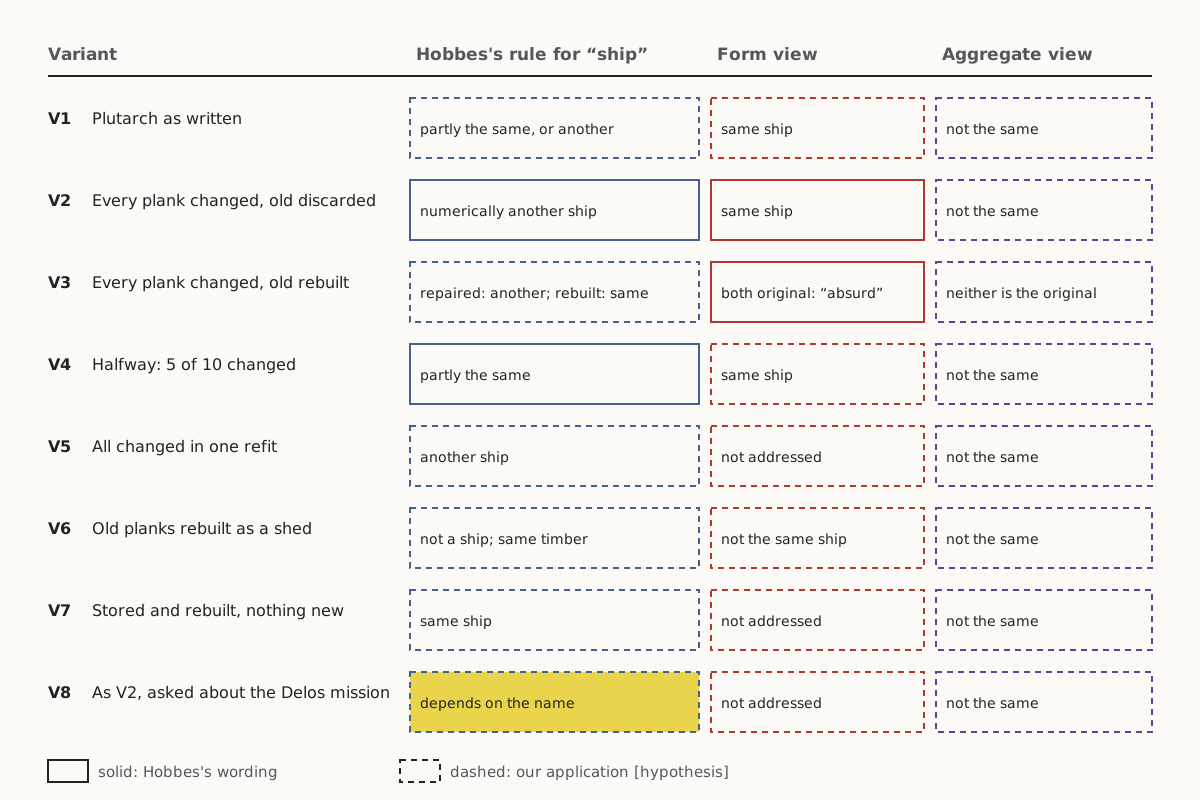
Wide figure: scroll it sideways, or open it full size.
Eight versions of the story under three rules; a dashed cell contains our application of Hobbes, not only his wording.
Diagram: Puzzles, Charts & Dilemmas, CC BY 4.0
Copy the full credit line
"Eight Ship of Theseus variants under three rules" by Puzzles, Charts & Dilemmas, https://puzzleschartsanddilemmas.com/thought-experiments/ship-of-theseus/, licensed under CC BY 4.0 (https://creativecommons.org/licenses/by/4.0/).
| # | Variant | Hobbes's rule for “ship” | Form view (rejected by Hobbes) | Basis |
|---|---|---|---|---|
| V1 | Plutarch as written: old timbers swapped, no count | Partly the same, or another ship, depending on a count the text never gives | Same ship | Rule: explicit. Applying it to Plutarch, and form view: [hypothesis] |
| V2 | Every plank changed, old ones discarded | Numerically another ship | Same ship | Explicit |
| V3 | Every plank changed, old ones rebuilt in order | Replacement: another ship. Reassembly: same ship | Both are the original: “absurd” | Replacement and form view: explicit. Reassembly: [hypothesis] |
| V4 | Halfway: 5 of 10 planks changed | Partly the same, and partly not | Same ship | Rule: explicit. Form view: [hypothesis] |
| V5 | Every plank changed in one refit | Another ship; the rule ignores speed | Not addressed | [hypothesis] |
| V6 | Old planks rebuilt as a shed | Not a ship; the same timber, since a body named for its matter is the same “whether the parts of it be put together, or dispersed” | Not the same ship | Timber clause: explicit. Ship verdict: [hypothesis] |
| V7 | Taken apart for storage, rebuilt, nothing new | Same ship | Not addressed | [hypothesis] |
| V8 | Same as V2, but asked about “the ship Athens sends to Delos” as a civic office | Depends on the name; Hobbes's model for an institution is the city | Not addressed | City clause: explicit. Applying it here: [hypothesis] |
Under the aggregate-of-properties view, every row comes out “not the same,” because on that view, according to Hobbes, “nothing would be the same it was.” The complete table, including Hobbes's wording for each verdict, is in ship-of-theseus-variants.csv (file notes: source, version and license (JSON)).
Two rows carry most of the weight. V5 changes only the speed of the repairs, and on our reading Hobbes's rule does not move; V8 changes only the name being asked about, and the answer can move. Read this way, the name decides the outcome and the pace of repair does not.
Is it still the same ship? What philosophers say now
Philosophers still disagree. The SEP entry on identity over time presents the case as a clash with transitivity, the rule that if A is B and B is C, then A is C. If Replacement and Reassembly are both the original, they would have to be each other, yet they are two ships. The table summarizes how six of the views surveyed there respond.
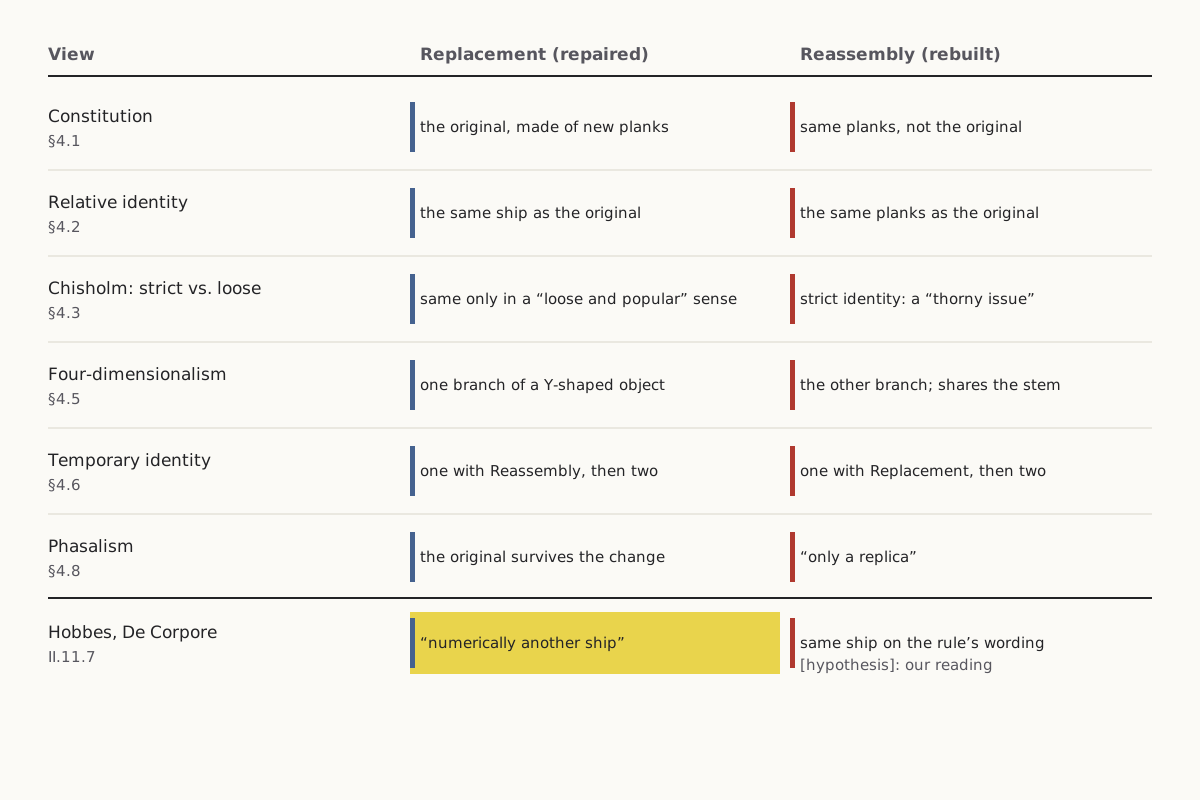
Wide figure: scroll it sideways, or open it full size.
Six views from the SEP survey on the two ships, with Hobbes's rule for contrast; wording is ours, section numbers are the SEP's.
Diagram: Puzzles, Charts & Dilemmas, CC BY 4.0
Copy the full credit line
"Six views on Replacement and Reassembly" by Puzzles, Charts & Dilemmas, https://puzzleschartsanddilemmas.com/thought-experiments/ship-of-theseus/, licensed under CC BY 4.0 (https://creativecommons.org/licenses/by/4.0/).
| View | Replacement (repaired) | Reassembly (rebuilt) | SEP, “Identity Over Time” |
|---|---|---|---|
| Constitution (being made of something is not the same as being identical to it) | Identical with the original ship, though not made of its planks | Made of the same planks, not identical with the original | §4.1 |
| Relative identity (ask “the same what?”: same ship, or same planks), some theorists | The same ship as the original | The same collection of planks as the original | §4.2 |
| Chisholm: strict vs. loose identity | The same only in a “loose and popular” sense | Strict identity with the original is “a thorny issue”; Chisholm's views shifted | §4.3 |
| Four-dimensionalism (objects extend in time as well as space), Heller and Lewis | One branch of a Y-shaped object | The other branch; the two share a stem | §4.5 |
| Temporary identity (two things can be identical at one time and not at another), Gallois | Identical with Reassembly at the start, distinct later | Same, read the other way | §4.6 |
| Phasalism (being a ship is a phase of an underlying thing, like being a teenager), Mooney | The original survives the change; nothing new is created | “Only a replica” | §4.8 |
Several of these views keep the original with the repaired ship, whereas Hobbes's rule does the reverse, and does so only for the word “ship.” Of the six, relative identity sits closest to Hobbes's question. Its advocates, the SEP explains, say we should ask whether something is the same statue or the same lump of clay, rather than the same thing without qualification. That resemblance is our comparison; the SEP entry does not connect the view to Hobbes.
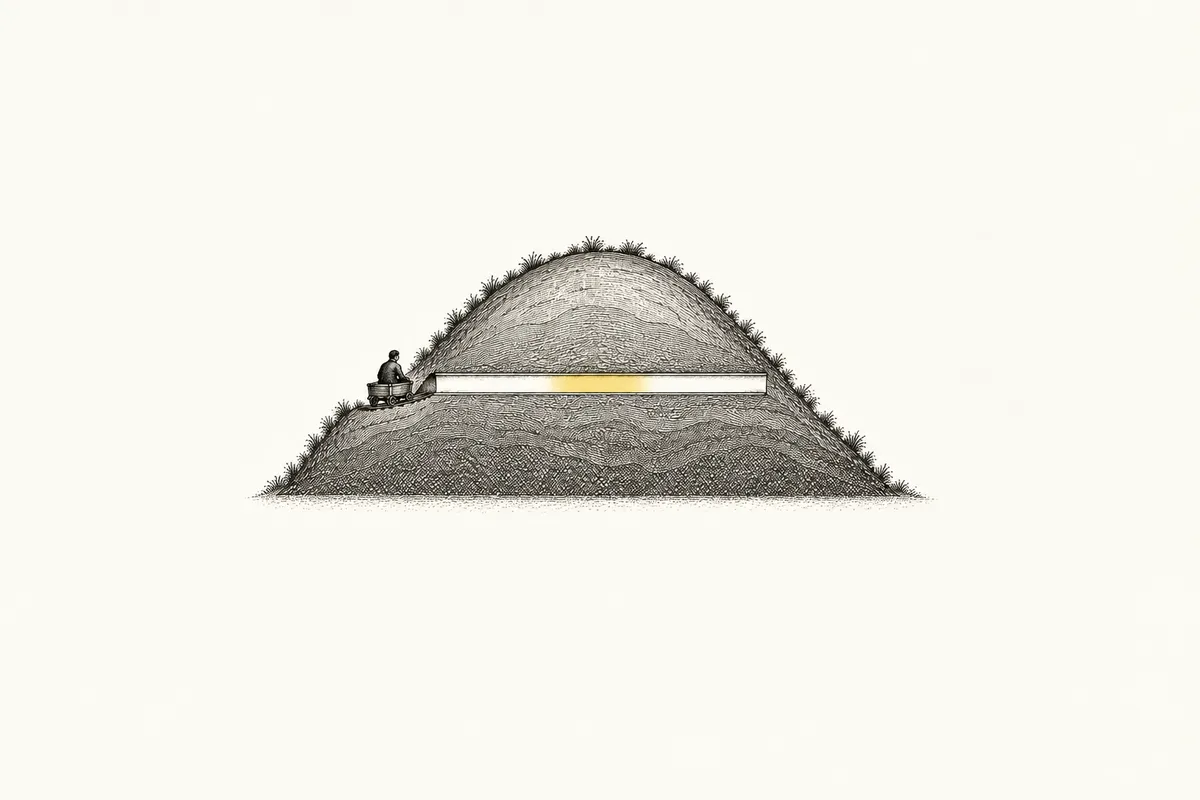
The gravity train is worked out on paper too, but its question is what would happen, not whether anything stays the same.
Quick answers
Where does the Ship of Theseus come from? The oldest account we read is Plutarch's Life of Theseus 23.1: Athens kept Theseus' galley by swapping old timbers for new, and philosophers argued about whether it remained the same ship. Plato's Phaedo, set in 399 BCE, mentions an Athenian ship associated with Theseus, but not the identity puzzle.
Where does the second ship appear? In Thomas Hobbes's De Corpore (1655), Part II, chapter 11, section 7, where someone saves the old planks and rebuilds them “in the same order”; Hobbes uses the pair of ships to argue that identity cannot depend on form alone. The SEP's entry on material constitution credits this version to him.
What is the answer to the Ship of Theseus? There is no agreed answer, and the SEP surveys at least six competing views. Hobbes offered one: ask what the name picks out. Because “ship” names “matter so figured,” a ship with none of its original matter is “numerically another ship.”
Obvious / Checked
| Obvious | Checked |
|---|---|
| The Ship of Theseus is an ancient Greek riddle about two ships: the repaired one and one rebuilt from the old planks. | Plutarch's account has one ship, no plank count, and no “all.” The rebuilt ship appears in Hobbes's De Corpore (1655), Part II, ch. 11, §7. |
| The puzzle has no answer. | Hobbes answered it for the repaired ship: “ship” names “matter so figured,” so a fully repaired ship is “numerically another ship.” Modern philosophers still disagree with each other and with him. |
| Every plank of Theseus' ship was replaced. | Plutarch's Greek and three English translations say old timbers were swapped (“from time to time,” in Perrin's words). “After all the planks were changed” is Hobbes's wording. |
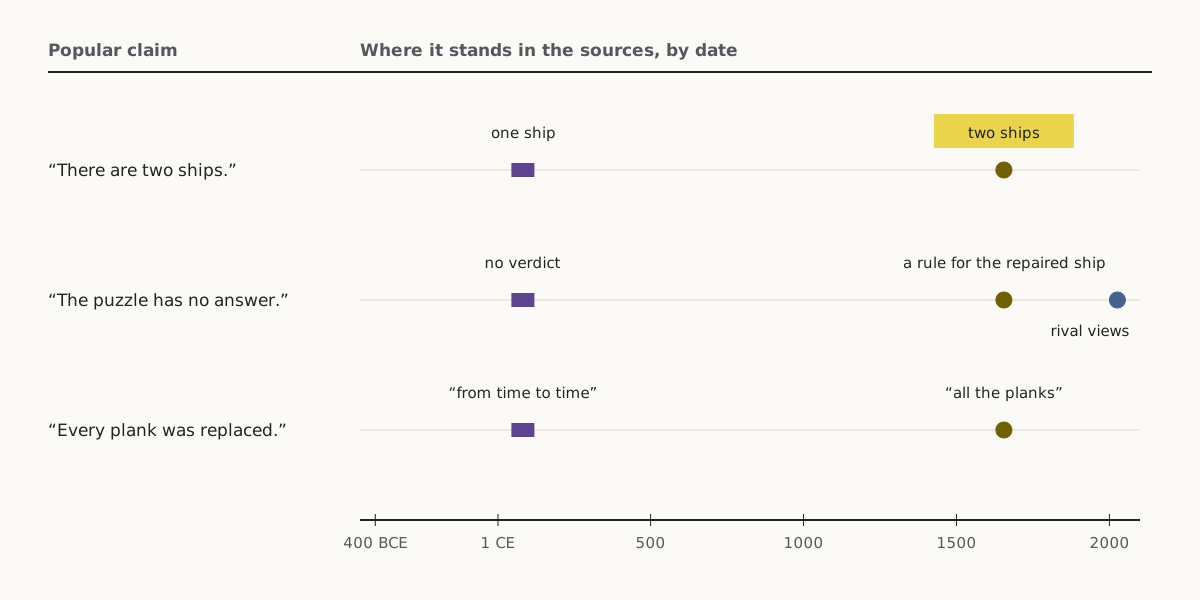
Wide figure: scroll it sideways, or open it full size.
Each popular claim on the dates of the accounts that support or contradict it, from the source-timeline CSV.
Diagram: Puzzles, Charts & Dilemmas, CC BY 4.0
Copy the full credit line
"Popular claims about the Ship of Theseus, by source date" by Puzzles, Charts & Dilemmas, https://puzzleschartsanddilemmas.com/thought-experiments/ship-of-theseus/, licensed under CC BY 4.0 (https://creativecommons.org/licenses/by/4.0/).
Push back:
The strongest objection is that Hobbes changed the subject. The puzzle asks whether a thing persists, and an answer that depends on the word being used may tell us about language rather than about ships; several views in the SEP survey, including the constitution view and four-dimensionalism, give verdicts about the ships themselves. Plutarch's one-ship case was also a complete puzzle already, which Hobbes's second ship sharpens but does not create. On that view, treating the two-ship case as “the” paradox overstates Hobbes's contribution.
- Unexpected hanging paradox: An argument that rules out one day at a time, as these repairs swap planks: where does it stop working?
- Galileo's falling bodies: Galileo's tied-stones argument, written out premise by premise.
Sources
- Plutarch, Life of Theseus 23.1, trans. Bernadotte Perrin, Loeb Classical Library, Plutarch's Lives vol. 1 (1914), with the Loeb editor's notes (note 29: Demetrius of Phalerum, regent of Athens for Cassander, 317–307 BCE). LacusCurtius, ed. Bill Thayer. https://penelope.uchicago.edu/Thayer/E/Roman/Texts/Plutarch/Lives/Theseus*.html Read: full text of 23.1 and the editor's notes.
- Plutarch, Theseus, Greek text (ed. Bernadotte Perrin, 1914), Perseus Digital Library canonical-greekLit, tlg0007.tlg001.perseus-grc2. https://raw.githubusercontent.com/PerseusDL/canonical-greekLit/master/data/tlg0007/tlg001/tlg0007.tlg001.perseus-grc2.xml Read: Greek text of 23.1. Text license: CC BY-SA 4.0.
- Plutarch, Lives of the Noble Grecians and Romans, ed. Arthur Hugh Clough. Project Gutenberg eBook #674. https://www.gutenberg.org/ebooks/674 Read: Life of Theseus, full text.
- Plutarch, Plutarch's Lives, vol. 1, trans. George Long. Project Gutenberg eBook #14033. https://www.gutenberg.org/ebooks/14033 Read: Life of Theseus, full text.
- Plato, Phaedo, trans. Benjamin Jowett. Project Gutenberg eBook #1658. https://www.gutenberg.org/ebooks/1658 Read: opening exchange.
- Thomas Hobbes, Elements of Philosophy, The First Section, Concerning Body (De Corpore), Part II, ch. 11, §7, in Sir William Molesworth (ed.), The English Works of Thomas Hobbes of Malmesbury, vol. 1 (London: John Bohn, 1839), pp. 135–138. Project Gutenberg eBook #73877. https://www.gutenberg.org/ebooks/73877 Read: full text of Part II, ch. 11.
- Andre Gallois and Irem Kurtsal, “Identity Over Time,” Stanford Encyclopedia of Philosophy (substantive revision 2026-01-12), §§4, 4.1–4.3, 4.5, 4.6, 4.8. https://plato.stanford.edu/entries/identity-time/ Read: full entry, section 4.
- Ryan Wasserman, “Material Constitution,” Stanford Encyclopedia of Philosophy (substantive revision 2026-01-14), §1. https://plato.stanford.edu/entries/material-constitution/ Read: section 1.
- Stewart Duncan, “Thomas Hobbes,” Stanford Encyclopedia of Philosophy (substantive revision 2025-03-01). https://plato.stanford.edu/entries/hobbes/ Read: entry, on the publication of De Corpore.
- George Karamanolis, “Plutarch,” Stanford Encyclopedia of Philosophy (substantive revision 2024-12-05). https://plato.stanford.edu/entries/plutarch/ Read: opening section and life.
- Debra Nails and S. Sara Monoson, “Socrates,” Stanford Encyclopedia of Philosophy (substantive revision 2022-05-26). https://plato.stanford.edu/entries/socrates/ Read: sections on his life and trial.
Downloads: Source timeline (CSV) (file notes: source, version and license (JSON)) · Variants under three rules (CSV) (file notes: source, version and license (JSON))
Cite this page
Puzzles, Charts & Dilemmas. “Ship of Theseus: Plutarch's Version Had Only One Ship.” Puzzles, Charts & Dilemmas. Published 2026-10-31. https://puzzleschartsanddilemmas.com/thought-experiments/ship-of-theseus/. Accessed: add the date you read it.
Dates are given as year-month-day. 31 October 2026 is the latest substantive revision.
Galileo's Falling Bodies: The Argument That Needed No Tower
Picture credit
Illustration: Puzzles, Charts & Dilemmas. Generated schematic illustration — not a photograph or historical record. Reuse: CC BY 4.0 (https://creativecommons.org/licenses/by/4.0/), to the extent Puzzles, Charts & Dilemmas holds rights in it.
Gravity Train: Uniform Earth, Straight Tunnel, About 42 Min
Picture credit
Illustration: Puzzles, Charts & Dilemmas. Generated schematic illustration — not a photograph or historical record. Reuse: CC BY 4.0 (https://creativecommons.org/licenses/by/4.0/), to the extent Puzzles, Charts & Dilemmas holds rights in it.