Galileo's Falling Bodies: The Argument That Needed No Tower
Published · Puzzles, Charts & Dilemmas
Folded answers print open where the browser allows it; if one prints closed, open it at https://puzzleschartsanddilemmas.com/thought-experiments/galileo-falling-bodies/ first.
Where it lands
Galileo's case against Aristotle's falling rule works on paper: tie a light stone to a heavy one, and the rule as his 1638 dialogue states it, plus a premise the dialogue's Aristotelian grants, says the pair must fall both slower and faster than the heavy stone alone. The same dialogue concedes that a real drop is not quite a dead heat: in the 1914 English translation, the larger ball lands “two finger-breadths” ahead.
Sections on this sheet (7)
- How does Galileo's tied-stones argument work?
- What does Galileo's dialogue actually say?
- Do heavier objects fall faster? The two finger-breadths
- Did Galileo drop balls from the Leaning Tower of Pisa?
- Why do objects fall at the same rate without air?
- What the tied-stones argument does not show
- Obvious / Checked
In 1638, Galileo had a character tie a heavy stone to a light one, entirely on paper. The story told about him today puts the proof somewhere else, on top of the Leaning Tower of Pisa, with two balls of different weight landing together. That story misses the layer where the work happens. The argument in the dialogue needs no tower and no drop, only a rule and a length of rope, and here it is in standard form.
In standard form: (Galileo, Two New Sciences, First Day; Crew and de Salvio translation, 1914, pp. 61–64)
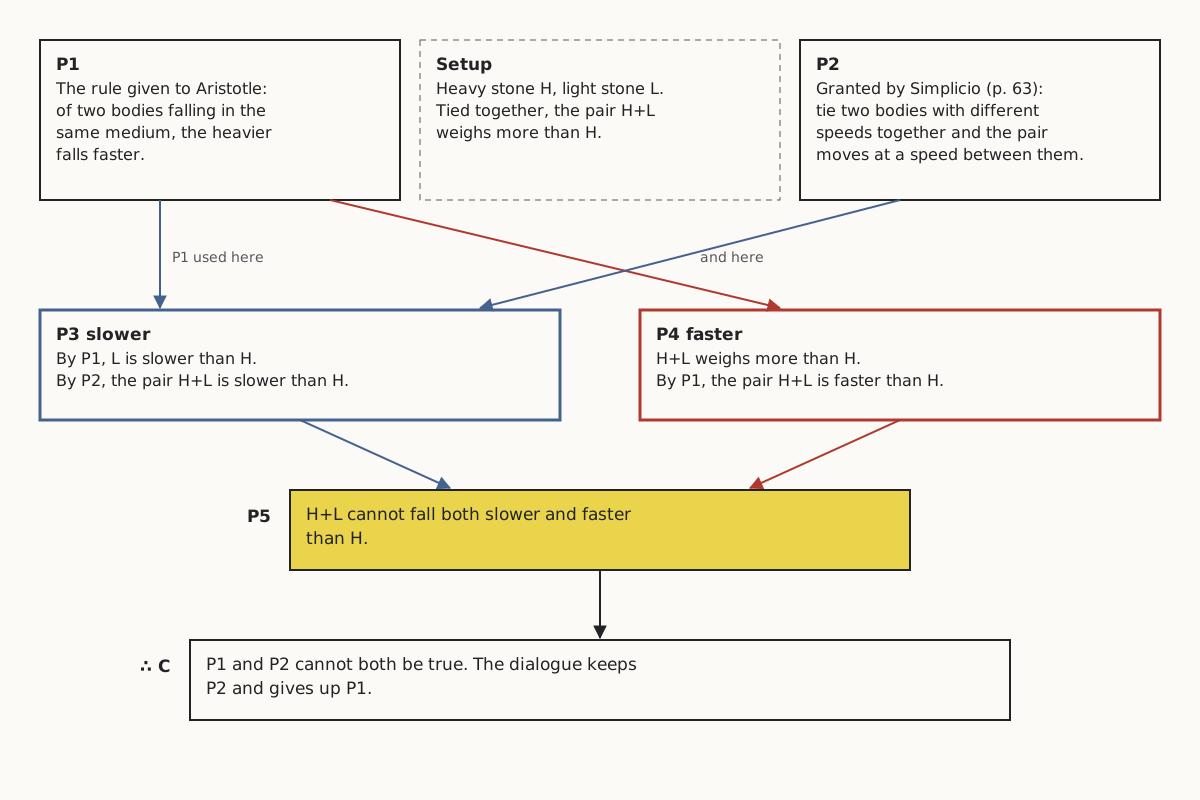
- Premise 1:The rule the dialogue gives Aristotle: of two bodies falling through the same medium, the heavier falls faster.
- Premise 2:Granted by Simplicio, who argues Aristotle's side: tie together two bodies whose natural speeds differ, and the slower holds back the faster, so the pair moves at a speed between the two.
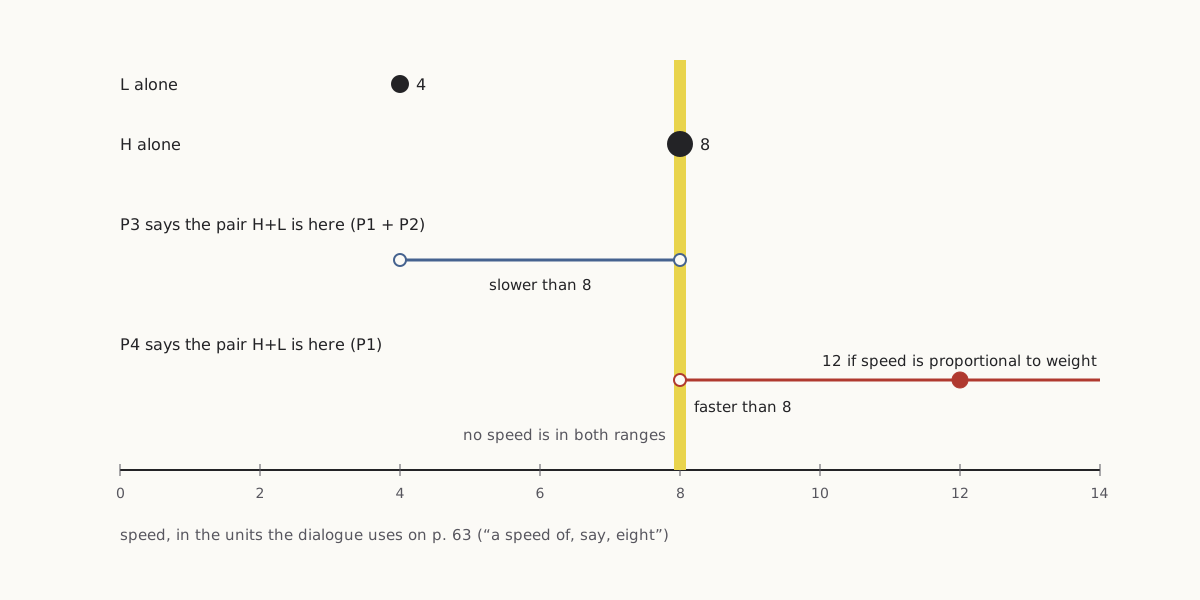
- Premise 3:Tie a light stone L to a heavy stone H. By P1, L is slower than H, so by P2 the pair H+L falls slower than H.
- Premise 4:The pair H+L weighs more than H, so by P1 it falls faster than H.
- Premise 5:H+L cannot fall both slower and faster than H.
- Therefore, conclusion:P1 and P2 cannot both be true. The dialogue keeps P2, gives up P1, and concludes that bodies of the same material fall at the same speed.
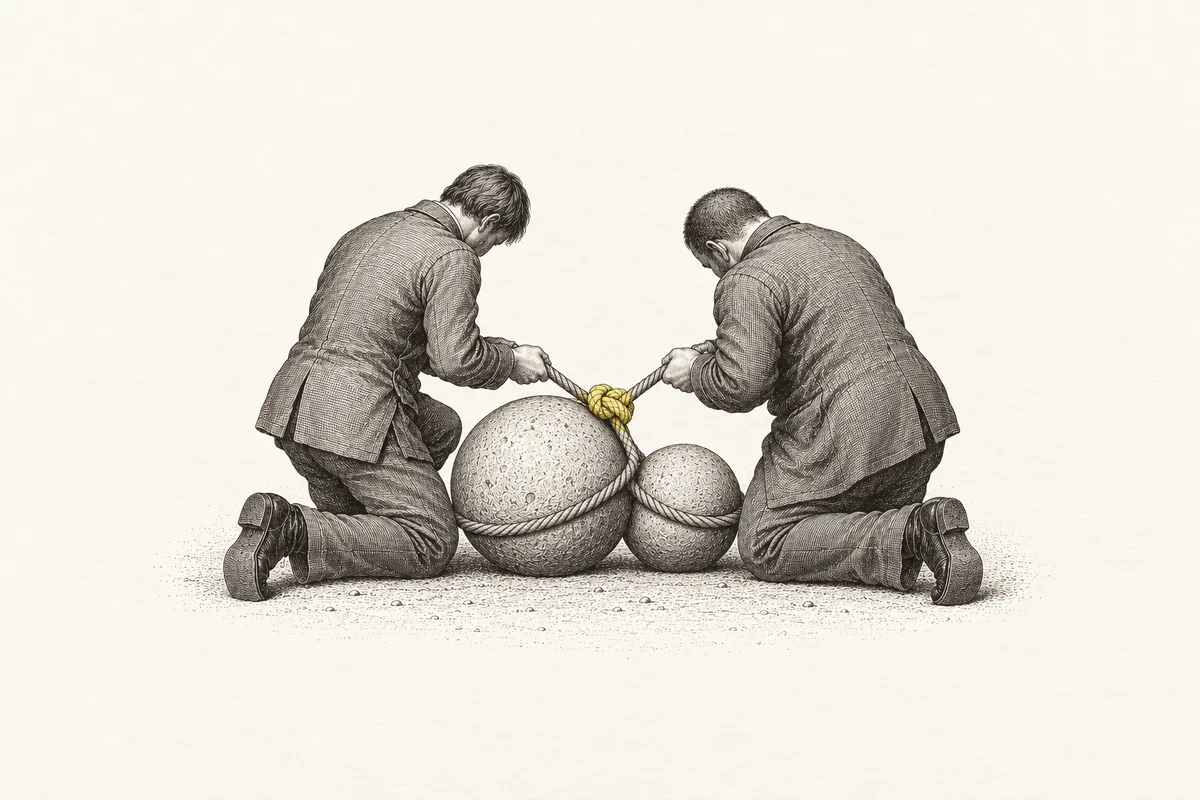
The tied stones as the dialogue sets them up: a heavy stone and a light one, joined, with no tower in sight.
Illustration: Puzzles, Charts & Dilemmas. Generated schematic illustration — not a photograph or historical record. Reuse: CC BY 4.0 (https://creativecommons.org/licenses/by/4.0/), to the extent Puzzles, Charts & Dilemmas holds rights in it.
How does Galileo's tied-stones argument work?
Two New Sciences has three speakers. Simplicio speaks for Aristotle, Salviati argues against him, and Sagredo asks to hear both. On page 61 of the 1914 translation, Simplicio states Aristotle's rule in its plainest form: “a body which is ten times as heavy as another will move ten times as rapidly as the other.” P1 keeps only the part the argument needs, that heavier means faster.
Two pages later Salviati gets Simplicio to agree to P2. When two bodies with different natural speeds are joined, “the more rapid one will be partly retarded by the slower, and the slower will be somewhat hastened by the swifter.” Simplicio's reply is short: “You are unquestionably right.”
Wide figure: scroll it sideways, or open it full size.
The tied-stones argument as a map of premises; the rule given to Aristotle feeds both of the clashing steps.
Diagram: Puzzles, Charts & Dilemmas, CC BY 4.0
Copy the full credit line
"The tied-stones argument, premise by premise" by Puzzles, Charts & Dilemmas, https://puzzleschartsanddilemmas.com/thought-experiments/galileo-falling-bodies/, licensed under CC BY 4.0 (https://creativecommons.org/licenses/by/4.0/).
| Step | What it says | Where it comes from |
|---|---|---|
| P1 | Of two bodies in the same medium, the heavier falls faster. | Simplicio states Aristotle's rule, p. 61 |
| P2 | Two joined bodies with different speeds move at a speed between them. | Salviati proposes, Simplicio agrees, p. 63 |
| P3 | The light stone is slower, so the tied pair is slower than the heavy stone. | P1, then P2 |
| P4 | The tied pair weighs more, so it is faster than the heavy stone. | P1 again |
| P5 | The pair cannot be both slower and faster. | Logic |
| ∴ C | P1 and P2 cannot both stand; the dialogue drops P1. | Salviati, p. 64 |
Salviati puts numbers on it. In his example, a large stone moving “with a speed of, say, eight” tied to a smaller one moving at four gives a pair that moves “with a speed less than eight,” although the pair is the bigger stone. If speed were simply proportional to weight, the same pair would have to move at 12.
The rope in the story is literal, but the logic has the shape of a knot pulled two ways: P3 and P4 are strands tied to the same rule, and when both are pulled, the rule is what gives.
We checked the logic in two independent ways. One method ran through every ordering of the three speeds, 13 in all; the other ran through 25,920 numeric cases, with weights from 1 to 6 and speeds from 1 to 12. Neither found a single case where P1 and P2 hold together. Each premise on its own has cases that work.
Try it first: Both P3 and P4 lean on P1. If you were defending Aristotle, which premise could you drop instead of P1, and what would it cost you?
Show it worked through
Worked through
You could drop P2. Our check finds cases that satisfy P1 alone, so the contradiction disappears. But P2 is the premise Simplicio has already granted, and it describes what a slow body tied to a fast one plainly does: holds it back. Dropping it while keeping P1 means saying that the light stone adds speed to the heavy one, since P1 makes the heavier pair fall faster.
Simplicio tries something close to this on page 63: the small stone adds weight, he says, and he cannot see how added weight would fail to add speed. Salviati answers on page 64 that in free fall the small stone does not press on the larger one, so while they fall it adds no weight at all.
His example is a handful of hemp tied to a stone. On a balance the hemp adds weight, but in a fall, he argues, a load presses on you only when you stop it from falling, not when you drop just as fast as it does.
There is a third way out. Weaken P1 to “a heavier body is never slower.” With that rule, P2 survives, but in every case our check finds, the heavy and the light stone have the same speed. That is the dialogue's own conclusion, reached from the other side.
What does Galileo's dialogue actually say?
Galileo's final book, Discourses and Mathematical Demonstrations Concerning Two New Sciences, was published in Holland by the Elzeviers in 1638, according to the Stanford Encyclopedia of Philosophy's entry on Galileo. Henry Crew and Alfonso de Salvio published their English translation in 1914. The SEP calls it “inferior” but widely available. We quote it because it is in the public domain and its page numbers could be checked against the printed pages.
Galileo Galilei, oil portrait attributed to Justus Sustermans, about 1640 (Royal Museums Greenwich, BHC2700).
“Galileo Galilei (1564-1642)” by Justus Sustermans (attributed), Public domain
Full credit line
"Galileo Galilei (1564-1642)" by Justus Sustermans (attributed) — https://commons.wikimedia.org/wiki/File:Galileo_Galilei_(1564-1642)_RMG_BHC2700.tiff — Public domain (painter d. 1681: EU, author's life + 70 years expired; US, published before 1931 per the Commons PD-Art tag, and an unpublished work by an author dead over 70 years is also out of copyright; faithful reproduction of a two-dimensional work (US Bridgeman v. Corel; EU DSM Directive art. 14); the holder, Royal Museums Greenwich, states no permission is required for reuse)
The falling-bodies passage opens with a claim and a doubt. Salviati says he greatly doubts that Aristotle ever tested whether a stone ten times heavier would land while the other “would not have fallen more than 10 cubits.” Sagredo then reports a test of his own: a cannon ball of one or two hundred pounds “will not reach the ground by as much as a span ahead” of a half-pound musket ball, dropped from 200 cubits. The dialogue names no place for that test.
Salviati does not lean on it. His next line sets it aside: “even without further experiment, it is possible to prove clearly, by means of a short and conclusive argument,” that a heavier body does not fall faster, “provided both bodies are of the same material.” The tied stones follow.
The SEP entry describes this passage as a thought experiment against the Aristotelian theory of fall, and notes that Galileo's texts “are full of illustrative scenarios he does not pretend to have carried out.” The argument ends on page 64 with a limit attached: “large and small bodies move with the same speed provided they are of the same specific gravity.” Specific gravity means density compared with water, so the claim covers stones of one material, not a stone and a feather.
What did Aristotle say about falling bodies?
This page reports Aristotle's rule only as the dialogue quotes or restates it; we did not read Aristotle's own text. In that restatement, on pages 61 and 62, the rule is one half of a larger argument against empty space. Simplicio explains that Aristotle first supposes bodies of different weight moving through one medium at speeds “in the same ratio as the weights,” then supposes one body moving through different media at speeds in inverse ratio to their densities.
From the second supposition, Simplicio goes on, Aristotle concludes that a body would cross a vacuum instantly, which is impossible, so a vacuum cannot be produced by motion. Salviati's reply is that both suppositions can be denied. The tied stones are his case against the first one.
On page 65 Salviati states the rule once more: bodies of different weights in the same medium travel, “in so far as their motion depends upon gravity,” at speeds “proportional to their weights.” He adds that Aristotle chose bodies in which the effect of gravity shows plainly, setting aside shape, whose effect depends on the medium. P1 keeps only the direction of that rule, not its proportions.
Do heavier objects fall faster? The two finger-breadths
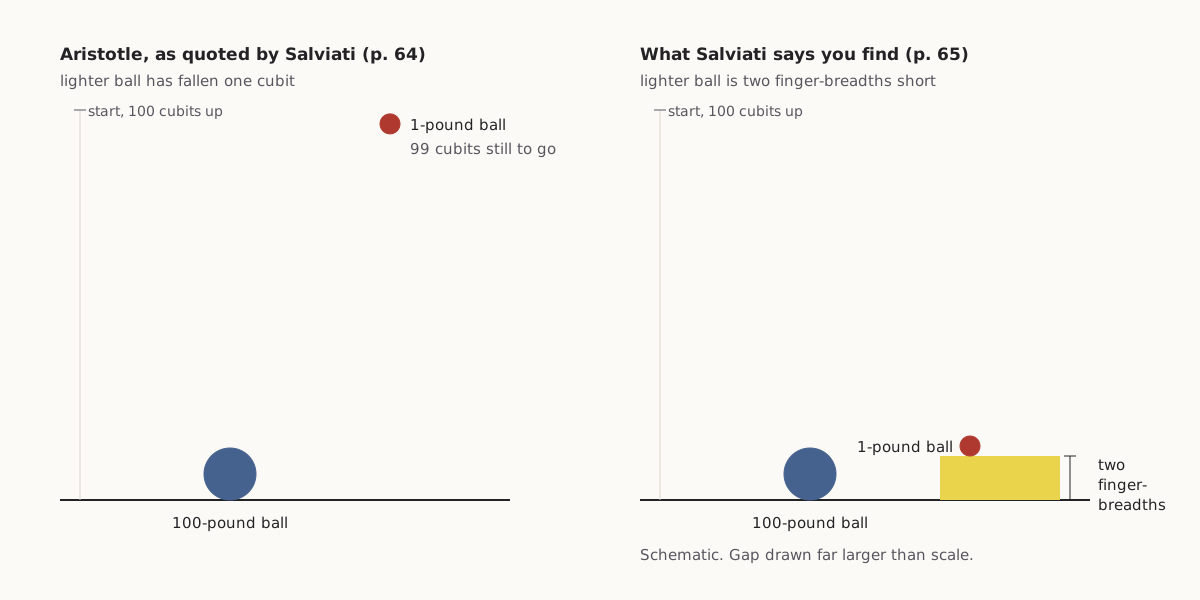
Right after the argument, Salviati quotes Aristotle against himself. An iron ball of one hundred pounds dropped from one hundred cubits, Aristotle says in this quotation, “reaches the ground before a one-pound ball has fallen a single cubit.” Salviati's answer on page 64 is blunt: “I say that they arrive at the same time.” Just before, he warns Simplicio not to fasten on a statement that “lacks a hair's-breadth of the truth” in order to hide a fault “as big as a ship's cable.”
Wide figure: scroll it sideways, or open it full size.
Aristotle's rule as quoted in the dialogue against the gap Salviati reports; the second gap is drawn far larger than scale.
Diagram: Puzzles, Charts & Dilemmas, CC BY 4.0
Copy the full credit line
"Aristotle’s rule against the two finger-breadths (schematic)" by Puzzles, Charts & Dilemmas, https://puzzleschartsanddilemmas.com/thought-experiments/galileo-falling-bodies/, licensed under CC BY 4.0 (https://creativecommons.org/licenses/by/4.0/).
Data: Galileo, Two New Sciences, trans. Henry Crew and Alfonso de Salvio (1914), public domain
On the next page he concedes something. “You find, on making the experiment, that the larger outstrips the smaller by two finger-breadths.” He does not hide the gap. He asks Simplicio not to hide Aristotle's error “behind these two fingers,” which would cover up “the ninety-nine cubits of Aristotle.”
So the dialogue's own answer to “do heavier objects fall faster?” has two parts. In an actual drop through air, a heavy ball can finish slightly ahead of a light one, and the dialogue says so. Aristotle's proportional rule overstates that difference by a huge margin. The tied stones show that the rule cannot be right as stated.
The dialogue then follows the air. On page 72, Salviati says a ball of gold would not beat a ball of copper over 100 cubits “by as much as four fingers,” and draws his conclusion: “in a medium totally devoid of resistance all bodies would fall with the same speed.” That is a separate claim from the tied stones, reached from falls through air and water.
Air costs a light body far more. In a later calculation (pp. 75–76), Salviati works out that when an ebony ball dropped from a tower 200 cubits high lands, an inflated bladder would have covered only “three-quarters” of the distance, because the air takes a much larger share of its speed.
| Page (1914) | Speaker | Bodies and height | What the dialogue says |
|---|---|---|---|
| 61 | Simplicio, stating Aristotle | Bodies of different weight | Ten times as heavy moves ten times as rapidly |
| 62 | Sagredo | Cannon ball and musket ball, 200 cubits | Not ahead “by as much as a span” |
| 64 | Salviati, quoting Aristotle | 100-pound and 1-pound balls, 100 cubits | Heavy lands before the light one has fallen one cubit |
| 65 | Salviati | The same balls | The larger is ahead by “two finger-breadths” |
| 72 | Salviati | Gold and copper, 100 cubits | Not ahead “by as much as four fingers” |
| 75–76 | Salviati | Lead and ebony, a tower 200 cubits high | Lead ahead by “less than four inches” |
The full list of 13 claims, with speakers and the exact quotations, is in galileo-dialogue-fall-claims.csv (file notes: source, version and license (JSON)) Data: Galileo, Two New Sciences, trans. Henry Crew and Alfonso de Salvio (1914), public domain.
Did Galileo drop balls from the Leaning Tower of Pisa?
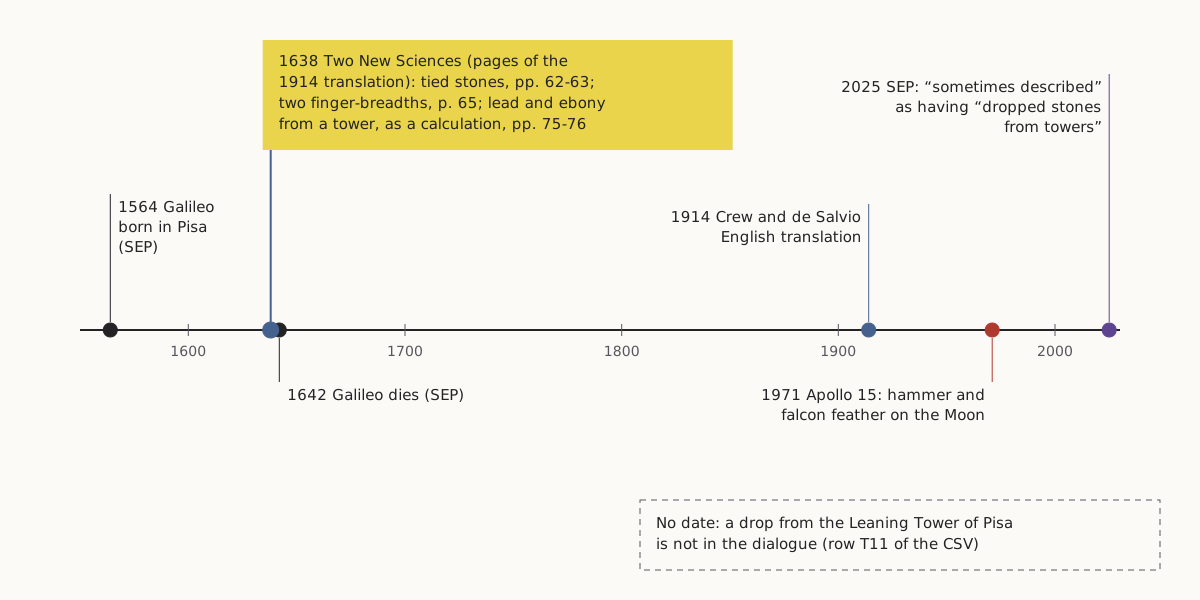
The dialogue does not say he did. We searched the full text of the 1914 translation for “Pisa” and found no match. In the dialogue's comparison of falling speeds (pp. 61–76), the only tower is in a calculation on pages 75 and 76, where Salviati works out that a lead ball let fall “from a tower two hundred cubits high” would beat an ebony ball by “less than four inches.”
Wide figure: scroll it sideways, or open it full size.
The dated accounts behind the story; the Pisa drop has no row with a date, because none of these sources gives one.
Diagram: Puzzles, Charts & Dilemmas, CC BY 4.0
Copy the full credit line
"Galileo’s falling bodies: dated accounts" by Puzzles, Charts & Dilemmas, https://puzzleschartsanddilemmas.com/thought-experiments/galileo-falling-bodies/, licensed under CC BY 4.0 (https://creativecommons.org/licenses/by/4.0/).
Data: Galileo, Two New Sciences, trans. Crew and de Salvio (1914); Stanford Encyclopedia of Philosophy, Galileo Galilei (2025); NASA NSSDCA; Apollo Lunar Surface Journal
The SEP entry's opening section says Galileo “is sometimes described” as an experimenter who “dropped stones from towers and ships' masts.” It reports that description; it does not say where the Pisa version began. We did not read an early source for the Pisa drop, so this page does not say who first told it or whether it took place.
The same entry adds a caution about how this passage is read. Much of the modern literature on it, the entry says, takes Galileo's work out of its historical context, and it concludes that Galileo “did not hold a unified doctrine of thought experimentation.” Scholars it describes as more historically sensitive point instead to the many different jobs such scenarios do in his books.
The book itself argues over who really made a drop. Simplicio reads Aristotle's words “We see the heavier” as proof that Aristotle had tried it (p. 62). Later, discussing falls from thousands of cubits, Salviati says Aristotle could not have made that experiment, yet “wishes to give us the impression of his having performed it” (p. 65).
What the dialogue does contain is a test claimed by a character, Sagredo, at no named place, and an argument offered as needing no further test. That is all the title of this page claims. None of it needs checking from a height: the argument works on paper, and the dialogue's own figures are enough to follow it.
Minard's map of the 1812 campaign is a chart with the same kind of gap, where a quick reading and the numbers on the map itself do not line up.
Why do objects fall at the same rate without air?
In the dialogue's account, air slows a light body such as an inflated bladder far more than a heavy one such as lead (pp. 75–76). Take the air away, and NASA's page on the Apollo 15 drop puts the result in one line: “all objects released together fall at the same rate regardless of mass.” That page, from NASA's Space Science Data Coordinated Archive, describes a demonstration made where there is almost no air, the condition the page 72 claim is about.
At the end of the last Apollo 15 moonwalk, Commander David Scott held out a geologic hammer and a feather and let them go together. Because the two objects “were essentially in a vacuum,” NASA's page says, “there was no air resistance.”
The page quotes Joe Allen's summary in the mission's preliminary science report: a 1.32-kg aluminum hammer and a falcon feather, released from about 1.6 m, struck the surface “simultaneously,” within the accuracy of the release. The report lists the feather at 0.03 kg, a figure NASA's page flags as too high, possibly because of a typo.
Wide figure: scroll it sideways, or open it full size.
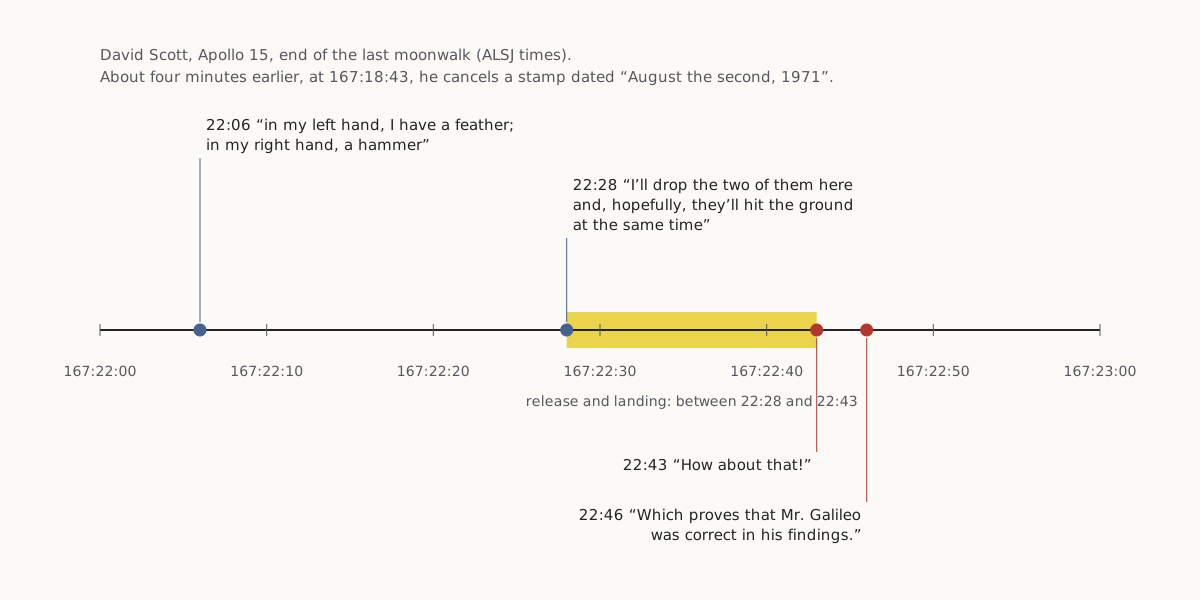
Scott's own words around the drop, placed on the mission clock as the Apollo Lunar Surface Journal gives it.
Diagram: Puzzles, Charts & Dilemmas, CC BY 4.0
Copy the full credit line
"Apollo 15 hammer and feather: David Scott’s words on the mission clock" by Puzzles, Charts & Dilemmas, https://puzzleschartsanddilemmas.com/thought-experiments/galileo-falling-bodies/, licensed under CC BY 4.0 (https://creativecommons.org/licenses/by/4.0/).
Data: David Scott, Apollo 15 transcript, Apollo Lunar Surface Journal
The transcript in the Apollo Lunar Surface Journal gives Scott's words. At 167:22:06 mission time he says that one of the reasons they got there was “a gentleman named Galileo, a long time ago, who made a rather significant discovery about falling objects in gravity fields.” At 167:22:43 he says “How about that!” and three seconds later, “Which proves that Mr. Galileo was correct in his findings.”
The transcript does not time the release itself. It falls between his line at 22:28, the last before the drop, and “How about that!” at 22:43, and the figure marks that 15-second window as our reading of his words. About four minutes earlier, at 167:18:43, Scott had cancelled a stamp and read out its date, “August the second, 1971.” The video is on NASA's page, linked under Sources.
The Moon checks the page 72 claim, not the tied stones. The stones show that one rule contradicts itself. The hammer and feather show what happens to two very different bodies when there is almost no air to resist them.
What the tied-stones argument does not show
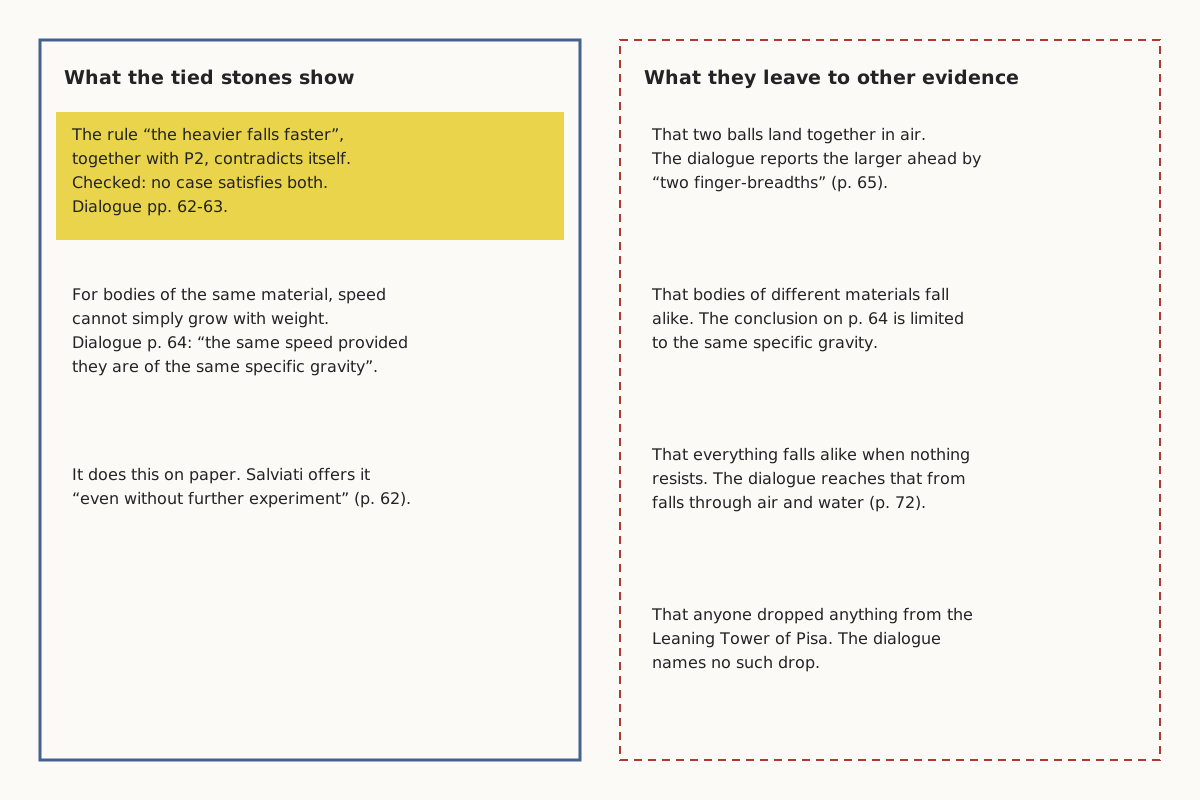
The argument is strong on one point and silent on others, and the dialogue keeps track of the difference better than the tower story does.
Wide figure: scroll it sideways, or open it full size.
What the tied stones establish, and what the dialogue leaves to observation or to other passages.
Diagram: Puzzles, Charts & Dilemmas, CC BY 4.0
Copy the full credit line
"What the tied-stones argument shows and does not show" by Puzzles, Charts & Dilemmas, https://puzzleschartsanddilemmas.com/thought-experiments/galileo-falling-bodies/, licensed under CC BY 4.0 (https://creativecommons.org/licenses/by/4.0/).
| Claim | Shown by the tied stones? | Where the dialogue stands |
|---|---|---|
| The rule “heavier falls faster,” with P2, contradicts itself | Yes | pp. 62–63; we checked that no case satisfies both |
| For one material, speed cannot simply grow with weight | Yes, given P2 | p. 64 concludes “the same speed provided they are of the same specific gravity” |
| Two balls land together in air | No | p. 65 reports the larger ahead by two finger-breadths |
| Bodies of different materials fall alike | No | Not claimed on p. 64; air and water are discussed separately |
| Everything falls alike when nothing resists | No | p. 72, concluded from falls through air and water |
| Someone dropped balls from the Leaning Tower | No | The dialogue names no such drop |
The tied stones settle the first two rows. The other four needed something else: a reported drop, an estimate of what air does, a remark about materials, or, more than three centuries later, a hammer and a feather on the Moon. Read as if it settled all six, the argument would be claiming more than the dialogue itself does.
Obvious / Checked
| Obvious | Checked |
|---|---|
| Galileo dropped balls from the Leaning Tower of Pisa to refute Aristotle. | The 1638 dialogue names no such drop; the 1914 translation has no match for “Pisa.” Its case is two stones tied together, offered “even without further experiment” (pp. 62–63), and in its pages on falling speeds the only tower sits inside a calculation (pp. 75–76). |
| He showed that heavy and light balls land together. | In the dialogue, Salviati first says the two balls “arrive at the same time” (p. 64), then grants that in an actual drop the larger is ahead by “two finger-breadths” (p. 65). Equal speed for bodies of any material is claimed only for a medium “totally devoid of resistance” (p. 72). |
| Nobody checked it where there is no air. | At the end of the last Apollo 15 moonwalk, David Scott dropped a hammer and a falcon feather together; NASA's summary reports that they struck the surface simultaneously, within the accuracy of the release. |
| The tied stones prove that all bodies fall alike. | They show that P1 and P2 cannot both hold. The dialogue's conclusion is limited to bodies “of the same specific gravity” (p. 64). |
Wide figure: scroll it sideways, or open it full size.
The two predictions for the tied pair, using the speeds of eight and four that Salviati picks on page 63.
Diagram: Puzzles, Charts & Dilemmas, CC BY 4.0
Copy the full credit line
"Two predictions for the tied pair" by Puzzles, Charts & Dilemmas, https://puzzleschartsanddilemmas.com/thought-experiments/galileo-falling-bodies/, licensed under CC BY 4.0 (https://creativecommons.org/licenses/by/4.0/).
Data: Galileo, Two New Sciences, trans. Henry Crew and Alfonso de Salvio (1914), public domain
Push back:
The strongest reply on Aristotle's side is that the argument hits a rule nobody needs to hold in that form. Two stones tied with a cord need not count as one body, so P4 may not apply. Speed may depend on density rather than weight, and Galileo's own conclusion carries exactly that limit, “the same specific gravity.” On this view the tied stones refute only the crudest proportional rule, and the real questions about air and density are settled by measurement, not by the argument.
- Gravity train: Another fall worked out on paper, this time straight through the Earth.
- Ship of Theseus: Another puzzle about what makes a thing count as one and the same object.
Sources
- Galileo Galilei, Dialogues Concerning Two New Sciences, trans. Henry Crew and Alfonso de Salvio (New York: Macmillan, 1914), First Day, pp. 61–65, 72, 75–76. Original: Discorsi e dimostrazioni matematiche intorno a due nuove scienze (Leiden: Elzevier, 1638). https://archive.org/details/dialoguesconcern00galiuoft Read: full text; quoted pages checked against the printed page images.
- David Marshall Miller, “Galileo Galilei,” Stanford Encyclopedia of Philosophy (first published 2005-03-04; substantive revision 2025-12-17), opening section, §2, §4.3 and bibliography. https://plato.stanford.edu/entries/galileo/ Read: full entry.
- NASA Space Science Data Coordinated Archive, “The Apollo 15 Hammer-Feather Drop” (curator David R. Williams; last updated 2023-03-31), quoting Joe Allen, Apollo 15 Preliminary Science Report, NASA SP-289, p. 2-11. https://nssdc.gsfc.nasa.gov/planetary/lunar/apollo_15_feather_drop.html Read: full page.
- Eric M. Jones (ed.), “The Hammer and the Feather,” Apollo Lunar Surface Journal, Apollo 15, corrected transcript (last revised 2025-05-04), 167:18:43 and 167:22:06–167:22:46. https://apollojournals.org/alsj/a15/a15.clsout3.html Read: transcript lines 167:18:43 and 167:22:06–167:22:46 (astronaut's words only).
Downloads: Tied-stones logic (JSON) (file notes: source, version and license (JSON)) · What the dialogue says about falls (CSV) (file notes: source, version and license (JSON)) Data: Galileo, Two New Sciences, trans. Henry Crew and Alfonso de Salvio (1914), public domain · Source timeline (CSV) (file notes: source, version and license (JSON)) Data: Galileo, Two New Sciences, trans. Crew and de Salvio (1914); Stanford Encyclopedia of Philosophy, Galileo Galilei (2025); NASA NSSDCA; Apollo Lunar Surface Journal
Cite this page
Puzzles, Charts & Dilemmas. “Galileo's Falling Bodies: The Argument That Needed No Tower.” Puzzles, Charts & Dilemmas. Published 2026-10-31. https://puzzleschartsanddilemmas.com/thought-experiments/galileo-falling-bodies/. Accessed: add the date you read it.
Dates are given as year-month-day. 31 October 2026 is the latest substantive revision.
Ship of Theseus: Plutarch's Version Had Only One Ship
Picture credit
Illustration: Puzzles, Charts & Dilemmas. Generated schematic illustration — not a photograph or historical record. Reuse: CC BY 4.0 (https://creativecommons.org/licenses/by/4.0/), to the extent Puzzles, Charts & Dilemmas holds rights in it.
Gravity Train: Uniform Earth, Straight Tunnel, About 42 Min
Picture credit
Illustration: Puzzles, Charts & Dilemmas. Generated schematic illustration — not a photograph or historical record. Reuse: CC BY 4.0 (https://creativecommons.org/licenses/by/4.0/), to the extent Puzzles, Charts & Dilemmas holds rights in it.