Gravity Train: Uniform Earth, Straight Tunnel, About 42 Min
Published · Puzzles, Charts & Dilemmas
Folded answers print open where the browser allows it; if one prints closed, open it at https://puzzleschartsanddilemmas.com/thought-experiments/gravity-train/ first.
Where it lands
With Earth equally dense all the way down and no friction or air, a car in the idealized gravity train falls through any straight tunnel to the far end in about 42 minutes, however long the tunnel is; with NASA's figures for Earth's radius and surface gravity, our calculation gives 42.17 minutes. The real Earth is denser toward the center, and Alexander Klotz's 2013 preprint finds about 38 minutes for the trip straight through the center.
Sections on this sheet (6)
In a novel whose preface is dated Christmas 1893, Lewis Carroll sent railway trains through straight tunnels on gravity alone. Carroll gave no travel times, but the question invites two quick guesses: a longer tunnel must take longer, and a car falling toward the center might come to rest there. The first guess twists length and time into one strand; the second forgets how fast a falling car is moving when it gets there.
Write down the pull along the tunnel, and in the idealized model the knot comes loose. Here is the argument in standard form.
In standard form:
- Premise 1:Inside an Earth of uniform density, the pull of gravity grows in proportion to distance from the center: g × r / R.
- Premise 2:Along any straight tunnel, the part of that pull pointing along the tunnel grows in proportion to distance from the tunnel's midpoint: g × y / R.
- Premise 3:A pull proportional to distance from a midpoint makes a back-and-forth swing whose period does not depend on how far the swing reaches.
- Premise 4:With no friction and no air, a car released at rest at one mouth stops at the other after half a swing, which takes π√(R/g).
- Therefore, conclusion:Every straight tunnel through a uniform, frictionless Earth takes the same one-way time, about 42 minutes (42.17 with NASA's R = 6,371.000 km and g = 9.820 m/s²).
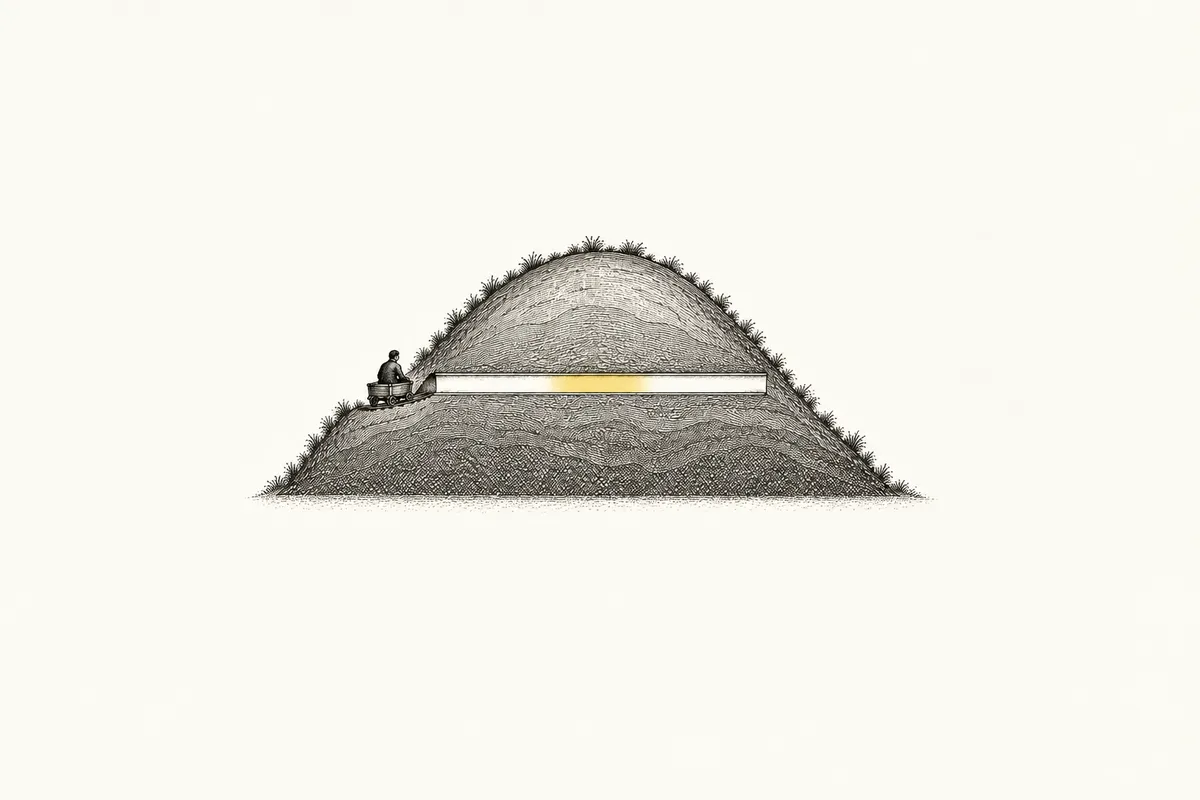
A small car with no engine beside the tunnel. Carroll's Mein Herr describes trains that run downhill to the middle and uphill after.
Illustration: Puzzles, Charts & Dilemmas. Generated schematic illustration — not a photograph or historical record. Reuse: CC BY 4.0 (https://creativecommons.org/licenses/by/4.0/), to the extent Puzzles, Charts & Dilemmas holds rights in it.
Where does the gravity train come from?
The earliest text we read is chapter 7 of Carroll's Sylvie and Bruno Concluded, in the 1894 New York printing on Project Gutenberg. A visitor called Mein Herr describes a country whose trains run “without any engines,” and the Earl objects that this would need railways running downhill. Mein Herr insists that they all do, “from both ends,” and then gives the whole idea in one sentence:
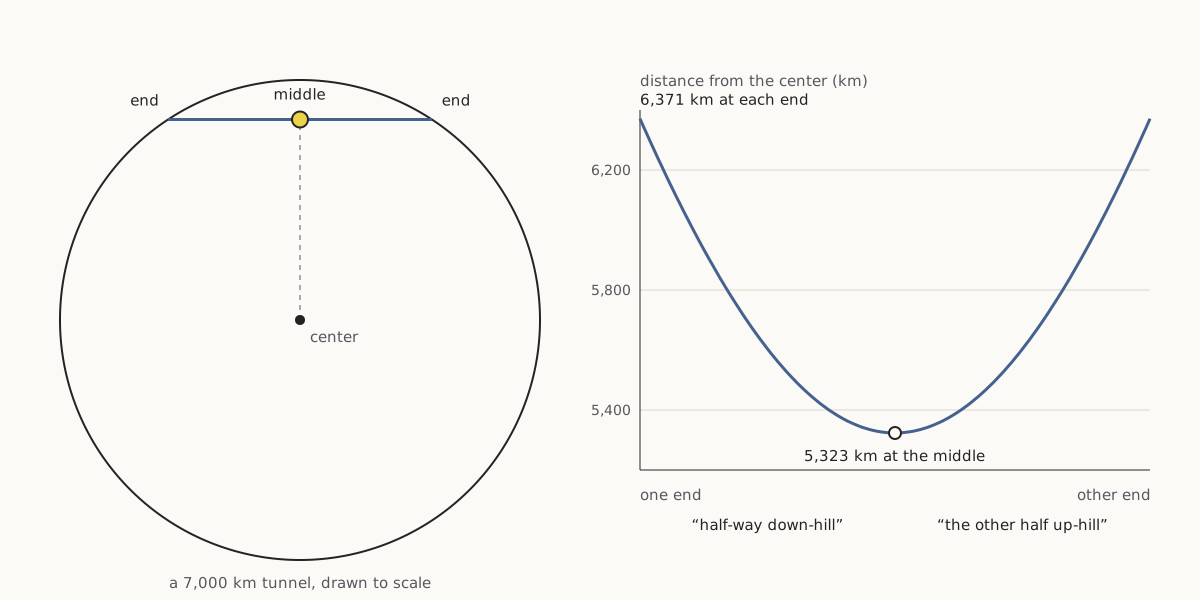
“Easily,” said Mein Herr. “Each railway is in a long tunnel, perfectly straight: so of course the middle of it is nearer the centre of the globe than the two ends: so every train runs half-way down-hill, and that gives it force enough to run the other half up-hill.”
Lady Muriel replies that “the velocity, in the middle of the tunnel, must be something fearful!” That remark turns out to be the right instinct. Carroll gives no times or speeds, so every number below is ours or comes from a source named beside it.
Wide figure: scroll it sideways, or open it full size.
A 7,000 km tunnel drawn to scale, with the distance from Earth's center along its length.
Diagram: Puzzles, Charts & Dilemmas, CC BY 4.0
Copy the full credit line
"Carroll’s straight tunnel, drawn to scale" by Puzzles, Charts & Dilemmas, https://puzzleschartsanddilemmas.com/thought-experiments/gravity-train/, licensed under CC BY 4.0 (https://creativecommons.org/licenses/by/4.0/).
Carroll's is not the only early version: Klotz's preprint dates the physics-journal version to a 1966 paper by P. W. Cooper in the American Journal of Physics and notes that the idea appears in an 1883 French magazine and in an 1898 engineering textbook. We have not read those three, which are listed here as Klotz cites them.
The Ship of Theseus is also a story built to make a point, but it asks what makes a thing the same thing. The gravity train asks what would happen, and it can be answered with arithmetic on paper. No such tunnel exists. Nothing here is meant to be tried.
Why does every straight tunnel take the same time?
Start with P1. Benjamin Crowell's open textbook Mechanics states Newton's shell theorem: inside a thin, hollow, spherical shell of matter, the pulls from all its parts cancel exactly. The book applies this to a mineshaft: the layers above a point deep in the shaft add nothing, and the deeper part of the planet pulls as if all of its mass sat at the center.
The next step is our own one-line derivation from the shell theorem. If the density is the same at every depth, the mass deeper than you grows with the cube of your distance r from the center, while its pull weakens with the square of that distance. What remains grows in step with r, so the pull is g × r / R, where g is surface gravity and R is Earth's radius. Klotz writes the same step as the first equation of his preprint.
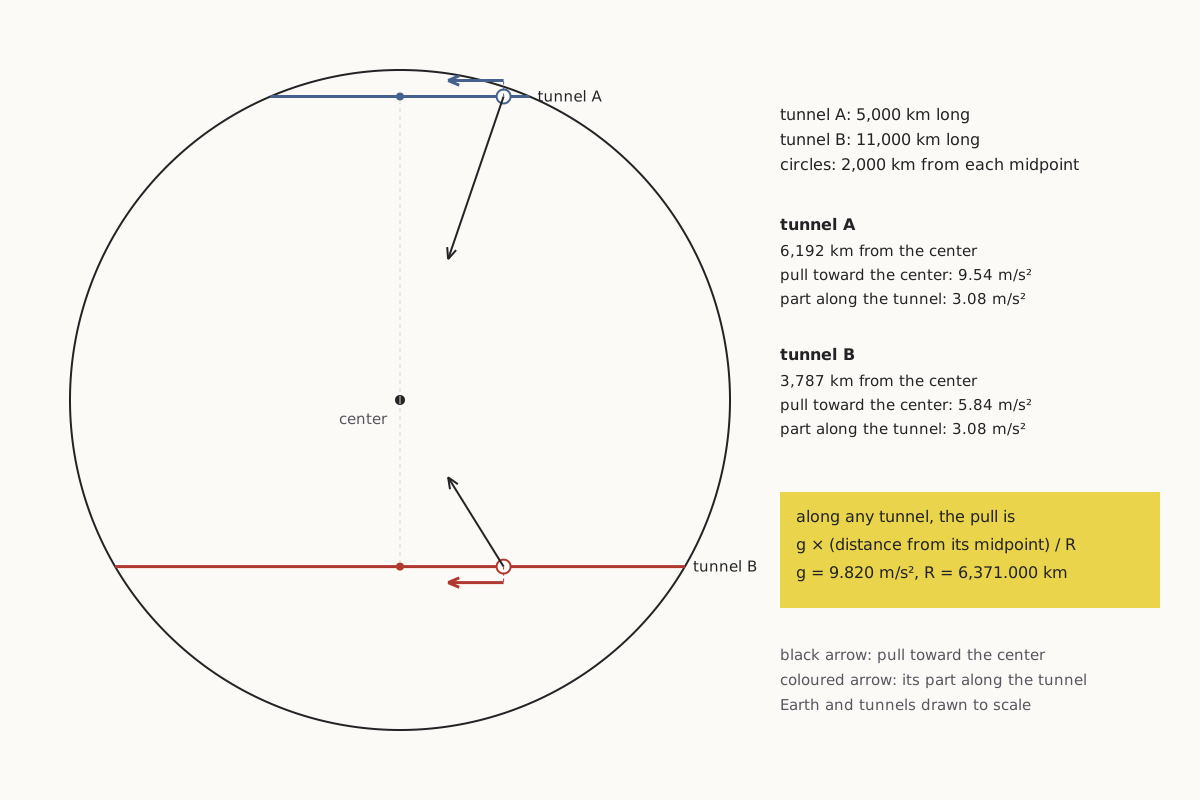
P2 is geometry. Put the tunnel's midpoint at a distance d from the center and the car at a distance y from that midpoint. The pull toward the center is g × r / R, but only the share y / r of it points along the tunnel. The r cancels, leaving g × y / R, and d drops out entirely.
Wide figure: scroll it sideways, or open it full size.
Two tunnels at the same distance from their midpoints: different total pull, the same pull along the track.
Diagram: Puzzles, Charts & Dilemmas, CC BY 4.0
Copy the full credit line
"Pull toward the center and along two tunnels" by Puzzles, Charts & Dilemmas, https://puzzleschartsanddilemmas.com/thought-experiments/gravity-train/, licensed under CC BY 4.0 (https://creativecommons.org/licenses/by/4.0/).
Data: NASA Earth Fact Sheet (radius and surface gravity)
| Point 2,000 km from the midpoint | Tunnel A, 5,000 km long | Tunnel B, 11,000 km long |
|---|---|---|
| Distance from Earth's center | 6,192 km | 3,787 km |
| Pull toward the center | 9.54 m/s² | 5.84 m/s² |
| Part of the pull along the tunnel | 3.08 m/s² | 3.08 m/s² |
So a shallow tunnel and a deep one push the car with exactly the same force at the same distance from their midpoints. The deep tunnel's car feels a weaker total pull, but more of it points down the track.
Past the midpoint, the same component points backward and slows the car by exactly as much as it sped the car up on the way in. That is Carroll's downhill half and uphill half, written as arithmetic: whatever speed the car gains before the middle, it gives back before the far mouth, so it arrives at rest and level with where it started.
How long would a fall through the Earth take?
P3 is the property that makes the answer surprising. A pull that grows with distance from a fixed point and always points back toward it gives the motion of a mass on a spring, which Crowell's textbook calls simple harmonic motion. His chapter on vibrations names the property that matters here: the frequency of such a swing “does not depend on amplitude at all,” so neither does its period. A longer swing starts with a stronger pull, and the two effects cancel in the timing.
Crowell gives the frequency of such a swing as ω = √(k/m), where k/m is the restoring pull per meter of displacement for each kilogram of mass. Along any tunnel in a uniform Earth that ratio is g/R, whatever the tunnel's length or depth, so ω = √(g/R). A half swing, from rest at one mouth to rest at the other, therefore lasts π/ω = π√(R/g), and nothing in that expression mentions the tunnel.
With NASA's Earth Fact Sheet values, a mean radius of 6,371.000 km and a mean surface gravity of 9.820 m/s², the half swing π√(R/g) comes to 2,530.45 seconds, or 42.17 minutes (42 minutes 10 seconds). We checked the closed form against a step-by-step numerical integration of the pull, and the two agreed to well under 0.1%.
Wide figure: scroll it sideways, or open it full size.
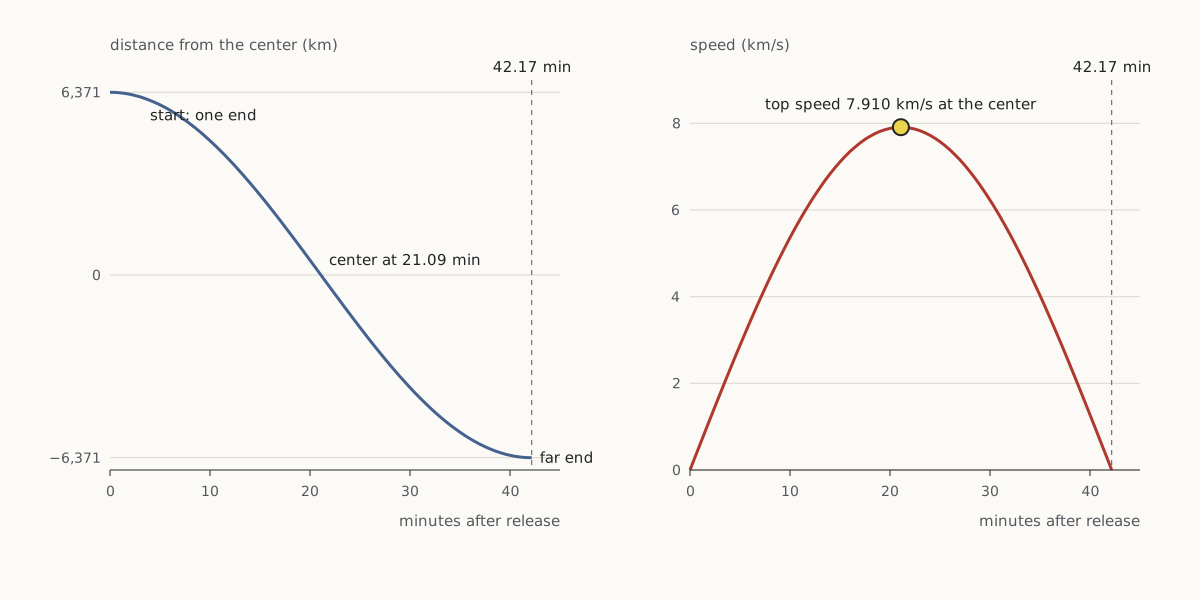
Straight through the center of a uniform Earth: where the car is, and how fast it moves, minute by minute.
Diagram: Puzzles, Charts & Dilemmas, CC BY 4.0
Copy the full credit line
"A fall through a uniform Earth, minute by minute" by Puzzles, Charts & Dilemmas, https://puzzleschartsanddilemmas.com/thought-experiments/gravity-train/, licensed under CC BY 4.0 (https://creativecommons.org/licenses/by/4.0/).
Data: NASA Earth Fact Sheet (radius and surface gravity)
So you would not stop at the center. Through the center, the car passes the midpoint after 21.09 minutes at its top speed of 7.910 km/s, about 28,475 km/h, and coasts up to the far mouth, arriving at rest after 42.17 minutes. Then it falls back, and the round trip takes 84.35 minutes. Klotz's preprint, using its own constants, gives 42 minutes 12 seconds for the one-way trip and a peak speed “near 8 km/s.”
Which constants you choose moves the answer by seconds, not minutes. NASA's fact sheet lists more than one radius and more than one surface value, so we ran the same formula on each pair it gives:
| Radius and gravity, NASA Earth Fact Sheet | One-way time, uniform Earth |
|---|---|
| Mean radius 6,371.000 km, mean surface gravity 9.820 m/s² | 42.17 min (42:10) |
| Mean radius, standard gravity 9.80665 m/s² | 42.20 min (42:12) |
| Equatorial radius 6,378.137 km, equatorial value 9.780 m/s² | 42.28 min (42:17) |
| Polar radius 6,356.752 km, polar value 9.832 m/s² | 42.10 min (42:06) |
Every pairing lands between 42.10 and 42.28 minutes, so rounding any of them gives 42 minutes. This page uses the mean values throughout, and the constants CSV under Sources has all four rows.
| Minutes after release | Distance from the center (km) | Speed (km/s) |
|---|---|---|
| 0 | 6,371.0 | 0.000 |
| 5 | 5,934.2 | 2.878 |
| 10 | 4,683.6 | 5.362 |
| 15 | 2,790.8 | 7.110 |
| 20 | 515.3 | 7.884 |
| 30 | −3,925.9 | 6.229 |
| 40 | −6,287.6 | 1.275 |
| 42.17 | −6,371.0 | 0.000 |
Negative distances are on the far side of the center. The full minute-by-minute table, with the closed form and the numerical integration side by side every 30 seconds, is in the series CSV under Sources.
Does a shorter tunnel take less time?
A short tunnel barely dips below the surface. A 1,000 km tunnel reaches only 19.7 km deep at its middle, while the tunnel through the center goes down 6,371 km.
Try it first: In a uniform Earth with no friction, which car arrives first, one in a straight 1,000 km tunnel between two nearby cities or one in a tunnel straight through the center?
Show it worked through
Worked through
They arrive together, 42.17 minutes after release. The car in the long tunnel starts with a much stronger pull along its track, so it covers 12.7 times the distance at 12.7 times the speed. Its top speed is 7.910 km/s, while the short tunnel's car peaks at 0.621 km/s.
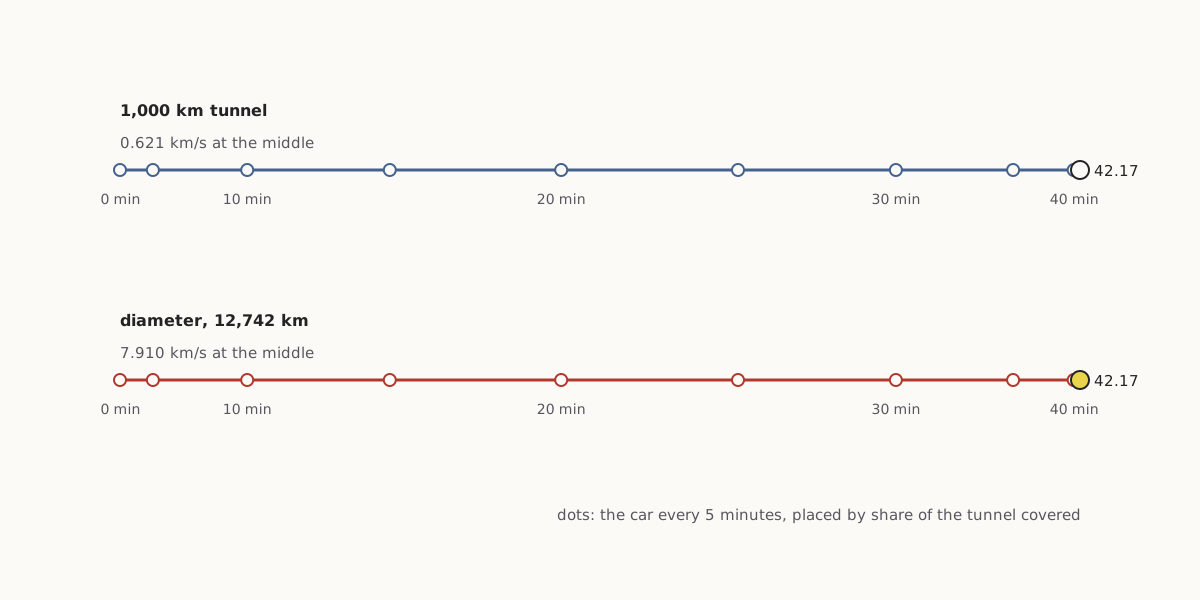
Wide figure: scroll it sideways, or open it full size.
The same 5-minute marks in a short tunnel and a long one, placed by the share of each tunnel covered.
Diagram: Puzzles, Charts & Dilemmas, CC BY 4.0
Copy the full credit line
"A short tunnel and the diameter, every 5 minutes" by Puzzles, Charts & Dilemmas, https://puzzleschartsanddilemmas.com/thought-experiments/gravity-train/, licensed under CC BY 4.0 (https://creativecommons.org/licenses/by/4.0/).
Data: NASA Earth Fact Sheet (radius and surface gravity)
That tie belongs to the uniform model. In Klotz's preprint, with density from seismic data, short trips take close to 42 minutes and the trip through the center about 38, so the long tunnel wins by about 4 minutes.
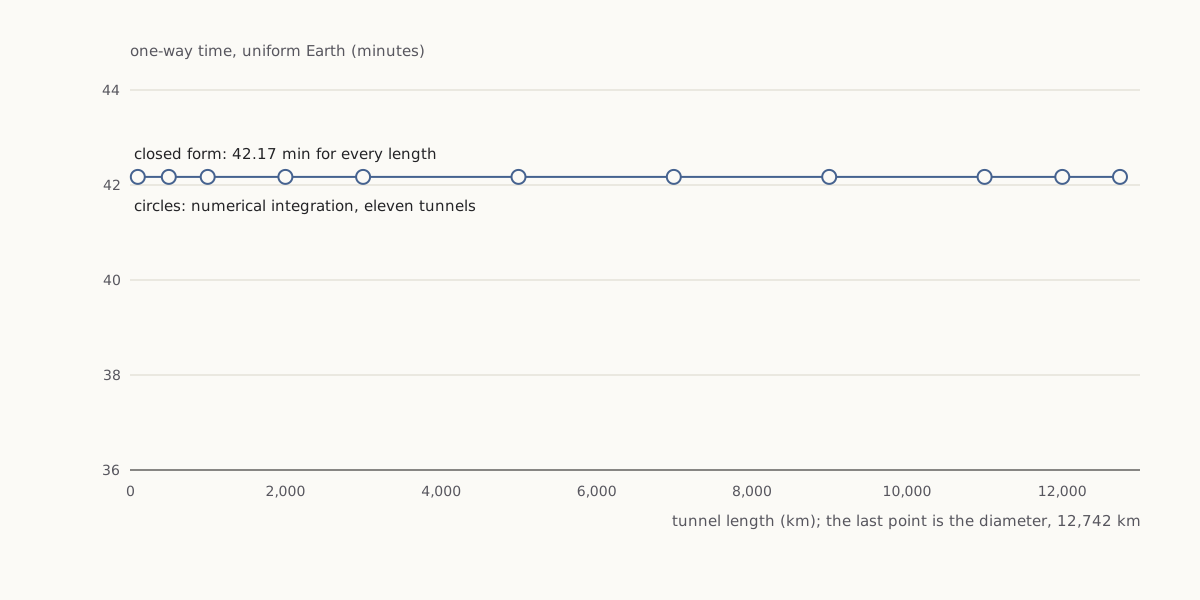
Wide figure: scroll it sideways, or open it full size.
Eleven tunnel lengths, one time: the closed form and the numerical integration agree for each.
Diagram: Puzzles, Charts & Dilemmas, CC BY 4.0
Copy the full credit line
"Eleven tunnel lengths, one time" by Puzzles, Charts & Dilemmas, https://puzzleschartsanddilemmas.com/thought-experiments/gravity-train/, licensed under CC BY 4.0 (https://creativecommons.org/licenses/by/4.0/).
Data: NASA Earth Fact Sheet (radius and surface gravity)
| Tunnel length | Depth at the middle | Top speed | One-way time, closed form | One-way time, numerical |
|---|---|---|---|---|
| 100 km | 0.2 km | 0.062 km/s | 42.17 min | 42.17 min |
| 1,000 km | 19.7 km | 0.621 km/s | 42.17 min | 42.17 min |
| 5,000 km | 511.0 km | 3.104 km/s | 42.17 min | 42.17 min |
| 9,000 km | 1,861.1 km | 5.587 km/s | 42.17 min | 42.17 min |
| 12,742 km (diameter) | 6,371.0 km | 7.910 km/s | 42.17 min | 42.17 min |
The tunnel's length changes how deep the car goes and how fast it moves, but not how long it takes. That is the knot from the opening, untied: in this model, distance and time are separate strands.
Why does the real Earth give about 38 minutes?
P1 fails for the real planet. Klotz describes an Earth that is denser toward the center, reaching about 13 tonnes per cubic meter, with a sharp drop in density at the boundary of the outer core. In the seismic model he uses, gravity does not weaken steadily as you go down. It grows to a maximum of about 1.09 g below the surface, then falls off roughly linearly through the core.
A stronger pull in the upper part of the fall means a faster trip. Klotz integrates the motion numerically and reports, to the nearest second, 38 minutes 11 seconds through the center with the seismic model, against 42 minutes 12 seconds for a uniform Earth. That gap of about four minutes is the paper's main result, and the paper is a preprint: the arXiv record lists a journal version in the American Journal of Physics in 2015, which we have not read.
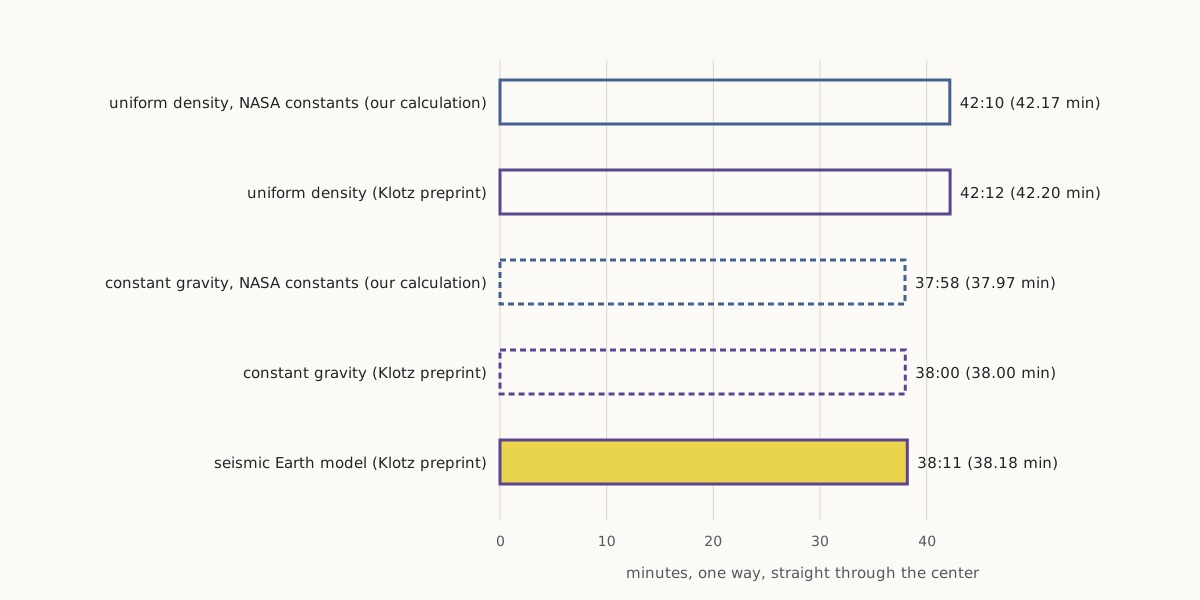
Wide figure: scroll it sideways, or open it full size.
Five answers for the trip through the center, each labeled with its model and its source.
Diagram: Puzzles, Charts & Dilemmas, CC BY 4.0
Copy the full credit line
"Five answers for the trip through the center" by Puzzles, Charts & Dilemmas, https://puzzleschartsanddilemmas.com/thought-experiments/gravity-train/, licensed under CC BY 4.0 (https://creativecommons.org/licenses/by/4.0/).
Data: NASA Earth Fact Sheet; Klotz 2013 preprint, arXiv:1308.1342
The preprint also tests a cruder assumption: that gravity keeps its surface strength, pointing at the center, all the way down. Through the center that gives 2√(2R/g), and Klotz finds it tracks the seismic result better than the uniform model does, 38 minutes 0 seconds against 38 minutes 11 seconds. With NASA's constants, we get 37.97 minutes for that trip.
Klotz offers a reason why the cruder model does so well. Inside the real Earth, gravity stays close to its surface value until the car is more than halfway to the center, and by the time it reaches the weaker pull of the core it is moving so fast that it spends little time there.
He also fits the mass enclosed within each radius to a power law and reports an exponent of 1.97 ± 0.02, very close to the exponent of 2 that would make gravity exactly constant.
The same constant-gravity model shows why tunnel length matters again. We integrated it for the same eleven tunnels: the time falls from 42.17 minutes for a 100 km tunnel to 41.75 at 5,000 km, 39.66 at 11,000 km and 37.97 through the center. Klotz's abstract describes the seismic case the same way, with times that move between “42 minutes for short trips and 38 minutes for long trips.”
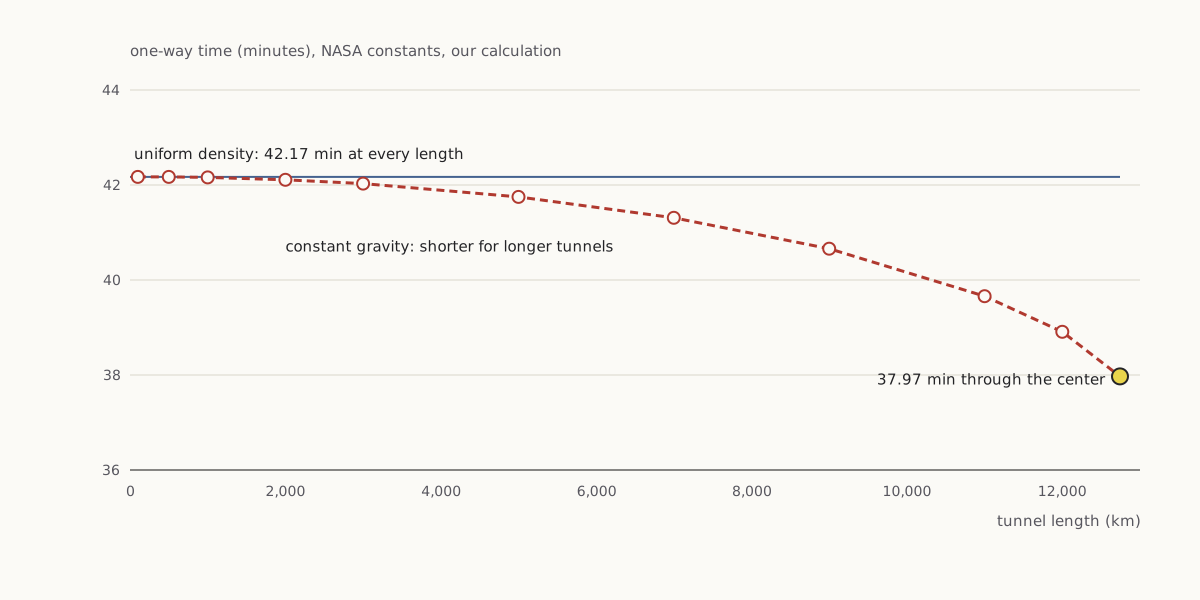
Wide figure: scroll it sideways, or open it full size.
In the constant-gravity approximation, longer tunnels are faster; a short tunnel stays close to the uniform answer.
Diagram: Puzzles, Charts & Dilemmas, CC BY 4.0
Copy the full credit line
"Constant gravity: longer tunnels are faster" by Puzzles, Charts & Dilemmas, https://puzzleschartsanddilemmas.com/thought-experiments/gravity-train/, licensed under CC BY 4.0 (https://creativecommons.org/licenses/by/4.0/).
Data: NASA Earth Fact Sheet (radius and surface gravity)
Is a straight tunnel the fastest route?
Not according to the same preprint. A curved tunnel that dips deeper than the straight one reaches the far end sooner; that path is the brachistochrone, a name Klotz glosses from the Greek for “shortest time.”
For a uniform Earth the curve is a hypocycloid, the shape traced by a point on a small circle rolling inside a larger one, and with the seismic model the fastest path runs deeper still. On these curved routes the travel time grows from near zero for nearby points to the full 42 or 38 minutes for opposite sides of the planet, so the straight tunnel is simply the version with the tidiest arithmetic.
As for building one, Klotz calls an excavated tunnel unlikely “in the near future” and treats the idea mostly as a teaching problem. He adds that it “may be difficult to excavate a tunnel through the liquid outer core,” and he puts smaller corrections at about ten seconds for Earth's flattening and about four seconds for its rotation.
Obvious / Checked
| Obvious | Checked |
|---|---|
| A longer tunnel takes longer. | In a uniform Earth, every straight tunnel takes 42.17 minutes one way (our calculation with NASA's R and g, checked for eleven lengths). In Klotz's 2013 preprint, with density from seismic data, longer tunnels are faster: about 42 minutes for short trips, about 38 for the trip through the center. |
| You would stop at the center. | With no friction or air, the car passes the center at its top speed and coasts up to the far mouth, then falls back; a round trip takes 84.35 minutes in the uniform model (our calculation). |
| You would keep speeding up the whole way. | Speed peaks at the tunnel's midpoint and falls to zero at the far mouth. Through the center of a uniform Earth the peak is 7.910 km/s (our calculation); the preprint gives “near 8 km/s.” |
| A straight tunnel is the fastest way through. | Klotz's 2013 preprint finds that a curved path dipping deeper, the brachistochrone, is faster, and between nearby points far faster than 42 minutes. |
| The answer is 42 minutes. | 42 minutes is the uniform-Earth answer. For the trip through the center, Klotz's preprint finds 38 minutes 11 seconds with a seismic Earth model. |
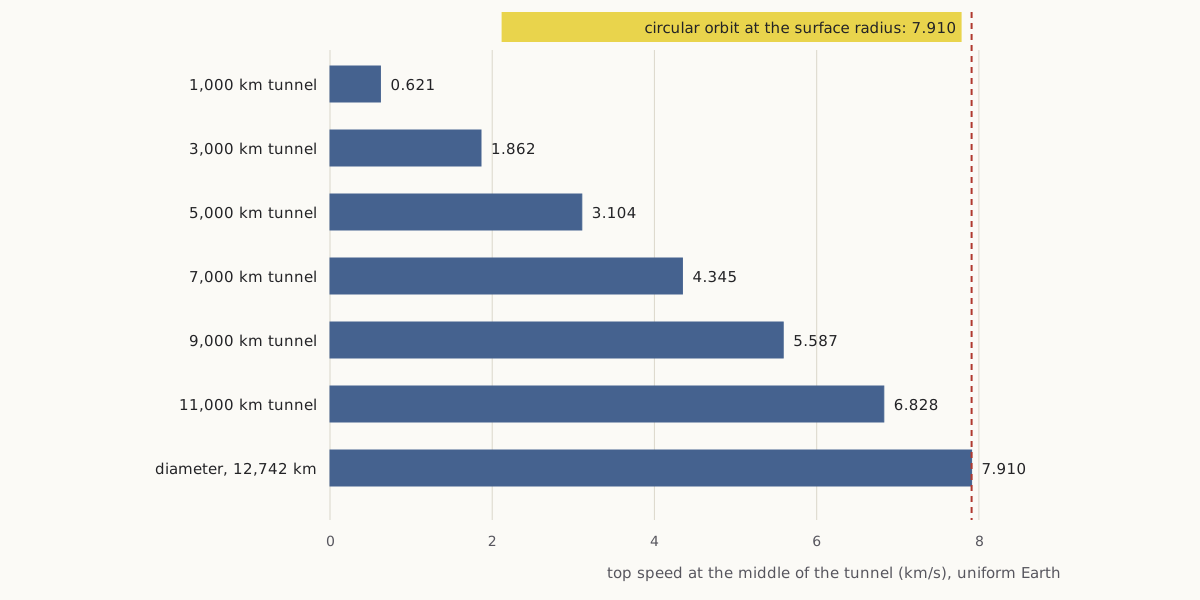
Wide figure: scroll it sideways, or open it full size.
Top speed grows with tunnel length; through the center it matches a circular orbit skimming the surface.
Diagram: Puzzles, Charts & Dilemmas, CC BY 4.0
Copy the full credit line
"Top speed by tunnel length, uniform Earth" by Puzzles, Charts & Dilemmas, https://puzzleschartsanddilemmas.com/thought-experiments/gravity-train/, licensed under CC BY 4.0 (https://creativecommons.org/licenses/by/4.0/).
Data: NASA Earth Fact Sheet (radius and surface gravity)
The match comes from the same two constants. A circular orbit at Earth's surface radius, with no air, moves at √(gR), which is the uniform model's top speed through the center, and it takes 84.35 minutes, exactly one round trip through the tunnel. Klotz notes the same agreement for both the period and the peak speed.
Push back:
The strongest objection is that both numbers rest on conditions no tunnel could meet: a vacuum, no friction, and walls that survive the heat and pressure near the core. On that view, 42.17 minutes and the preprint's 38 minutes 11 seconds look precise only because two models produce them, and the precision belongs to the models, not to the planet. What this thought experiment offers is the shape of the answer, every tunnel tying in one model and long tunnels winning in another; the decimals add nothing.
- Galileo's falling bodies: Another fall worked out on paper, with tied stones instead of a tunnel.
- Tower of Hanoi: Another number you can get from arithmetic alone: how long the legend's 64 disks would take.
Sources
- Lewis Carroll, Sylvie and Bruno Concluded, illustrated by Harry Furniss (New York: Macmillan, 1894; preface dated Christmas 1893), chapter 7. https://www.gutenberg.org/ebooks/48795 Read: full text of chapter 7 and the preface date.
- Alexander R. Klotz, “The Gravity Tunnel in a Non-Uniform Earth,” arXiv:1308.1342v1 [physics.class-ph] (preprint, 6 August 2013), abstract, introduction, sections A–C, discussion. Journal version listed on the arXiv record: American Journal of Physics 83, 231 (2015), not read. https://arxiv.org/abs/1308.1342 Read: preprint, abstract and full text; journal version not read.
- David R. Williams, “Earth Fact Sheet,” NASA Space Science Data Coordinated Archive (last updated 15 November 2024): volumetric mean radius, equatorial and polar radius, surface gravity and accelerations, standard acceleration of gravity. https://nssdc.gsfc.nasa.gov/planetary/factsheet/earthfact.html Read: full page.
- Benjamin Crowell, Mechanics (Fullerton, CA: Light and Matter, rev. 5 November 2019), section 10.4 (the shell theorem), and section 16.2 (simple harmonic motion). Licensed CC BY-SA 3.0. https://lightandmatter.com/mechanics/ Read: sections 10.4 and 16.2. Text license: CC BY-SA 3.0.
Downloads: Models compared (CSV) (file notes: source, version and license (JSON)) Data: NASA Earth Fact Sheet; Klotz 2013 preprint, arXiv:1308.1342 · Fall through the center, every 30 seconds (CSV) (file notes: source, version and license (JSON)) Data: NASA Earth Fact Sheet (radius and surface gravity) · Eleven straight tunnels (CSV) (file notes: source, version and license (JSON)) Data: NASA Earth Fact Sheet (radius and surface gravity) · Which radius and gravity (CSV) (file notes: source, version and license (JSON)) Data: NASA Earth Fact Sheet
Cite this page
Puzzles, Charts & Dilemmas. “Gravity Train: Uniform Earth, Straight Tunnel, About 42 Min.” Puzzles, Charts & Dilemmas. Published 2026-10-31. https://puzzleschartsanddilemmas.com/thought-experiments/gravity-train/. Accessed: add the date you read it.
Dates are given as year-month-day. 31 October 2026 is the latest substantive revision.

Ship of Theseus: Plutarch's Version Had Only One Ship
Picture credit
Illustration: Puzzles, Charts & Dilemmas. Generated schematic illustration — not a photograph or historical record. Reuse: CC BY 4.0 (https://creativecommons.org/licenses/by/4.0/), to the extent Puzzles, Charts & Dilemmas holds rights in it.

Galileo's Falling Bodies: The Argument That Needed No Tower
Picture credit
Illustration: Puzzles, Charts & Dilemmas. Generated schematic illustration — not a photograph or historical record. Reuse: CC BY 4.0 (https://creativecommons.org/licenses/by/4.0/), to the extent Puzzles, Charts & Dilemmas holds rights in it.