Knights and Knaves: 108 of 256 Puzzles Have a Single Answer
Published · Puzzles, Charts & Dilemmas
Folded answers print open where the browser allows it; if one prints closed, open it at https://puzzleschartsanddilemmas.com/puzzles/knights-and-knaves/ first.
Where it lands
A knights-and-knaves puzzle asks which islanders are knights, who always tell the truth, and which are knaves, who always lie; under the rules on this page, the answer depends only on what each one says about who is a knight. We checked every two-speaker puzzle, where each of two islanders makes one such statement: 108 of the 256 have exactly one answer, and the featured puzzle's checked answer is in the fold below it.
Sections on this sheet (6)
Knights-and-knaves puzzles are associated with What Is the Name of This Book?, a 1978 puzzle book by Raymond Smullyan. We have read only that book's catalog record, so nothing on this page is quoted from it, and every puzzle below is one we wrote ourselves.
A puzzle of this kind has a checkable answer only after two quiet rules are written down: nobody on the island is some third kind of person, and every statement concerns only which islanders are knights. The standard form below writes the first rule as P1, and its one statement keeps to the second, so try the featured puzzle there before you open the answer.
In standard form:
- Premise 1:Every islander is a knight or a knave, never both, and there is no third kind.
- Premise 2:A knight's statements are true; a knave's statements are false.
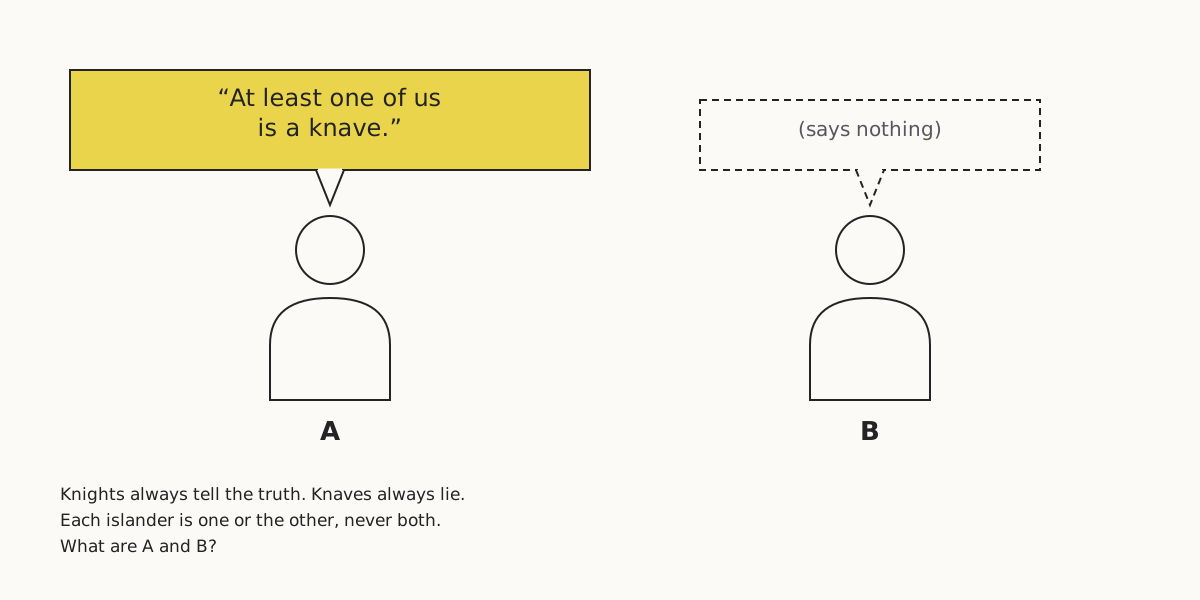
- Premise 3:A says: “At least one of us is a knave.”
- Premise 4:B says nothing.
- Question:What are A and B?
Wide figure: scroll it sideways, or open it full size.
The featured puzzle: A speaks, and B stays silent.
Diagram: Puzzles, Charts & Dilemmas, CC BY 4.0
Copy the full credit line
"The featured knights-and-knaves puzzle" by Puzzles, Charts & Dilemmas, https://puzzleschartsanddilemmas.com/puzzles/knights-and-knaves/, licensed under CC BY 4.0 (https://creativecommons.org/licenses/by/4.0/).
The puzzle
You meet two islanders, A and B, and you know nothing about them except that each is a knight or a knave. A makes a single statement about the pair, and B stays silent. Everything you learn has to come from A's words.
| Islander | What they say | What that tells you |
|---|---|---|
| A | “At least one of us is a knave.” | The statement is true if A is a knight and false if A is a knave |
| B | Nothing | No condition on B from B's own words |
Decide what A and B are before you open the solution, and notice which step of your reasoning feels most certain.
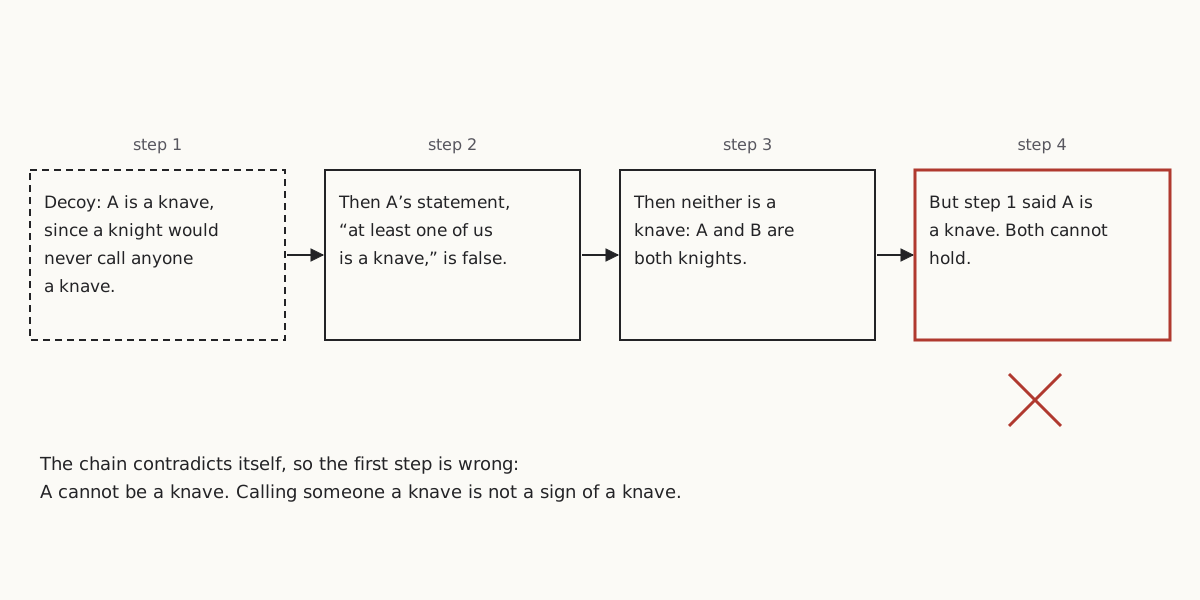
A is a knave, because a knight would never call anyone a knave. The answer is tempting because an accusation sounds like something a liar would say, so the accusation itself seems to count as evidence against the speaker.
Show the checked solution (1 of 3)
Checked solution
∴ A is a knight and B is a knave, and no other assignment fits.
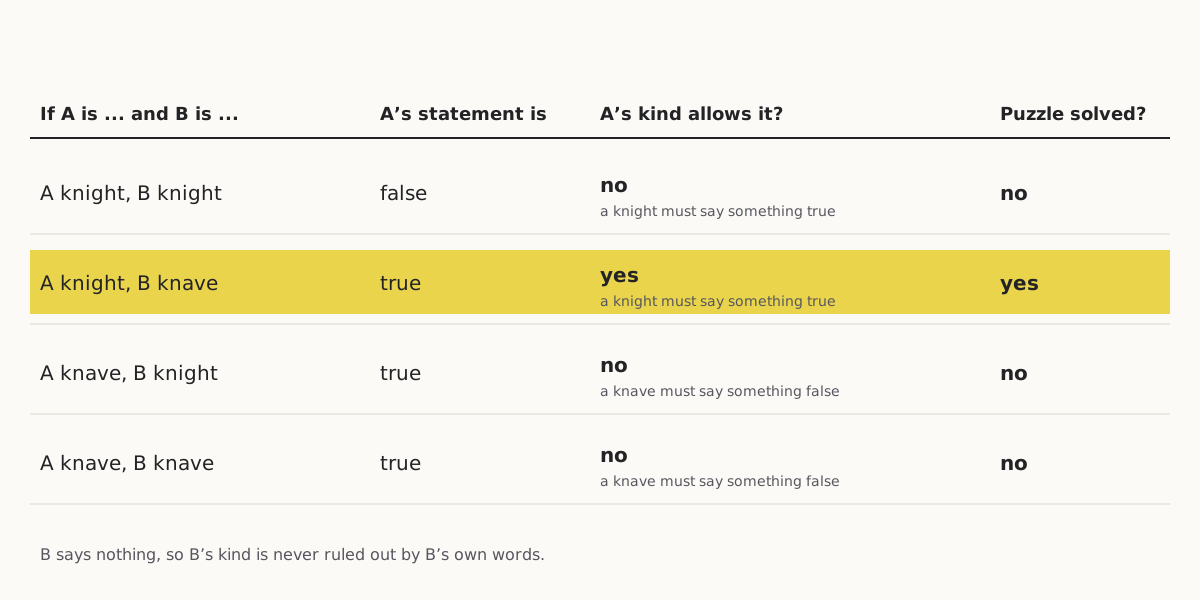
We checked all four possible assignments of the two kinds, and a second check, written separately, reads the statement from its English wording and finds the same single answer. By hand, the reasoning takes three steps:
- Suppose A is a knave. Then A's statement is false, which means neither islander is a knave, so A would be a knight, contradicting the supposition.
- Therefore A is a knight, and A's statement is true: at least one of the two islanders is a knave.
- A is not that knave, so the knave must be B.
Wide figure: scroll it sideways, or open it full size.
The four ways to assign the two kinds, checked against A's statement.
Diagram: Puzzles, Charts & Dilemmas, CC BY 4.0
Copy the full credit line
"The featured puzzle checked under all four assignments" by Puzzles, Charts & Dilemmas, https://puzzleschartsanddilemmas.com/puzzles/knights-and-knaves/, licensed under CC BY 4.0 (https://creativecommons.org/licenses/by/4.0/).
| If A is … and B is … | A's statement is | A's kind allows it? | Puzzle solved? |
|---|---|---|---|
| A knight, B knight | false | no: a knight must say something true | no |
| A knight, B knave | true | yes | yes |
| A knave, B knight | true | no: a knave must say something false | no |
| A knave, B knave | true | no: a knave must say something false | no |
The decoy fails at its very first step. If A were a knave, the statement would have to be false, and a false “at least one of us is a knave” means that both islanders are knights, so the chain ends by contradicting its own starting point.
Wide figure: scroll it sideways, or open it full size.
The decoy's reasoning, followed until it contradicts itself.
Diagram: Puzzles, Charts & Dilemmas, CC BY 4.0
Copy the full credit line
"Where the decoy answer breaks" by Puzzles, Charts & Dilemmas, https://puzzleschartsanddilemmas.com/puzzles/knights-and-knaves/, licensed under CC BY 4.0 (https://creativecommons.org/licenses/by/4.0/).
An accusation is therefore not a sign of a knave. A knight may call someone a knave whenever the accusation is true. In this puzzle it is.
The 16 things an islander can say
Before counting puzzles, we need a complete list of the statements an islander can make. On this page, a statement concerns only which of A and B are knights, and two wordings that are true in exactly the same situations count as one statement. For example, “B is a knight” and “B is not a knave” are the same statement, because each is true precisely when B is a knight.
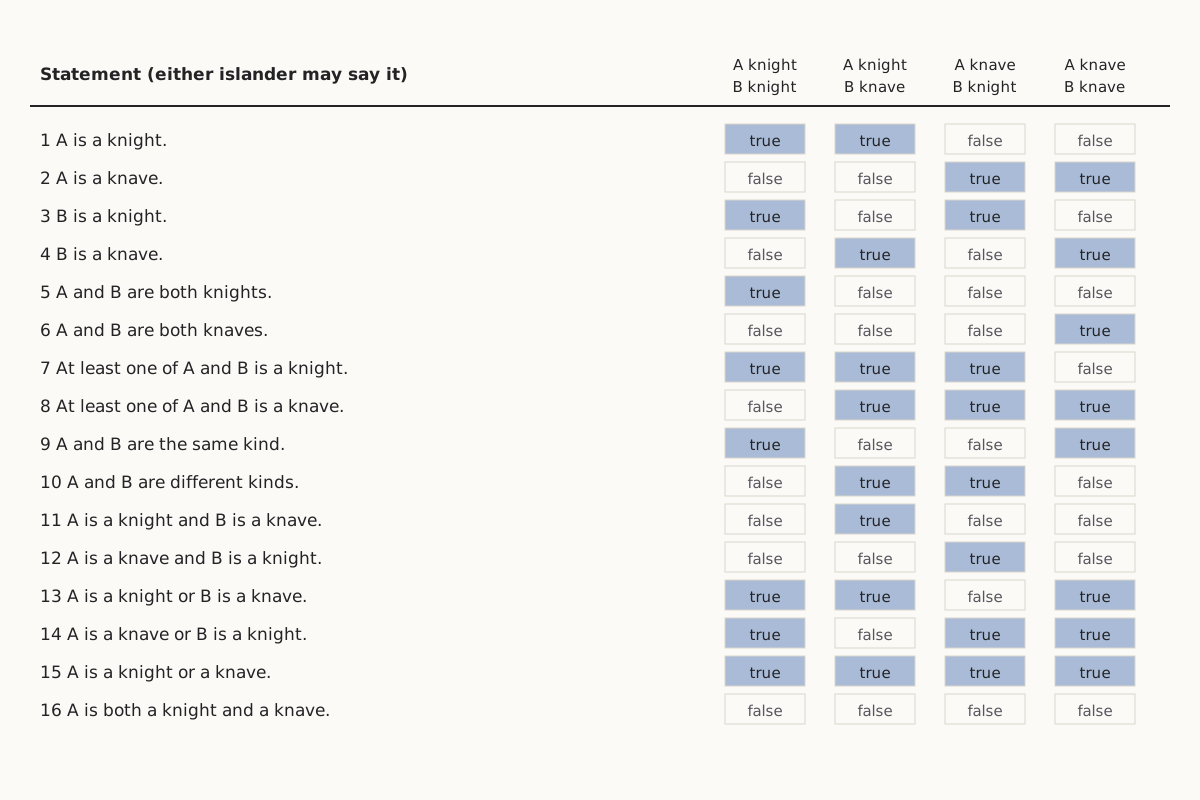
There are four possible assignments: both knights, A a knight and B a knave, A a knave and B a knight, or both knaves. A statement is fixed by which of those four assignments make it true, and each assignment can go either way independently, so there are 2 × 2 × 2 × 2 = 16 different statements.
The list uses names, even when an islander talks about itself, so A saying “A is a knave” is the island version of a speaker calling itself a knave. The list also includes one statement that is true under every assignment and one that is false under every assignment. Whoever says statement 15 must be a knight, and whoever says statement 16 must be a knave.
Wide figure: scroll it sideways, or open it full size.
The 16 statements, and the assignments under which each one is true.
Diagram: Puzzles, Charts & Dilemmas, CC BY 4.0
Copy the full credit line
"The 16 statements an islander can make" by Puzzles, Charts & Dilemmas, https://puzzleschartsanddilemmas.com/puzzles/knights-and-knaves/, licensed under CC BY 4.0 (https://creativecommons.org/licenses/by/4.0/).
| Statement | A knight, B knight | A knight, B knave | A knave, B knight | A knave, B knave |
|---|---|---|---|---|
| 1. A is a knight. | true | true | false | false |
| 2. A is a knave. | false | false | true | true |
| 3. B is a knight. | true | false | true | false |
| 4. B is a knave. | false | true | false | true |
| 5. A and B are both knights. | true | false | false | false |
| 6. A and B are both knaves. | false | false | false | true |
| 7. At least one of A and B is a knight. | true | true | true | false |
| 8. At least one of A and B is a knave. | false | true | true | true |
| 9. A and B are the same kind. | true | false | false | true |
| 10. A and B are different kinds. | false | true | true | false |
| 11. A is a knight and B is a knave. | false | true | false | false |
| 12. A is a knave and B is a knight. | false | false | true | false |
| 13. A is a knight or B is a knave. | true | true | false | true |
| 14. A is a knave or B is a knight. | true | false | true | true |
| 15. A is a knight or a knave. | true | true | true | true |
| 16. A is both a knight and a knave. | false | false | false | false |
Every two-speaker puzzle, counted
A two-speaker puzzle gives A one of the 16 statements and B one of the 16, which makes 16 × 16 = 256 different puzzles. Like the Tower of Hanoi with a few disks, the island is small enough that every possibility can be examined, and the method is simple enough to follow by hand:
- Write down the four assignments of knight and knave to A and B.
- For each assignment, decide whether A's statement is true, and cross the assignment out if a knight would be lying or a knave would be telling the truth.
- Do the same with B's statement on the assignments that are left.
- Whatever survives is the answer; if nothing survives, the puzzle has no answer.
We ran these four steps on all 256 puzzles, which comes to 1,024 checks, and a separately written second check agrees on every row of the CSV.
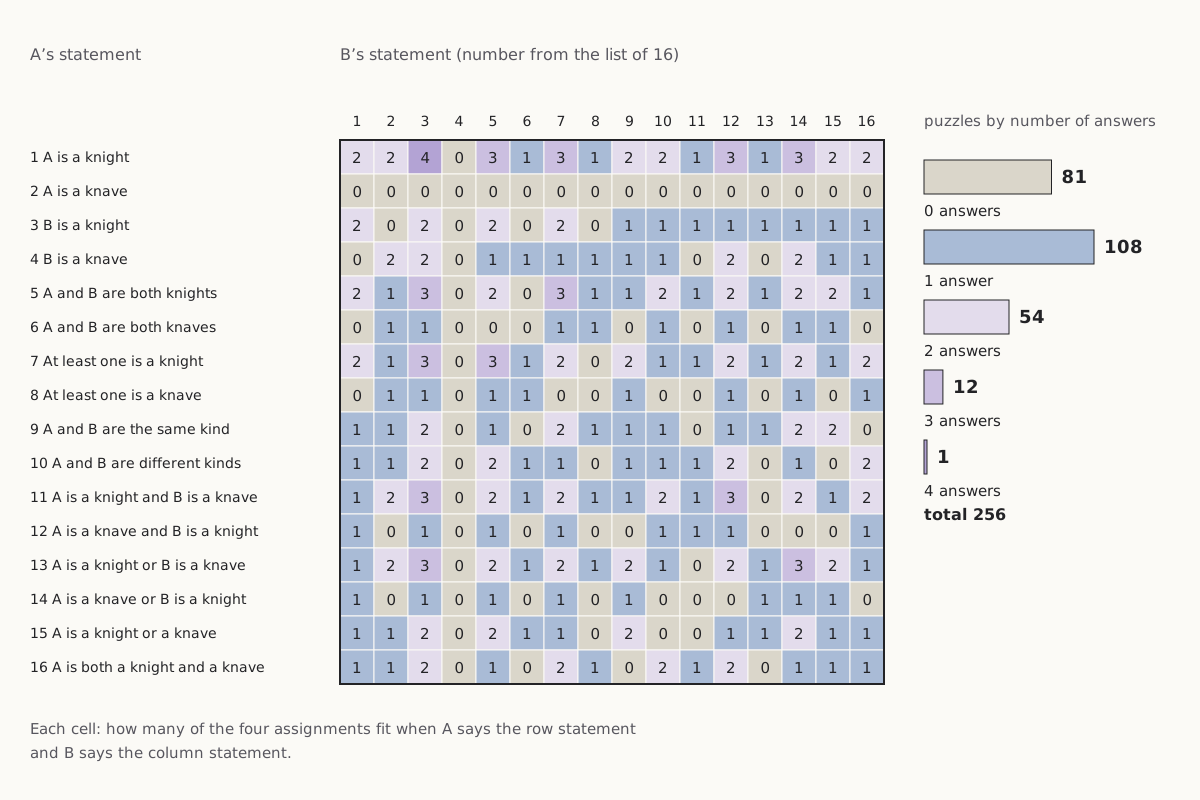
Wide figure: scroll it sideways, or open it full size.
Answers for all 256 two-speaker puzzles, with the totals at the right.
Diagram: Puzzles, Charts & Dilemmas, CC BY 4.0
Copy the full credit line
"Answers for all 256 two-speaker puzzles" by Puzzles, Charts & Dilemmas, https://puzzleschartsanddilemmas.com/puzzles/knights-and-knaves/, licensed under CC BY 4.0 (https://creativecommons.org/licenses/by/4.0/).
| Answers | Two-speaker puzzles | Share of 256 |
|---|---|---|
| 0 | 81 | 31.6% |
| 1 | 108 | 42.2% |
| 2 | 54 | 21.1% |
| 3 | 12 | 4.7% |
| 4 | 1 | 0.4% |
So 108 of the 256 puzzles have exactly one answer, which makes them puzzles in the usual sense, while the other 148 have either no answer or more than one.
The totals follow a simple pattern. Take any single assignment, such as A a knight and B a knave. A's statement must be true under it, and 8 of the 16 statements are; B's statement must be false under it, and 8 of the 16 are. So 8 × 8 = 64 of the 256 puzzles, or 1 in 4, fit that assignment, and the same holds for each of the other three.
Whether a statement is true under one assignment says nothing about the other three, and the 256 puzzles cover every combination exactly once. The four assignments therefore pass or fail independently, each in 1 of every 4 puzzles. No assignment passes in 3 × 3 × 3 × 3 = 81 puzzles, and exactly one passes in 4 × 27 = 108: four choices for the assignment that passes, times 27 ways for the other three to fail.
The same count for a single speaker, with B silent, covers only 16 puzzles: 1 with no answer, 4 with one, 6 with two, 4 with three and 1 with four. The featured puzzle is one of those 4 single-speaker puzzles with exactly one answer.
The full grid, with A's statement in each row and B's statement in each column, numbered as in the list above:
| A says ↓ · B says → | 1 | 2 | 3 | 4 | 5 | 6 | 7 | 8 | 9 | 10 | 11 | 12 | 13 | 14 | 15 | 16 |
|---|---|---|---|---|---|---|---|---|---|---|---|---|---|---|---|---|
| 1. A is a knight. | 2 | 2 | 4 | 0 | 3 | 1 | 3 | 1 | 2 | 2 | 1 | 3 | 1 | 3 | 2 | 2 |
| 2. A is a knave. | 0 | 0 | 0 | 0 | 0 | 0 | 0 | 0 | 0 | 0 | 0 | 0 | 0 | 0 | 0 | 0 |
| 3. B is a knight. | 2 | 0 | 2 | 0 | 2 | 0 | 2 | 0 | 1 | 1 | 1 | 1 | 1 | 1 | 1 | 1 |
| 4. B is a knave. | 0 | 2 | 2 | 0 | 1 | 1 | 1 | 1 | 1 | 1 | 0 | 2 | 0 | 2 | 1 | 1 |
| 5. A and B are both knights. | 2 | 1 | 3 | 0 | 2 | 0 | 3 | 1 | 1 | 2 | 1 | 2 | 1 | 2 | 2 | 1 |
| 6. A and B are both knaves. | 0 | 1 | 1 | 0 | 0 | 0 | 1 | 1 | 0 | 1 | 0 | 1 | 0 | 1 | 1 | 0 |
| 7. At least one of A and B is a knight. | 2 | 1 | 3 | 0 | 3 | 1 | 2 | 0 | 2 | 1 | 1 | 2 | 1 | 2 | 1 | 2 |
| 8. At least one of A and B is a knave. | 0 | 1 | 1 | 0 | 1 | 1 | 0 | 0 | 1 | 0 | 0 | 1 | 0 | 1 | 0 | 1 |
| 9. A and B are the same kind. | 1 | 1 | 2 | 0 | 1 | 0 | 2 | 1 | 1 | 1 | 0 | 1 | 1 | 2 | 2 | 0 |
| 10. A and B are different kinds. | 1 | 1 | 2 | 0 | 2 | 1 | 1 | 0 | 1 | 1 | 1 | 2 | 0 | 1 | 0 | 2 |
| 11. A is a knight and B is a knave. | 1 | 2 | 3 | 0 | 2 | 1 | 2 | 1 | 1 | 2 | 1 | 3 | 0 | 2 | 1 | 2 |
| 12. A is a knave and B is a knight. | 1 | 0 | 1 | 0 | 1 | 0 | 1 | 0 | 0 | 1 | 1 | 1 | 0 | 0 | 0 | 1 |
| 13. A is a knight or B is a knave. | 1 | 2 | 3 | 0 | 2 | 1 | 2 | 1 | 2 | 1 | 0 | 2 | 1 | 3 | 2 | 1 |
| 14. A is a knave or B is a knight. | 1 | 0 | 1 | 0 | 1 | 0 | 1 | 0 | 1 | 0 | 0 | 0 | 1 | 1 | 1 | 0 |
| 15. A is a knight or a knave. | 1 | 1 | 2 | 0 | 2 | 1 | 1 | 0 | 2 | 0 | 0 | 1 | 1 | 2 | 1 | 1 |
| 16. A is both a knight and a knave. | 1 | 1 | 2 | 0 | 1 | 0 | 2 | 1 | 0 | 2 | 1 | 2 | 0 | 1 | 1 | 1 |
The figure 108 of 256 is one summary of this grid. That summary hides where the zeros sit. As Anscombe's quartet shows with scatter plots, a single summary number can stand for tables that look nothing alike.
Puzzles with no possible answer
Row 2 and column 4 of the grid are all zeros. In each of those 31 puzzles, an islander says of itself that it is a knave, which nobody on this island can do. A knight cannot say it, because the statement would be false. A knave cannot say it either, because the statement would then be true.
The remaining 50 puzzles without an answer are less obvious, because each statement could be said on its own. Only the pair is impossible. In the example below, the two islanders point at each other, and the knot never closes: pull on either end and the whole thing comes loose.
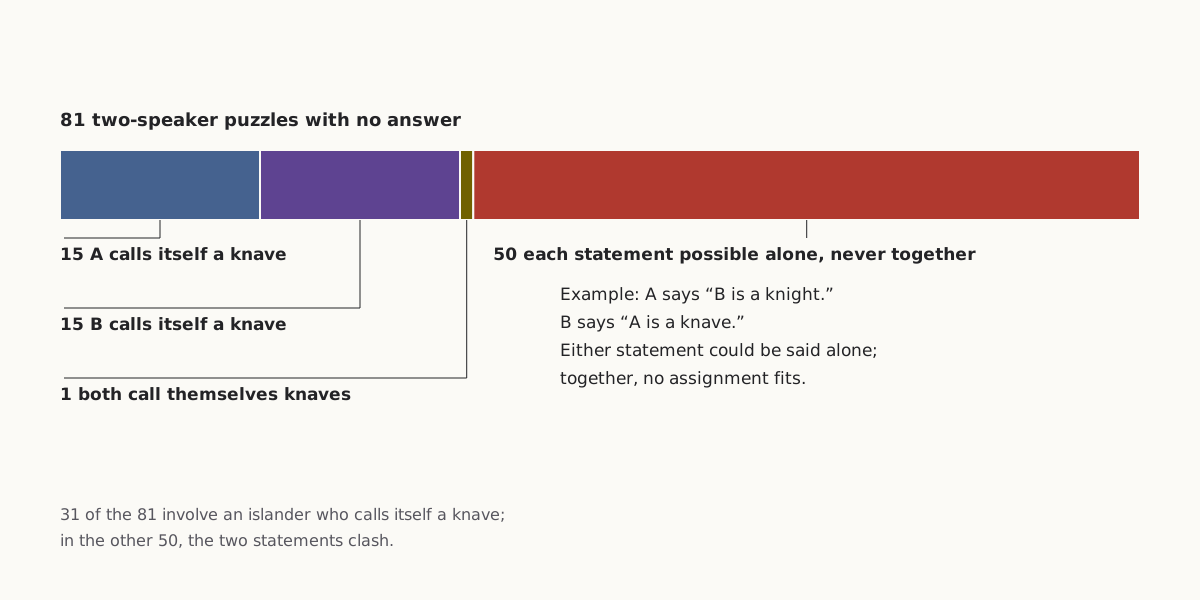
Wide figure: scroll it sideways, or open it full size.
Why 81 of the 256 two-speaker puzzles have no answer.
Diagram: Puzzles, Charts & Dilemmas, CC BY 4.0
Copy the full credit line
"The 81 two-speaker puzzles with no answer, by reason" by Puzzles, Charts & Dilemmas, https://puzzleschartsanddilemmas.com/puzzles/knights-and-knaves/, licensed under CC BY 4.0 (https://creativecommons.org/licenses/by/4.0/).
Here is one of those 50: A says “B is a knight,” and B says “A is a knave.”
Try it first: Which of the four assignments fits both statements?
Show the checked solution (2 of 3)
Checked solution
∴ None of the four assignments fits, so the puzzle has no answer.
If A is a knight, A's statement is true, so B is a knight too; then B's statement is true as well, which makes A a knave and contradicts the start. If A is a knave, A's statement is false, so B is a knave; then B's statement is false, which makes A a knight and contradicts the start again.
| A and B | A's statement is | Fits A's kind? | B's statement is | Fits B's kind? | Puzzle solved? |
|---|---|---|---|---|---|
| A knight, B knight | true | yes | false | no | no |
| A knight, B knave | false | no | false | yes | no |
| A knave, B knight | true | no | true | yes | no |
| A knave, B knave | false | yes | true | no | no |
Puzzles with two answers
In 54 puzzles, exactly two assignments fit. Nothing the islanders say can separate them. In the example below, each islander accuses the other of being a knave.
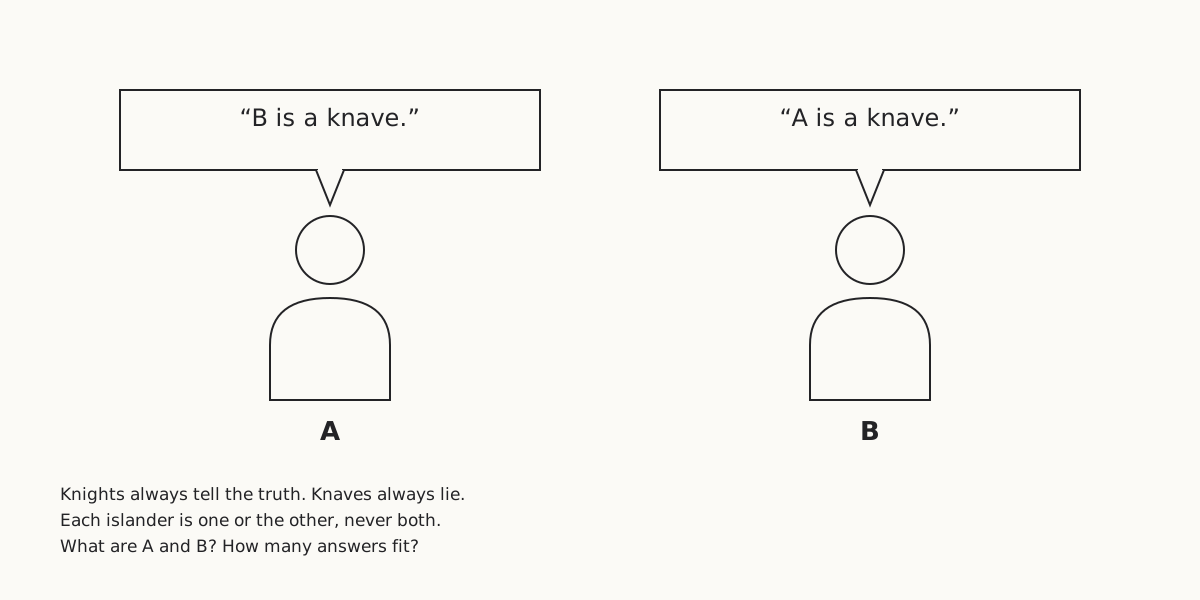
Wide figure: scroll it sideways, or open it full size.
A two-speaker puzzle in which each islander accuses the other.
Diagram: Puzzles, Charts & Dilemmas, CC BY 4.0
Copy the full credit line
"A two-speaker puzzle with two answers" by Puzzles, Charts & Dilemmas, https://puzzleschartsanddilemmas.com/puzzles/knights-and-knaves/, licensed under CC BY 4.0 (https://creativecommons.org/licenses/by/4.0/).
Try it first: How many assignments fit, and which ones?
Show the checked solution (3 of 3)
Checked solution
∴ Two assignments fit: A a knight and B a knave, or A a knave and B a knight.
If both were knights, each would be telling a lie, and if both were knaves, each would be telling the truth. If exactly one of them is a knight, the knight's accusation is true and the knave's is false, which is precisely what each kind must do. The puzzle therefore shows that exactly one of the two is a knight, but not which one.
| A and B | A's statement is | Fits A's kind? | B's statement is | Fits B's kind? | Puzzle solved? |
|---|---|---|---|---|---|
| A knight, B knight | false | no | false | no | no |
| A knight, B knave | true | yes | false | yes | yes |
| A knave, B knight | false | yes | true | yes | yes |
| A knave, B knave | true | no | true | no | no |
Twelve puzzles have three answers. Just one puzzle has four: A says “A is a knight” and B says “B is a knight.” Every assignment fits that pair, because a knight who says so is telling the truth and a knave who says so is lying, so the two statements reveal nothing at all.
Where the island comes from
The catalog record we read lists Raymond Smullyan's What Is the Name of This Book?, subtitled The Riddle of Dracula and Other Logical Puzzles, as published by Prentice-Hall in Englewood Cliffs, New Jersey, in 1978. That record does not list the puzzles inside the book, and we have not read any source that dates the first puzzle about truth-tellers and liars, so this page names no first one.
Two islanders, one speaking and one silent, on a small island.
Illustration: Puzzles, Charts & Dilemmas. Generated schematic illustration — not a photograph or historical record. Reuse: CC BY 4.0 (https://creativecommons.org/licenses/by/4.0/), to the extent Puzzles, Charts & Dilemmas holds rights in it.
The counts on this page describe a single definition: two kinds of islander, two speakers, and one statement each, always about which islanders are knights. Puzzles with more islanders, more statements or other kinds of statements fall outside that definition. Their numbers would be different. The CSV lists all 256 puzzles with every assignment checked, so a reader who prefers another definition can recount from it.
Push back:
The strongest objection is that 256 is an artifact of how we counted. Grouping statements by truth table merges wordings a reader would treat as different puzzles, and it keeps empty ones such as “A is a knight or a knave.” On that view, the real space of puzzles depends on the islanders' language, and 108 of 256 measures our bookkeeping, not the puzzles. That is fair: the count claims nothing beyond the set defined here, and the CSV lets a reader change the definition and recount.
- River crossing puzzle: Another puzzle whose rules, once written out, can be searched to the end.
- Unexpected hanging paradox: An announcement that seems to rule itself out, and a surprise that still arrives.
Sources
- Raymond M. Smullyan, What Is the Name of This Book? The Riddle of Dracula and Other Logical Puzzles (Englewood Cliffs, N.J.: Prentice-Hall, 1978). https://archive.org/details/whatisnameofthis00smul Read: bibliographic record only.
Downloads: All 256 two-speaker puzzles (CSV) (file notes: source, version and license (JSON)) · The featured puzzle, the 16 statements and the counts (JSON) (file notes: source, version and license (JSON))
Cite this page
Puzzles, Charts & Dilemmas. “Knights and Knaves: 108 of 256 Puzzles Have a Single Answer.” Puzzles, Charts & Dilemmas. Published 2026-10-31. https://puzzleschartsanddilemmas.com/puzzles/knights-and-knaves/. Accessed: add the date you read it.
Dates are given as year-month-day. 31 October 2026 is the latest substantive revision.
River Crossing Puzzle: Under Its Rules, Two Shortest Routes
Picture credit
Illustration: Puzzles, Charts & Dilemmas. Generated schematic illustration — not a photograph or historical record. Reuse: CC BY 4.0 (https://creativecommons.org/licenses/by/4.0/), to the extent Puzzles, Charts & Dilemmas holds rights in it.
Newcomb's Problem: Rules Split if the Predictor Tops 50.05%
Picture credit
Illustration: Puzzles, Charts & Dilemmas. Generated schematic illustration — not a photograph or historical record. Reuse: CC BY 4.0 (https://creativecommons.org/licenses/by/4.0/), to the extent Puzzles, Charts & Dilemmas holds rights in it.
Tower of Hanoi: 8 Disks Need 255 Moves on Three Pegs
Picture credit
Illustration: Puzzles, Charts & Dilemmas. Generated schematic illustration — not a photograph or historical record. Reuse: CC BY 4.0 (https://creativecommons.org/licenses/by/4.0/), to the extent Puzzles, Charts & Dilemmas holds rights in it.