Prisoner's Dilemma: In One Round, Betrayal Pays Each Player
Published · Puzzles, Charts & Dilemmas
Folded answers print open where the browser allows it; if one prints closed, open it at https://puzzleschartsanddilemmas.com/dilemmas/prisoners-dilemma/ first.
Where it lands
For each player in a single round of the prisoner's dilemma, betraying pays more whatever the other does, yet two betrayals leave both players worse off than two silences. That arithmetic holds one round at a time; when the game repeats and nobody knows which round is last, the plan that does best can change.
Sections on this sheet (6)
In early 1950, as the Stanford Encyclopedia of Philosophy recounts, two RAND researchers had colleagues play one game 100 times. Merrill Flood and Melvin Dresher wanted to know whether players would settle on what is now called a Nash equilibrium, an outcome in which neither player gains by switching alone. The verdict the SEP entry spells out for the one-round game is short: two rational players betray, and each ends up with less than two silent players would get.
That verdict is right about one layer and says nothing about the next. It is arithmetic about a single round with fixed payoffs. Change something outside the payoff table, such as whether another round may follow, and the players are in a different game; even then, a known run of 100 rounds still unravels to betrayal. Here are both sides of the argument in standard form.
In standard form:
- Premise 1:Betray side: if the other player stays silent, betraying pays you more (5 points against 3).
- Premise 2:Betray side: if the other player betrays, betraying still pays you more (1 point against 0).
- Premise 3:Silence side: two silences pay each player more than two betrayals (3 points each against 1).
- Premise 4:Silence side: both players face the same table and can reason the same way.
- Therefore, conclusion:In one round, betraying is each player's best reply whatever the other does. P3 and P4 are true, but they do not make the other player copy your choice, so two betrayals is the only stable outcome even though two silences would pay both players more.

Two players who cannot see each other, each facing the same two doors.
Illustration: Puzzles, Charts & Dilemmas. Generated schematic illustration — not a photograph or historical record. Reuse: CC BY 4.0 (https://creativecommons.org/licenses/by/4.0/), to the extent Puzzles, Charts & Dilemmas holds rights in it.
The payoff table
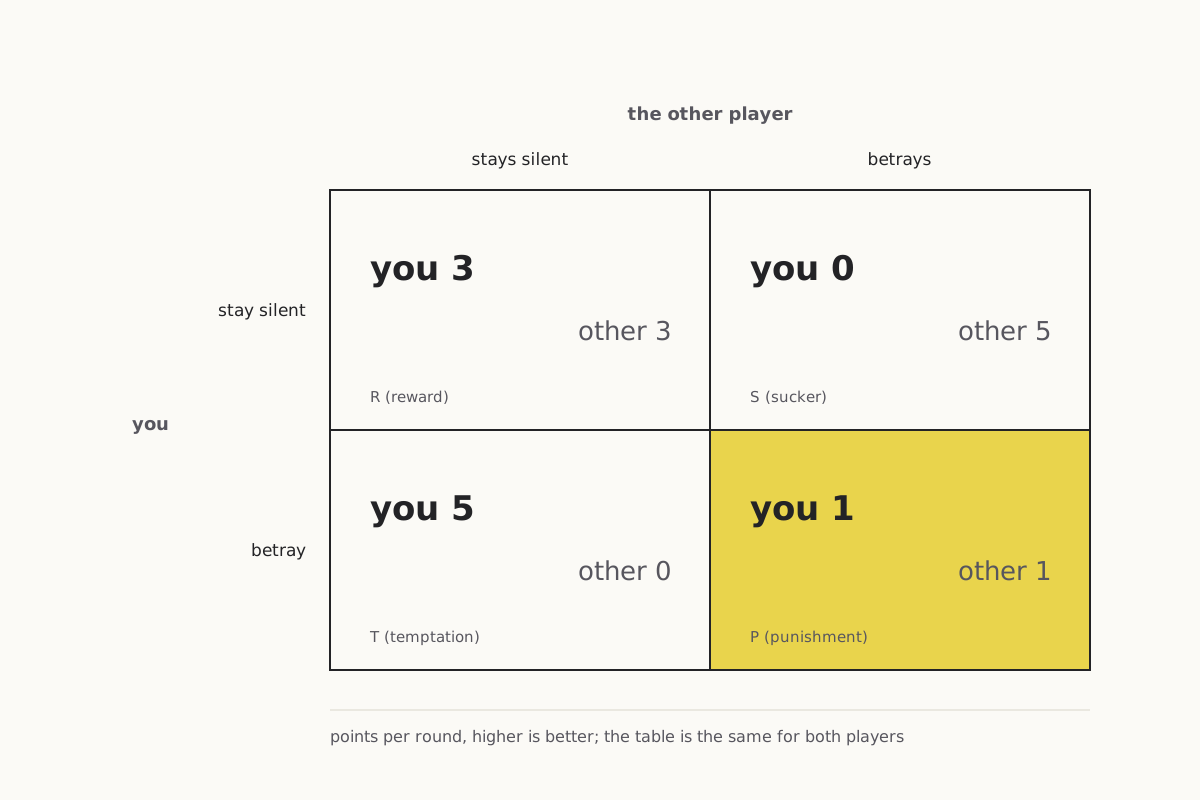
The story behind the name is a prosecutor's offer to two suspects held in separate cells. Here it is only a wrapper for a table of payoffs; nothing on this page is about real interrogations or legal strategy. We score the game in points instead of prison years, so a higher number is always better for the player who gets it.
Wide figure: scroll it sideways, or open it full size.
The four outcomes of one round, scored in points; the highlighted cell is the only outcome where neither player gains by switching alone.
Diagram: Puzzles, Charts & Dilemmas, CC BY 4.0
Copy the full credit line
"The payoff table of the one-round prisoner's dilemma" by Puzzles, Charts & Dilemmas, https://puzzleschartsanddilemmas.com/dilemmas/prisoners-dilemma/, licensed under CC BY 4.0 (https://creativecommons.org/licenses/by/4.0/).
| You | The other stays silent | The other betrays |
|---|---|---|
| You stay silent | You 3, other 3 (reward) | You 0, other 5 (sucker) |
| You betray | You 5, other 0 (temptation) | You 1, other 1 (punishment) |
The SEP entry names the four payoffs reward, temptation, sucker and punishment. In the simplest, symmetric version, the game is a prisoner's dilemma whenever temptation ranks above reward, reward above punishment, and punishment above sucker. Our 5, 3, 1 and 0 meet that rule. They also meet a condition the SEP calls customary for repeated play: two rounds of mutual silence (6 points each) beat taking turns at betraying each other (5 points each).
Why it is called a dilemma
The SEP entry puts the dilemma in two sentences: whatever the other does, each player is better off betraying, yet the outcome when both betray is worse for each than two silences. A common reading, the entry says, is a conflict between individual and group rationality. A group of players who each pursue their own interest can all end up worse off than a group who do not.
The entry also records a second reading. Betraying benefits the player who does it, while staying silent benefits the other player, whatever that player does. On this reading the game sets selfishness against a kind of altruism that both players would prefer to see on both sides, and the SEP notes that David Gauthier and others have taken it to say something important about morality.
Why betraying pays each player
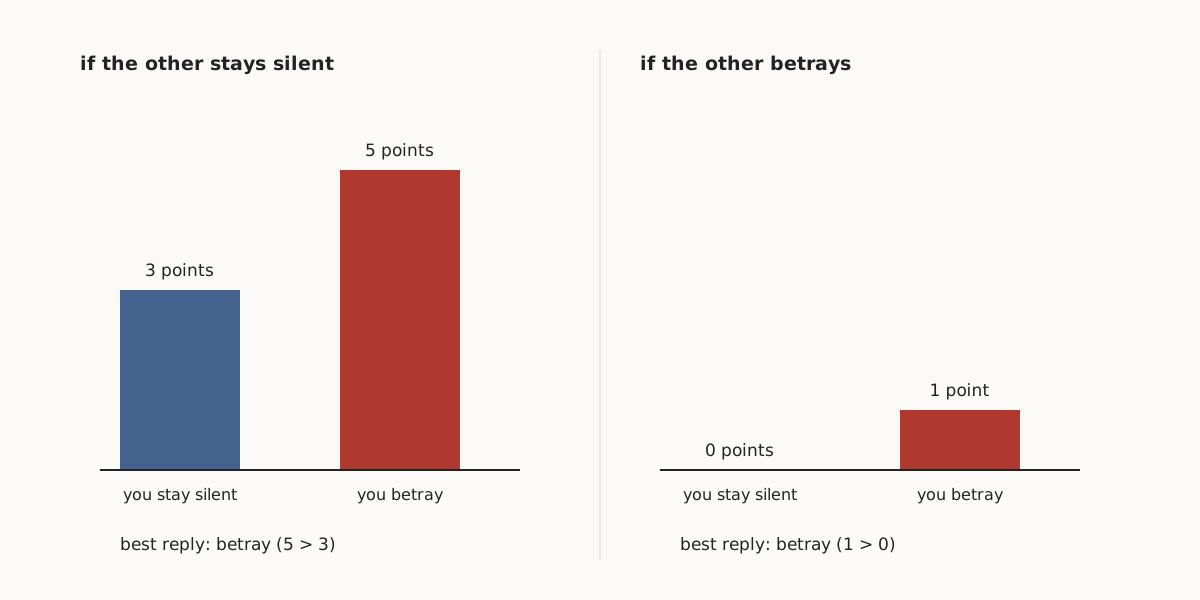
Read the table one column at a time. If the other player stays silent, you get 3 for silence and 5 for betrayal. If the other player betrays, you get 0 for silence and 1 for betrayal. Betraying is your best reply to both moves, and the table is the same from the other chair.
Wide figure: scroll it sideways, or open it full size.
Your points for each move, against each move the other player can make.
Diagram: Puzzles, Charts & Dilemmas, CC BY 4.0
Copy the full credit line
"Best reply to each move in the prisoner's dilemma" by Puzzles, Charts & Dilemmas, https://puzzleschartsanddilemmas.com/dilemmas/prisoners-dilemma/, licensed under CC BY 4.0 (https://creativecommons.org/licenses/by/4.0/).
A move that pays more whatever the other player does is called a dominant move. When both players take it, the result is a Nash equilibrium: neither player can do better by changing their own move alone. We checked all four outcomes in two independent ways, first by listing each player's best reply to each move, then by testing every outcome for a profitable switch. Both methods name the same single outcome: both betray.
That outcome is also Pareto-dominated, meaning another outcome is better for both players at once. Two silences give 3 points each instead of 1. According to the SEP entry, Flood and Dresher seem to have seen the game as a counterexample to the claim that a game's Nash equilibria are its natural solutions.
The silence side has its numbers right. Its weak premise is P4, because facing the same table does not tie the other player's choice to yours. If you stay silent, the other player still scores more by betraying, and nothing in a single round stops them.
The same table without prisoners
The SEP entry's second story has no crime in it. Bill has a blue cap and would prefer a red one; Rose has a red cap and would prefer a blue one. Each would rather have two caps than one, and any cap rather than none, and each can either keep their cap or give it away.
Keeping plays the part of betraying and giving plays the part of silence. Whatever Rose does, Bill ends up better off keeping his cap, and the same holds for Rose, yet both do better by swapping caps than by both keeping them. The SEP suggests that any market built for exchanges that benefit both sides will need to overcome this structure or avoid it.
Where the prisoner's dilemma came from
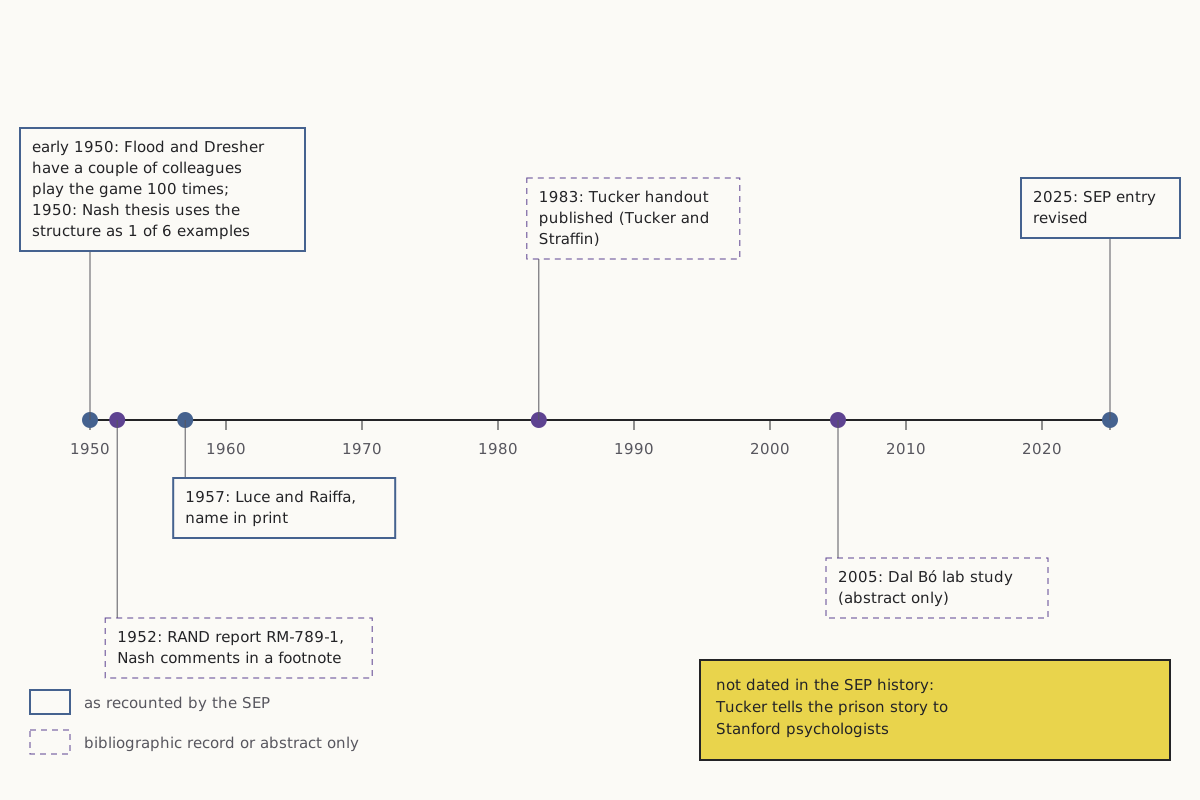
The history below is as the SEP entry recounts it. We could not read the 1952 RAND report, so it appears under Sources as a bibliographic record only. According to the SEP, Flood and Dresher's 1950 experiment came first, and the prison story came later, from Albert Tucker, who told it to an audience of Stanford psychologists to make their game easier to follow.
Wide figure: scroll it sideways, or open it full size.
Dated events in the history of the game, each marked by how its source was read; the SEP's history section gives Tucker's talk no date.
Diagram: Puzzles, Charts & Dilemmas, CC BY 4.0
Copy the full credit line
"Where the prisoner's dilemma came from, 1950 to 2025" by Puzzles, Charts & Dilemmas, https://puzzleschartsanddilemmas.com/dilemmas/prisoners-dilemma/, licensed under CC BY 4.0 (https://creativecommons.org/licenses/by/4.0/).
| Year | Event | How we know |
|---|---|---|
| Early 1950 | Flood and Dresher have colleagues play a game with this structure 100 times in a row | As recounted by the SEP |
| 1950 | John Nash's Ph.D. dissertation uses a game with this structure as the second of six examples | As recounted by the SEP |
| 1952 | Flood, Some Experimental Games, RAND RM-789-1, with ten sentences of Nash's comments in a footnote | As recounted by the SEP; report not read |
| Not dated | Tucker tells the version with prison sentences to Stanford psychologists | As recounted by the SEP |
| 1957 | Luce and Raiffa, the earliest use of the name in print | SEP, citing Guerra-Pujol and Martinez-Garcia |
| 1983 | Tucker's handout published in The Two-Year College Mathematics Journal 14(3), from p. 228 | Bibliographic record |
| 2005 | Pedro Dal Bó's lab study of repeated games with a random rule for continuing, American Economic Review 95(5) | Abstract only |
| 2025 | Substantive revision of the SEP entry used on this page | The entry itself, sections listed under Sources |
The name has a small story of its own. The SEP notes that the title is often credited to Tucker, but that the earliest use in print, according to Guerra-Pujol and Martinez-Garcia, is Luce and Raiffa (1957). The version of Tucker's handout published in 1983, with Philip Straffin, carries the subtitle “The Prisoner's Dilemma”; the original mimeograph handed out at the talk did not.
Others were close to the same idea. The SEP reports that Howard Raiffa became interested in the game at about the same time and ran informal experiments of his own, and that Nash's dissertation includes the game without giving it any particular emphasis. None of them, the entry adds, rushed to publicize their ideas on the game in the early 1950s.
The swap test
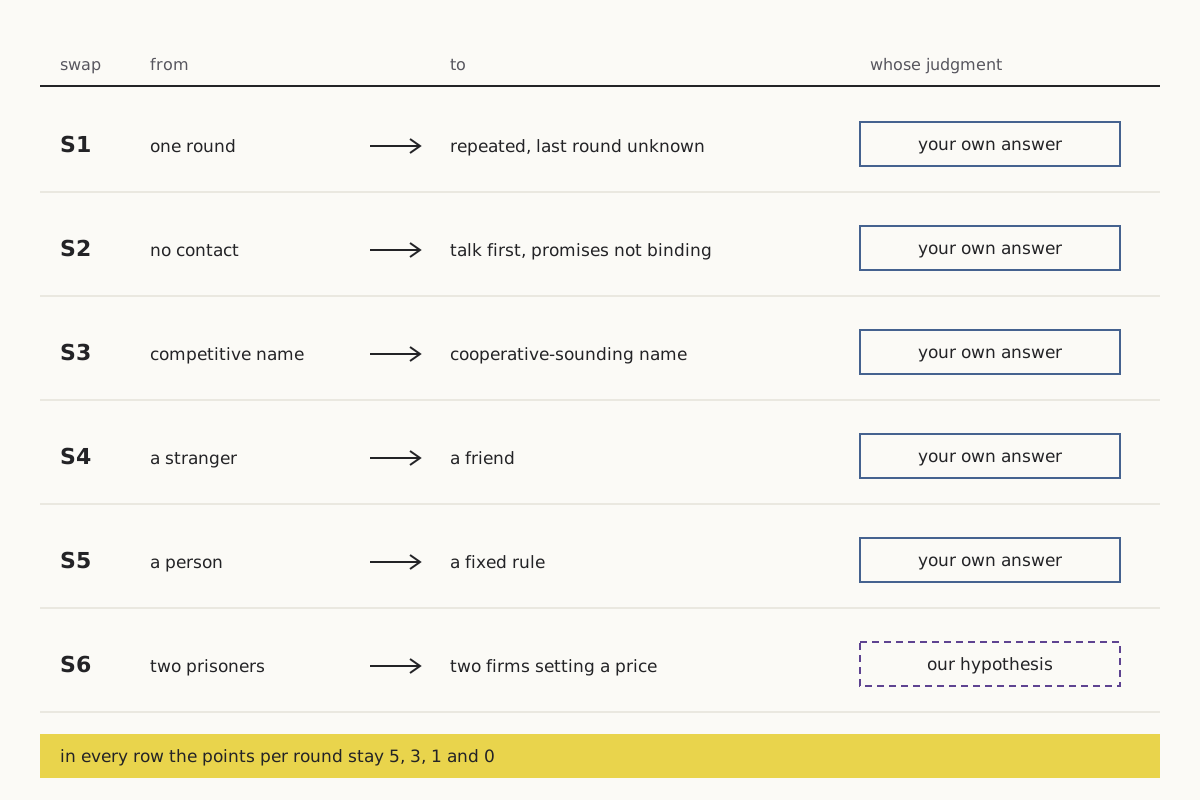
The swap test changes one condition at a time while the payoff table stays fixed, lists what else changes with it, and asks whether the judgment changes. The experience machine gets the same treatment on this site. Each row below says where its judgment comes from: your own answer, a published experiment with its sample size, or our hypothesis.
Wide figure: scroll it sideways, or open it full size.
Six swaps, each with the source of its judgment; only the last row carries a judgment of ours, marked as a hypothesis.
Diagram: Puzzles, Charts & Dilemmas, CC BY 4.0
Copy the full credit line
"The swap test for the prisoner's dilemma" by Puzzles, Charts & Dilemmas, https://puzzleschartsanddilemmas.com/dilemmas/prisoners-dilemma/, licensed under CC BY 4.0 (https://creativecommons.org/licenses/by/4.0/).
| Swap | What else changes | Does the judgment change? | Source of the judgment |
|---|---|---|---|
| S1: one round → repeated, with another round following at a fixed probability, so nobody knows which round is last | Paying back a betrayal later and building a reputation become possible | may change | your own answer |
| S2: no contact → a short talk before choosing; promises are not binding | The players hear each other and can make promises | may change | your own answer |
| S3: the same table under a cooperative-sounding name instead of a competitive one | Only the label | may change | your own answer |
| S4: a stranger → a friend | A relationship, the chance of meeting again, and caring about the other's points | may change | your own answer |
| S5: a person → a fixed rule that always makes the same move | No one to let down; the other move is known in advance | may change | your own answer |
| S6: two prisoners → two firms deciding whether to keep a price high | Legality, what the points stand for, and who else bears the cost | may change | [hypothesis] |
Try it first: Mark each row from S1 to S6: would you change your choice if only that condition changed?
Show it worked through
Worked through
S1 is the swap the next section works through. Pedro Dal Bó's 2005 paper in the American Economic Review ran repeated games in a lab with a random rule for continuing, and used finitely repeated games as controls. According to the abstract, the “shadow of the future” made a difference by “significantly reducing opportunistic behavior.” We read only the abstract, which gives no number of players, so the row stays your own answer.
S2 and S3 leave every number alone. In S2 a promise binds no one, so P1 and P2 are as true after the talk as before it. If your answer moved, something the points do not record may have moved it. In S3 only the name changes, so a different answer there suggests the label may matter.
S5 is a useful check on yourself. If the fixed rule always betrays, betraying pays you 1 point instead of 0; if it always stays silent, betraying pays 5 instead of 3. So a different answer in S5 comes from something other than the points, since the points favor betraying either way.
S4 changes three things at once, which is why its row lists them all; a changed answer there cannot show which of the three mattered. S6 is our hypothesis only. When firms keep a price high, their customers pay for that cooperation, so a reader may judge a betrayal between firms by people who never appear in the payoff table.
What repeating the game changes
According to the SEP, Nash's short comments on Flood's draft already drew the line this section depends on. He separated games repeated a fixed number of times from games with no known end, and he described the rule the SEP calls GRIM, grim trigger here, as an equilibrium of the open-ended version. Grim trigger stays silent until the other player betrays once, then betrays for good.
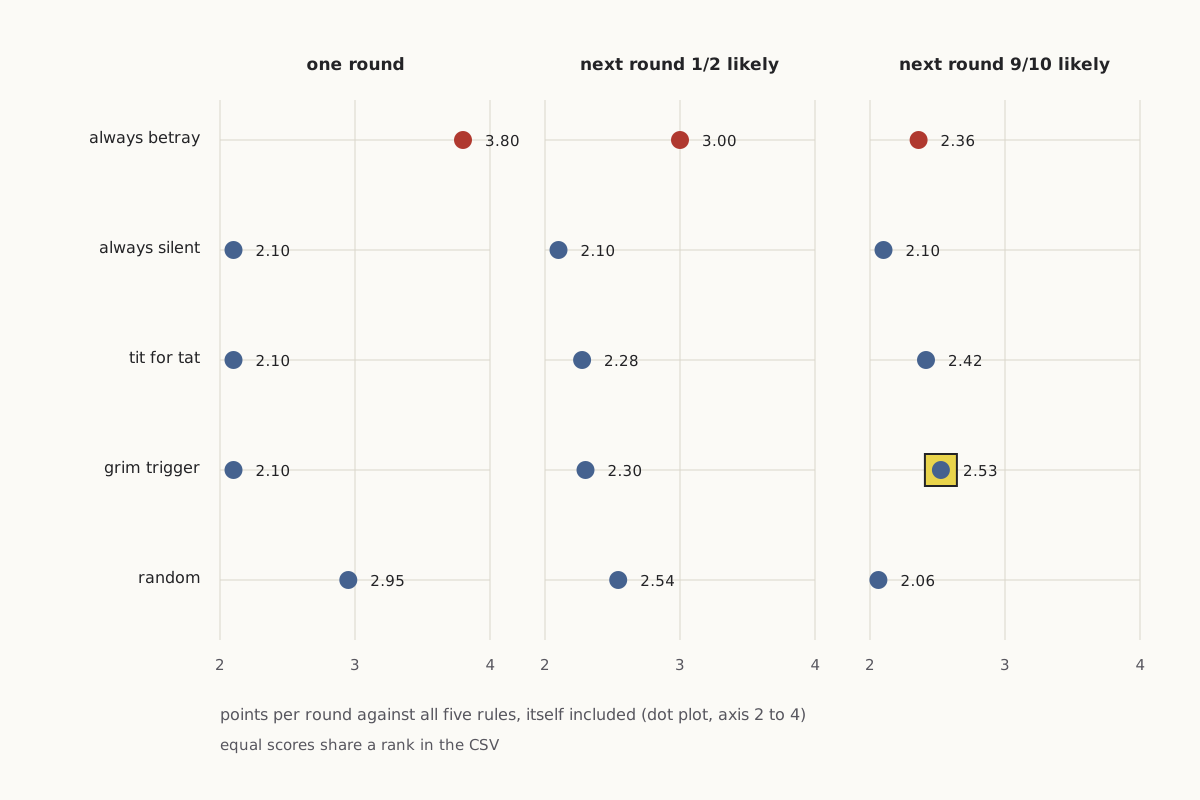
Tit for tat, as the SEP defines it, cooperates (stays silent) in the first round and then copies the other player's previous move. To see what repetition does to these rules, we set up a small round robin. Five rules (always betray, always silent, tit for tat, grim trigger, and a random rule that flips a fair coin each round) each met all five, a copy of itself included.
After each round of our matches, play continued with a fixed probability: zero (a single round), one half, or nine tenths. The SEP calls that chance “the shadow of the future”; as it shrinks toward zero the game becomes a single round and betraying gains value, and as it grows toward one, betraying loses value. We simulated 200,000 matches for each pair in each setting with a fixed seed, and we also computed every average exactly. The two methods agree to within 0.02 points per round.
Wide figure: scroll it sideways, or open it full size.
Average points per round for each rule against all five, under three chances that another round follows.
Diagram: Puzzles, Charts & Dilemmas, CC BY 4.0
Copy the full credit line
"A five-rule round robin of the repeated prisoner's dilemma" by Puzzles, Charts & Dilemmas, https://puzzleschartsanddilemmas.com/dilemmas/prisoners-dilemma/, licensed under CC BY 4.0 (https://creativecommons.org/licenses/by/4.0/).
In a single round, always betray scores 3.80 points per round and the three rules that open with silence score 2.10. With a one-half chance of another round, always betray still leads at 3.00. When another round follows nine times in ten, grim trigger leads at 2.53, tit for tat follows at 2.42, and always betray drops to 2.36. These rankings belong to this pool of five rules under these settings; the SEP entry notes that no rule scores highest against every possible group of opponents.
The pairings show where the change comes from. Against tit for tat or grim trigger, always betray earns 5 points in a single round but only 1.40 per round when another round follows nine times in ten, because the betrayal is answered in every round after the first. Grim trigger edges out tit for tat only through the random rule: it scores 2.73 per round against that rule, where tit for tat scores 2.18, and the two tie against every other opponent.
Wide figure: scroll it sideways, or open it full size.
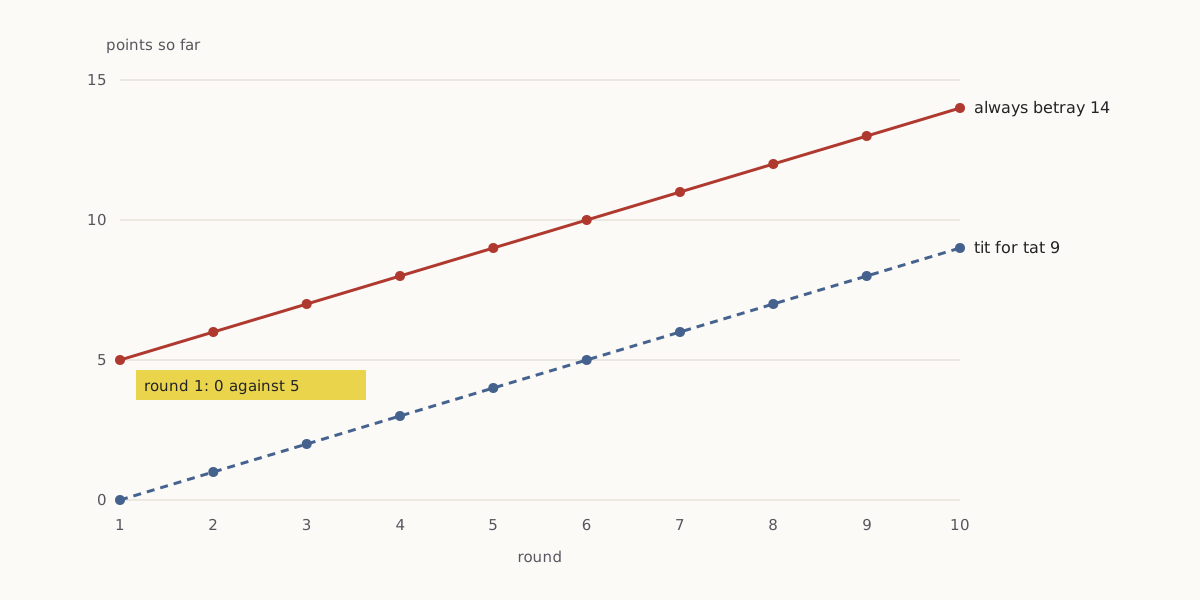
Tit for tat against always betray, round by round: it loses the first round and then matches its opponent's betrayals.
Diagram: Puzzles, Charts & Dilemmas, CC BY 4.0
Copy the full credit line
"Tit for tat against always betray, round by round" by Puzzles, Charts & Dilemmas, https://puzzleschartsanddilemmas.com/dilemmas/prisoners-dilemma/, licensed under CC BY 4.0 (https://creativecommons.org/licenses/by/4.0/).
Tit for tat never beats always betray head to head: after 10 rounds the score is 9 to 14. Its points come from meeting rules that stay silent, where both players collect 3 a round instead of 1. Repetition did not change the arithmetic of any single round in these matches. It changed which plans across many rounds pay off.
One round versus a known hundred
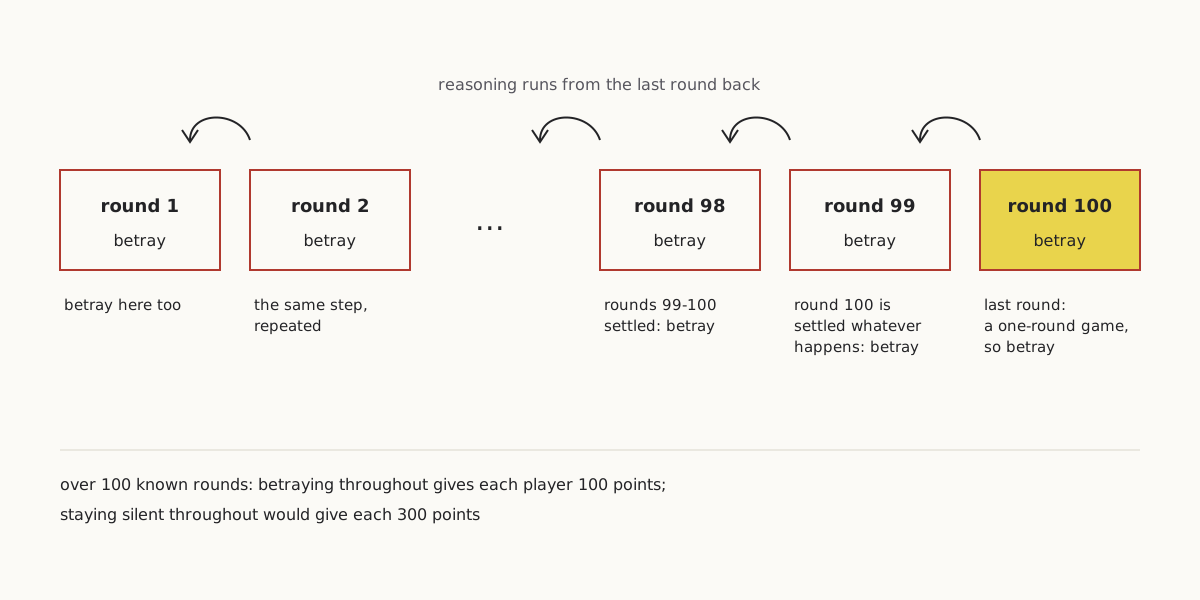
Flood and Dresher's game ran 100 rounds. Suppose both players know in advance that it will last exactly 100; the SEP entry describes the argument, called backward induction, that settles such a game. In round 100 nothing can follow, so it is a one-round game and both betray. Once round 100 is settled, round 99 is effectively the last round that matters, so both betray there too, and the same step runs all the way back to round 1.
Wide figure: scroll it sideways, or open it full size.
Backward induction from the last round: every round of a known 100-round game comes out as betrayal.
Diagram: Puzzles, Charts & Dilemmas, CC BY 4.0
Copy the full credit line
"Backward induction over 100 known rounds" by Puzzles, Charts & Dilemmas, https://puzzleschartsanddilemmas.com/dilemmas/prisoners-dilemma/, licensed under CC BY 4.0 (https://creativecommons.org/licenses/by/4.0/).
We checked this for every known length from 1 to 100 rounds, solving each round from the last one back, and betraying came out as each player's best reply in every round. Over 100 rounds that gives each player 100 points, where steady silence would have given 300. So repetition alone does not rescue silence. What moves the answer in the round robin above is that nobody knows which round is last.
The SEP pushes this one step further. An observation it traces to Gregory Kavka (1983) is that the same unraveling works whenever both players know some upper limit on the number of rounds, even if they do not know the exact count. The entry's example is a shopkeeper and a customer who can work out that they cannot possibly trade more than a trillion times. The entry then questions whether real players could meet the assumptions this argument needs.
The SEP adds two cautions. Nash pointed out that the colleagues' failure to betray throughout the 100 rounds did not show that betraying would be irrational in a one-round game. He also suggested that people cannot actually reason backward through 100 moves. According to the SEP, people in practice behave much the same in long fixed-length games as in games of unknown length, except in the last few rounds.
Push back:
Calling the silence side's weak premise a gap may be too quick. Two players who reason in exactly the same way can expect the same choice from each other, and then the only live outcomes are two silences or two betrayals, so silence wins. The SEP entry sets out this argument from replicas, with Davis (1977, 1985) for it and Binmore (1994) against, and reports that each side still has defenders. Rows such as S4 also bundle several changes, so the swap test cannot say which one moved an answer.
- Newcomb's problem: A predictor, two boxes, and the same clash between a dominant move and a better expected payoff that the SEP finds in a prisoner's dilemma played between replicas.
- Veil of ignorance: What people chose when they had to set the rules before learning which place would be theirs.
Sources
- Steven Kuhn, “Prisoner's Dilemma,” Stanford Encyclopedia of Philosophy (first published 1997-09-04; substantive revision 2025-10-24), introduction and §§1, 7, 11, 13, 14, 14.1, with the definition of GRIM in §16. https://plato.stanford.edu/entries/prisoner-dilemma/ Read: introduction and sections 1, 7, 11, 13, 14 and 14.1; the definition of GRIM in section 16.
- Merrill M. Flood, Some Experimental Games, Research Memorandum RM-789-1 (Santa Monica: The Rand Corporation, 1952). https://www.rand.org/pubs/research_memoranda/RM789-1.html Read: bibliographic record only, as listed in the SEP entry.
- Albert W. Tucker and Philip D. Straffin, “The Mathematics of Tucker: A Sampler,” The Two-Year College Mathematics Journal 14(3) (June 1983): 228–232. doi:10.2307/3027092. https://doi.org/10.2307/3027092 Read: bibliographic record only.
- Pedro Dal Bó, “Cooperation under the Shadow of the Future: Experimental Evidence from Infinitely Repeated Games,” American Economic Review 95(5) (December 2005): 1591–1604. doi:10.1257/000282805775014434. https://www.aeaweb.org/articles?id=10.1257/000282805775014434 Read: abstract only.
Downloads: Payoff table (CSV) (file notes: source, version and license (JSON)) · Best replies and backward induction (JSON) (file notes: source, version and license (JSON)) · Swap test table (CSV) (file notes: source, version and license (JSON)) · Round robin and round-by-round results (CSV) (file notes: source, version and license (JSON)) · Source timeline (CSV) (file notes: source, version and license (JSON)) Data: Steven Kuhn, Prisoner's Dilemma, Stanford Encyclopedia of Philosophy (substantive revision 2025-10-24), https://plato.stanford.edu/entries/prisoner-dilemma/ (facts paraphrased)
Cite this page
Puzzles, Charts & Dilemmas. “Prisoner's Dilemma: In One Round, Betrayal Pays Each Player.” Puzzles, Charts & Dilemmas. Published 2026-10-31. https://puzzleschartsanddilemmas.com/dilemmas/prisoners-dilemma/. Accessed: add the date you read it.
Dates are given as year-month-day. 31 October 2026 is the latest substantive revision.
Experience Machine: A No to Plugging In Does Not Say Why
Picture credit
Illustration: Puzzles, Charts & Dilemmas. Generated schematic illustration — not a photograph or historical record. Reuse: CC BY 4.0 (https://creativecommons.org/licenses/by/4.0/), to the extent Puzzles, Charts & Dilemmas holds rights in it.
Veil of Ignorance: At Most 1 of 81 Groups Chose Rawls's Rule
Picture credit
Illustration: Puzzles, Charts & Dilemmas. Generated schematic illustration — not a photograph or historical record. Reuse: CC BY 4.0 (https://creativecommons.org/licenses/by/4.0/), to the extent Puzzles, Charts & Dilemmas holds rights in it.