Experience Machine: A No to Plugging In Does Not Say Why
Published · Puzzles, Charts & Dilemmas
Folded answers print open where the browser allows it; if one prints closed, open it at https://puzzleschartsanddilemmas.com/dilemmas/experience-machine/ first.
Where it lands
Robert Nozick's experience machine asks whether you would plug into a device that supplies any experience you choose, and he took a refusal to show that “something matters to us in addition to experience” (Anarchy, State, and Utopia, 1974, pp. 43–44, as cited in the SEP). A refusal from someone who trusts the machine to work does show that much, but on its own it does not show which other thing matters, so the swap test below changes one condition at a time to pull the candidates apart.
Sections on this sheet (7)
In 1974, Robert Nozick asked whether you would plug into a machine that supplied any experience you chose. His own answer was no, and he took the refusal as evidence against hedonism, the view that only how life feels makes a life go well. His conclusion covers the first step and stops before the second: a no can have several reasons behind it, and the question as posed gives every one of them the same answer. The standard form below sets out both steps.
In standard form:
- Premise 1:If only how life feels mattered to you, you would plug in.
- Premise 2:On reflection, and trusting the machine to work as described, you would not plug in.
- Premise 3:Such a refusal can come from wanting to do things rather than seem to, wanting to be a certain sort of person, wanting to make a difference in the world, wanting real relationships, or wanting to keep the life you already have.
- Premise 4:The original question gives all five of these the same answer: no.
- Therefore, conclusion:Something besides how life feels matters to you (P1, P2), but the refusal alone does not show which of these things it is (P3, P4).
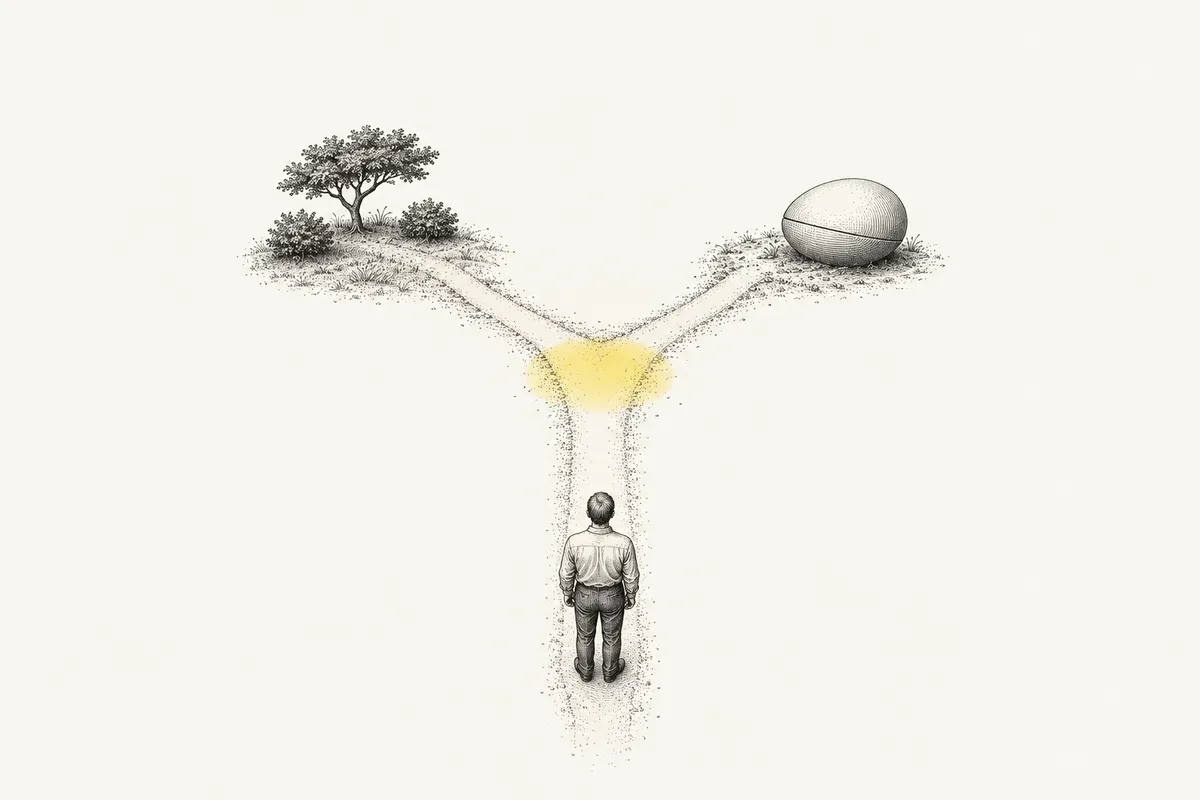
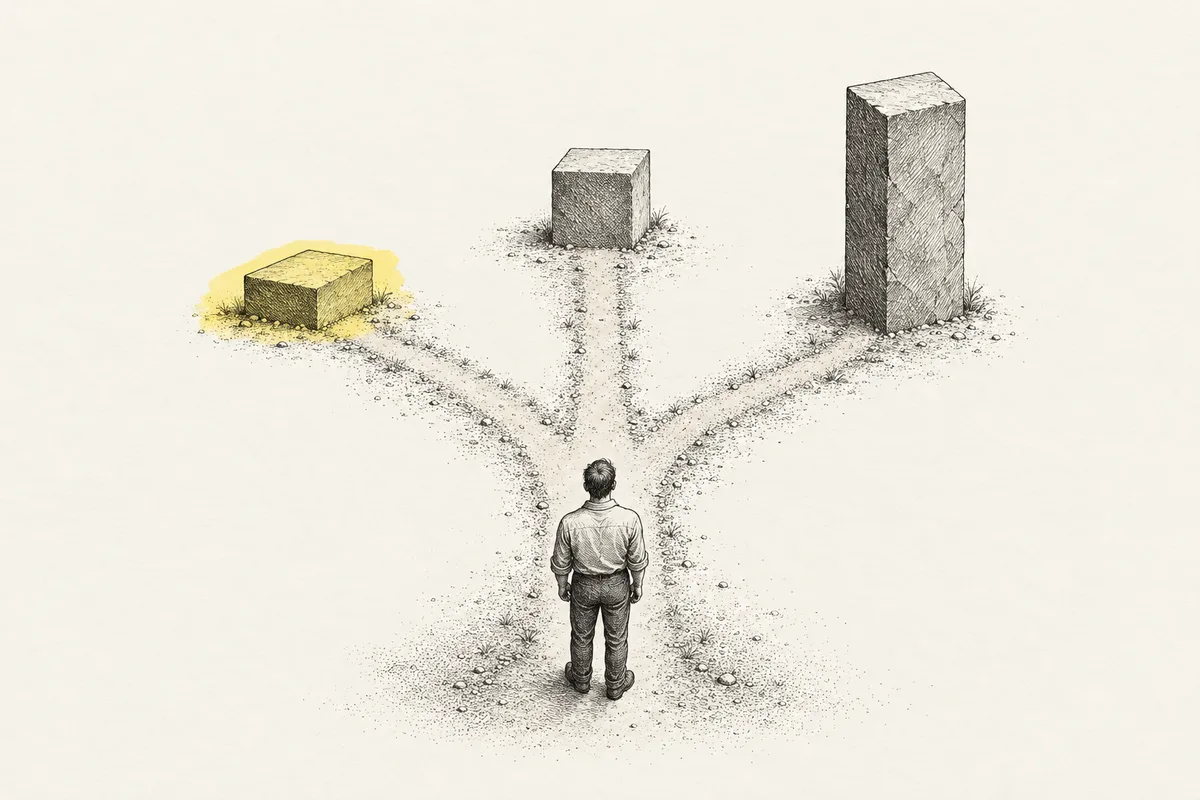
One figure at a fork: open ground one way, a closed pod the other.
Illustration: Puzzles, Charts & Dilemmas. Generated schematic illustration — not a photograph or historical record. Reuse: CC BY 4.0 (https://creativecommons.org/licenses/by/4.0/), to the extent Puzzles, Charts & Dilemmas holds rights in it.
What Nozick asked, and what he concluded
The machine, as the SEP entry Well-Being describes it, is one you could be plugged into for the rest of your life. It would supply experiences of whatever kind you found most valuable or enjoyable, such as writing a great novel. You would not know you were on the machine, and you need not worry about it breaking down. The question is whether plugging in would be wise for your own well-being.
Nozick thought it would be a big mistake, according to the same entry, which quotes him on what plugging in costs: it “limits us to a man-made reality” (p. 43). The SEP entry Hedonism quotes three things he said are good in themselves besides the experiences: “to do certain things,” not only to have the experience of doing them; “to be a certain sort of person”; and “to make a difference in the world.”
Wide figure: scroll it sideways, or open it full size.
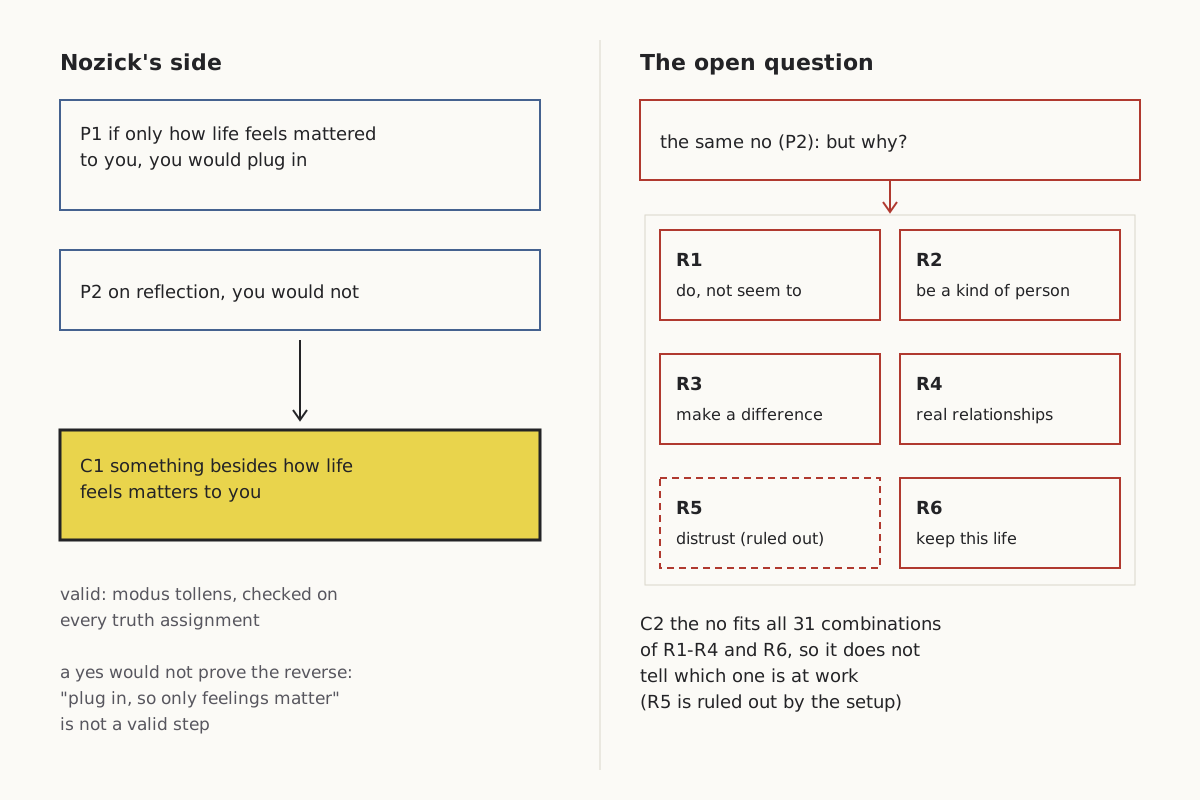
Nozick's argument on the left; on the right, the question his conclusion leaves open.
Diagram: Puzzles, Charts & Dilemmas, CC BY 4.0
Copy the full credit line
"The two arguments of the experience machine" by Puzzles, Charts & Dilemmas, https://puzzleschartsanddilemmas.com/dilemmas/experience-machine/, licensed under CC BY 4.0 (https://creativecommons.org/licenses/by/4.0/).
The form of his argument is modus tollens: if A, then B; not B; therefore, not A. Here A is “only how life feels matters to you” and B is “you would plug in.” We checked the form over every assignment of true and false, and it is valid, meaning that the conclusion cannot be false while both premises are true. Whether the premises are true is a separate question.
The check also shows what the argument cannot do in reverse. Someone who would plug in has not proved that only feelings matter, because “if A, then B; B; therefore, A” is not a valid form. We have not read Nozick's book itself; the quotations and page numbers above are as cited in the two SEP entries. The Hedonism entry also sets the machine beside earlier and less fantastical sketches of the same kind by Nozick (1971) and Thomas Nagel (1970).
The Well-Being entry notes that the machine can be made to sound more palatable. On the machine, you might make genuine choices, share a common virtual world with other users, and talk with them in the ordinary way. The entry's author says this will not be enough for many who reject hedonism. One reply from the philosophy of mind holds that really writing a great novel and seeming to write one are different experiences, even when they feel the same from the inside.
What a no can mean
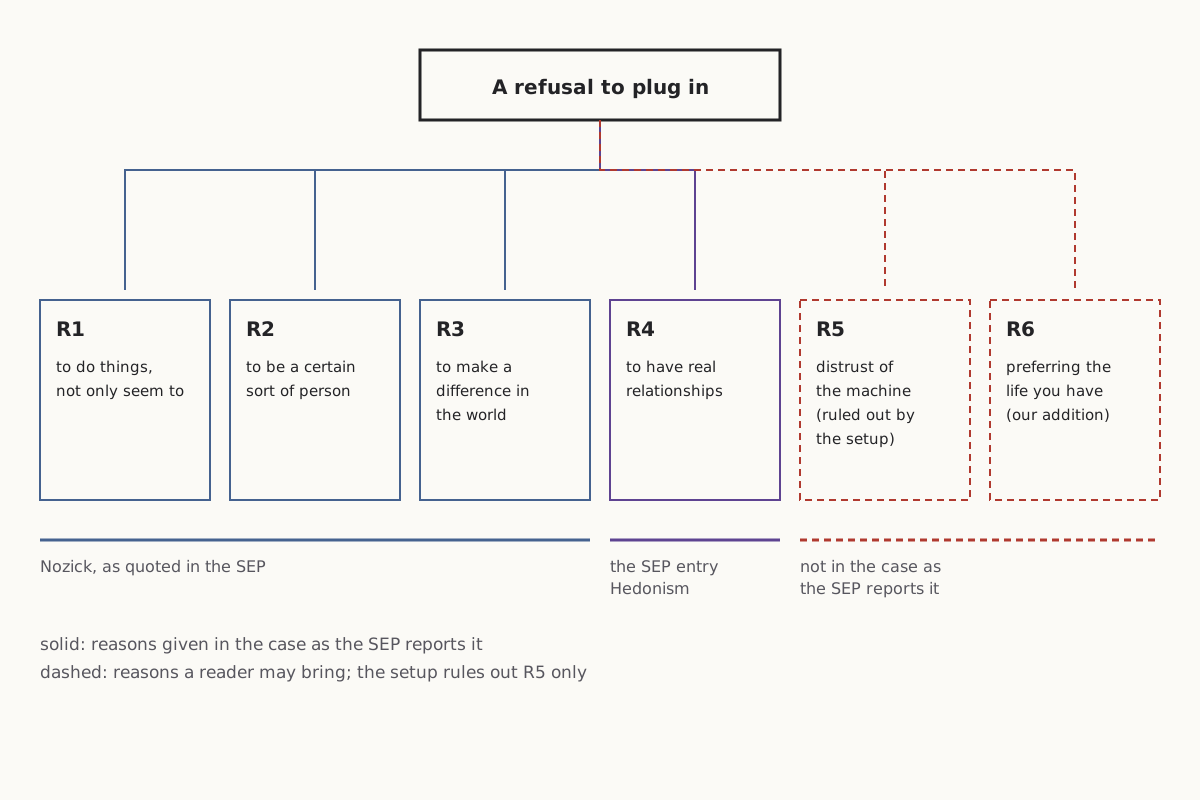
Nozick's conclusion says that something besides experience matters, and the three things he named are candidates for it. Other candidates sit close by. The Hedonism entry, discussing the case, adds actual relationships with other people as something that may matter beyond the experience of having them. Two more reasons come from outside the case as written, and we list them because a reader may bring them along anyway.
Wide figure: scroll it sideways, or open it full size.
Six reasons a person might give for refusing, grouped by where each one comes from.
Diagram: Puzzles, Charts & Dilemmas, CC BY 4.0
Copy the full credit line
"Six reasons behind a refusal" by Puzzles, Charts & Dilemmas, https://puzzleschartsanddilemmas.com/dilemmas/experience-machine/, licensed under CC BY 4.0 (https://creativecommons.org/licenses/by/4.0/).
| Reason | What the person wants | Where it comes from | Ruled out by the setup? |
|---|---|---|---|
| R1 | To do things, not only seem to | Nozick, as quoted in the SEP entry Hedonism | No |
| R2 | To be a certain sort of person | Nozick, as quoted in the SEP entry Hedonism | No |
| R3 | To make a difference in the world | Nozick, as quoted in the SEP entry Hedonism | No |
| R4 | Real relationships with other people | The SEP entry Hedonism, section 2.3.1 | No |
| R5 | Not to depend on a machine they distrust | A reader's reason | Yes |
| R6 | To keep the life they already have | Added by this site | No |
R1 to R3 are close, but they are not the same: R1 is about action, writing the novel rather than seeming to. R2 is about character, about being a certain sort of person rather than, in Nozick's phrase as the SEP quotes it, an “indeterminate blob” floating in a tank. R3 is about effects outside your own head. R6 is the hardest to place, because wanting to keep your life can rest on the people and projects in it, or simply on its being yours.
R5 is unlike the other five in one respect. Someone who cares only about how life feels, but doubts the machine will deliver, would also refuse. We checked that case in a small model, and the refusal comes out the same. A no that rests on distrust therefore gives no support to Nozick's conclusion, and P2 rules it out by asking you to trust the machine as described.
For the other five reasons, we checked all 31 ways a person could hold one or more of them, assuming any one of them is enough on its own for a refusal. Every combination then produces the same answer, no. A single no ties several strands into one knot, and the question as posed gives you no way to see which strand is pulling. The swap test is one way to loosen the knot.
The swap test
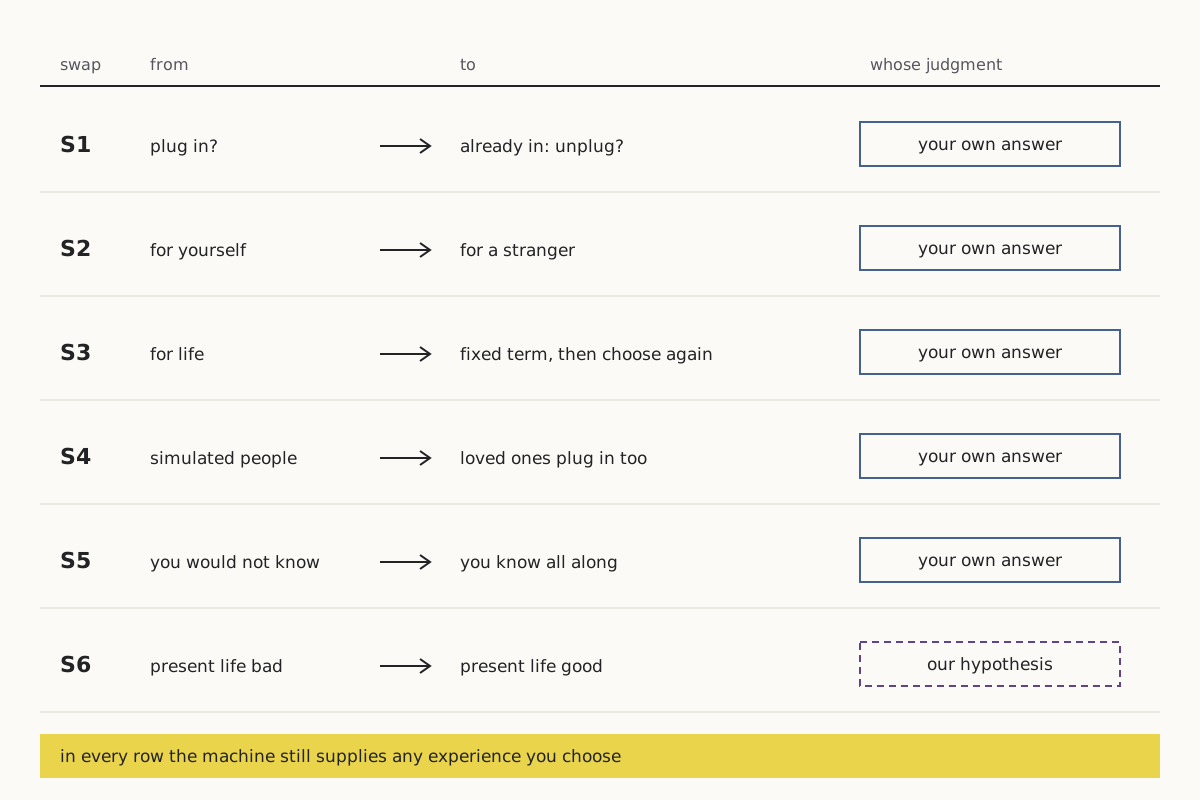
The swap test changes one condition at a time while the machine itself stays the same, lists what else changes along with it, and asks whether the judgment changes. The prisoner's dilemma gets the same treatment on this site. Each row says where its judgment comes from: your own answer, a published experiment with its sample size, or our hypothesis.
Wide figure: scroll it sideways, or open it full size.
Six swaps, each with the source of its judgment; only the last row carries a judgment of ours, marked as a hypothesis.
Diagram: Puzzles, Charts & Dilemmas, CC BY 4.0
Copy the full credit line
"Experience machine swap test" by Puzzles, Charts & Dilemmas, https://puzzleschartsanddilemmas.com/dilemmas/experience-machine/, licensed under CC BY 4.0 (https://creativecommons.org/licenses/by/4.0/).
| Swap | What else changes | Does the judgment change? | Source of the judgment |
|---|---|---|---|
| S1: asked to plug in → told you are already plugged in and asked whether to unplug | Which side you start on and what you would give up; you now know about the machine; what waits outside is unknown | may change | your own answer |
| S2: choosing for yourself → choosing for a stranger whose wishes you do not know | Your attachment to your own life drops out; you judge what is good for someone else | may change | your own answer |
| S3: for the rest of your life → for a fixed term, then out to choose again | The choice becomes reversible | may change | your own answer |
| S4: the people inside are simulated → people you care about plug in too and share one world | Your relationships stay real; their lives are at stake too | may change | your own answer |
| S5: you would not know you are on the machine → you know the whole time | Whether you are deceived | may change | your own answer |
| S6: your present life is going badly → it is going well | How much you would leave behind | may change | [hypothesis] |
Try it first: Answer S1 to S6 for yourself before reading on. In which rows would your answer change?
Show it worked through
Worked through
A changed answer is most informative when it points toward a single reason. In S4 your relationships become real, so if you would refuse alone but accept with the people you care about beside you, R4 may have been doing much of the work, though their lives are now at stake too. In S3, R5 and R6 cost less, because you can come out again, and R1 to R4 cost less as well, because fewer of your years go to the machine.
S5 targets deception. If knowing it is a machine makes the offer easier to accept, not being fooled may be part of what you want; if it makes the offer worse, the illusion may have been part of the appeal, and if it makes no difference, deception may not have been the issue. S2 removes your attachment to your own life, so it tests whether you think a machine life is bad for anyone, which is the question theories of well-being try to answer.
S1 and S6 can move an answer for reasons that have little to do with R1 to R4; the next section takes S1 apart. S6 is our hypothesis only. A present life that is going badly may make the machine more tempting, yet a yes from someone in that position would not show that only feelings matter to them, since a yes does not prove the reverse of Nozick's conclusion.
Two published papers in Philosophical Psychology are listed in the sources below, by Felipe De Brigard (2010) and Dan Weijers (2014). We have read only their bibliographic records, so this page reports none of their results, and every row stays your own answer or our hypothesis.
Plugging in versus unplugging
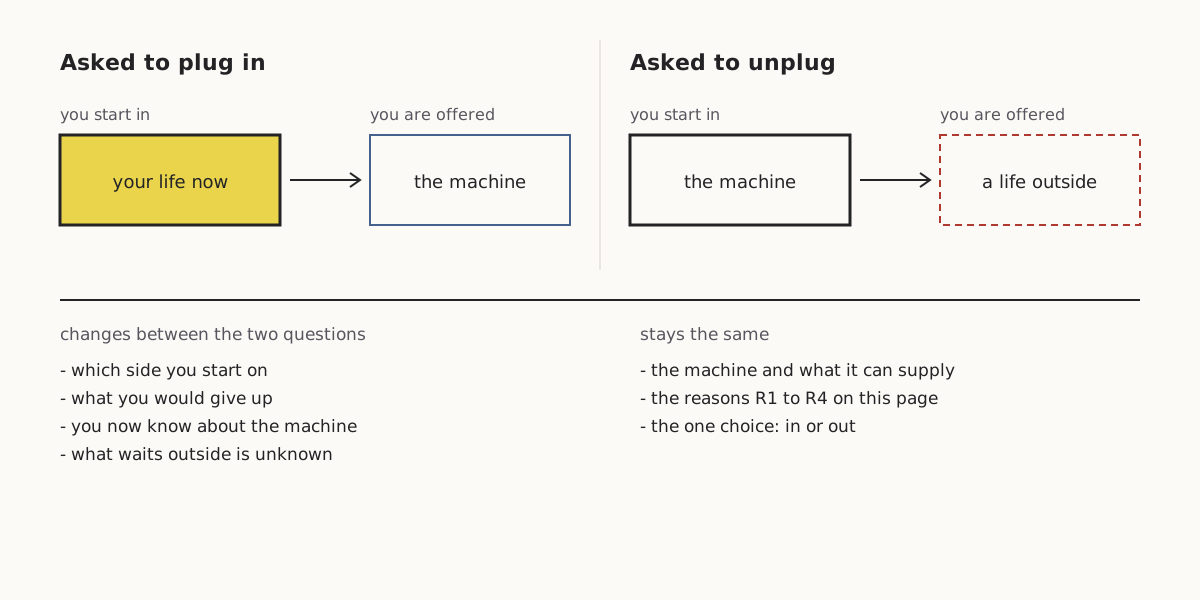
S1 keeps the machine and changes where you stand. In the first question you start in your life now and are offered the machine; in the second you start inside it and are offered a life outside, which you know nothing about. The reasons R1 to R4 apply in much the same way to both questions, since in each the life on the machine is the one without real doing or real relationships.
Wide figure: scroll it sideways, or open it full size.
The two forms of S1: the starting point, what you would leave behind and what you know about the machine all change, while the machine stays as it was.
Diagram: Puzzles, Charts & Dilemmas, CC BY 4.0
Copy the full credit line
"Plugging in versus unplugging" by Puzzles, Charts & Dilemmas, https://puzzleschartsanddilemmas.com/dilemmas/experience-machine/, licensed under CC BY 4.0 (https://creativecommons.org/licenses/by/4.0/).
So if you would choose the life outside in one question but the machine in the other (a no to plugging in and a yes to unplugging are the same choice), something other than R1 to R4 probably moved you. Three candidates are in the figure: which side you start on, what you would be giving up, and the fact that you now know about the machine.
An unknown life outside could also be worse than the one inside, which is a reason about feelings, not about reality. This is our reading of the row's structure; we report no measured result for it.
Comparing the machine to a simulation you already live in turns it into S1's second question. Asked that way, the choice is about leaving what you have, and that pulls in R6 as well as anything Nozick named.
A lifetime or a trial run
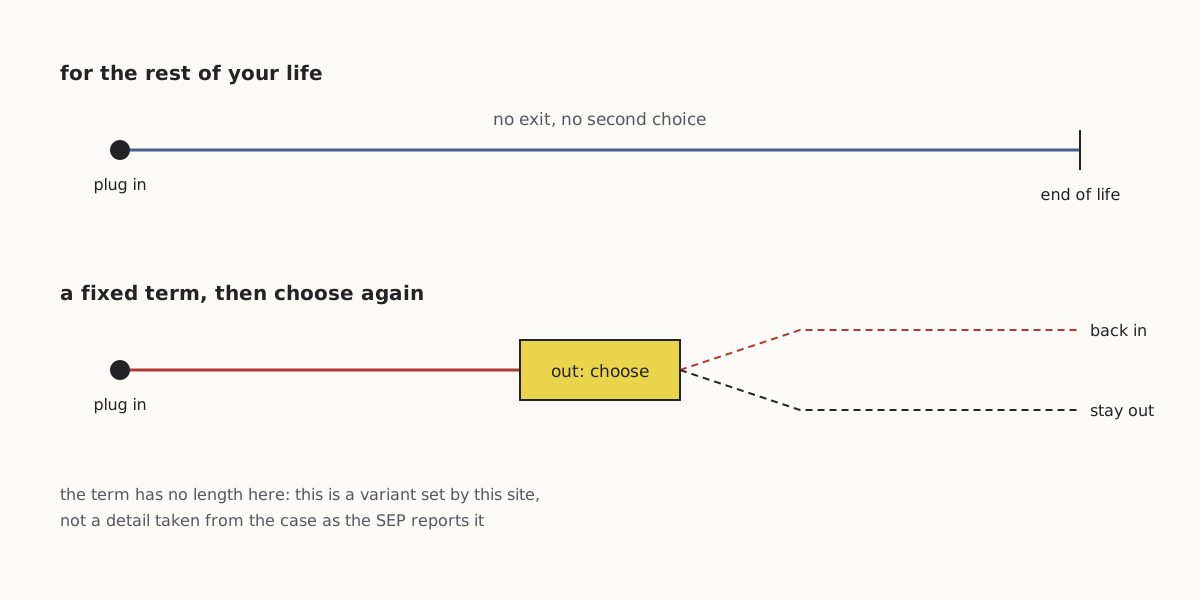
The SEP's description of the machine is for the rest of your life, and it mentions no exit and no second choice. S3 is our variant: you plug in for a fixed term, then come out and choose again. We set no length for the term on purpose. The row is about whether the choice can be undone, not about any particular number of years.
Wide figure: scroll it sideways, or open it full size.
A lifetime against a fixed term; the term has no set length because the variant is ours.
Diagram: Puzzles, Charts & Dilemmas, CC BY 4.0
Copy the full credit line
"A lifetime or a fixed term" by Puzzles, Charts & Dilemmas, https://puzzleschartsanddilemmas.com/dilemmas/experience-machine/, licensed under CC BY 4.0 (https://creativecommons.org/licenses/by/4.0/).
Reversibility lowers the price of two reasons. Distrust (R5) matters less when a machine that goes wrong costs you only the term, provided the exit at its end works, and keeping your life (R6) matters less when that life is waiting for you afterward. R1 to R4 still apply during the term, since you do nothing real and meet no one real there, but they now cost only the term rather than the rest of your life.
A reader who would refuse a lifetime but accept a trial run has learned something specific. Their no to the lifetime version may have rested at least partly on the loss being permanent. The original question bundles permanence into the offer, so it cannot separate that worry from the reasons Nozick named.
What else changes
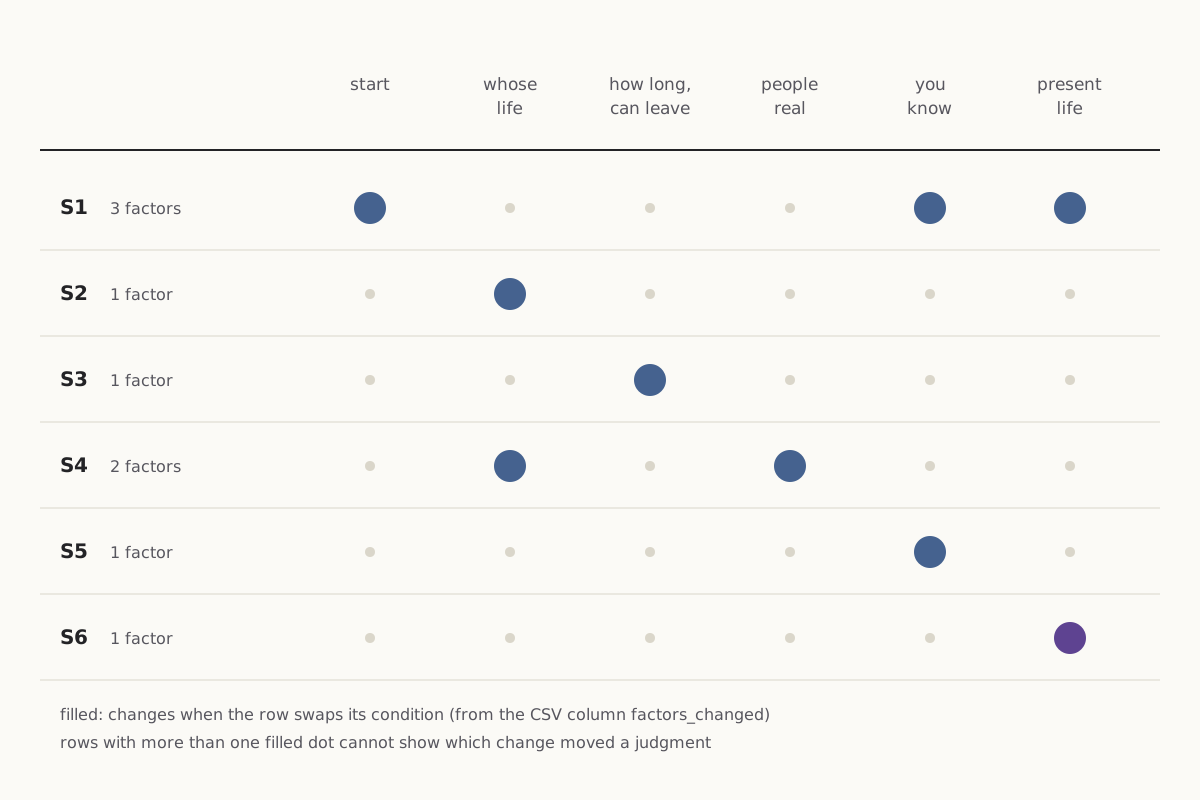
A swap that targets one condition can still carry other changes along with it. The table below lists the factors that move with each row, taken from the same CSV as the swap table. Rows with a single factor are the cleanest tests, and rows with several cannot tell you which change moved your answer.
Wide figure: scroll it sideways, or open it full size.
Which factors change in each row; a row with more than one filled dot cannot isolate a single cause.
Diagram: Puzzles, Charts & Dilemmas, CC BY 4.0
Copy the full credit line
"What else changes with each swap" by Puzzles, Charts & Dilemmas, https://puzzleschartsanddilemmas.com/dilemmas/experience-machine/, licensed under CC BY 4.0 (https://creativecommons.org/licenses/by/4.0/).
| Swap | Factors that change with it |
|---|---|
| S1 | which side you start on; whether you know it is a machine; how your present life is going |
| S2 | whose life it is |
| S3 | how long, and whether you can leave |
| S4 | whether the people inside are real; whose life it is |
| S5 | whether you know it is a machine |
| S6 | how your present life is going |
S1 changes three factors at once, which is why a change of answer there is hard to read. S4 changes two: the people become real, and their lives are now part of the deal. Choosing for a stranger in S2 is a choice made without knowing what that person wants, a cousin of the veil of ignorance, where you choose rules without knowing where you will land.
Even a single-factor row has a limit. A changed judgment in S5 says that knowing, with whatever comes along with knowing, may matter to you. It does not show that your judgment follows that one detail and nothing else.
Where philosophers land
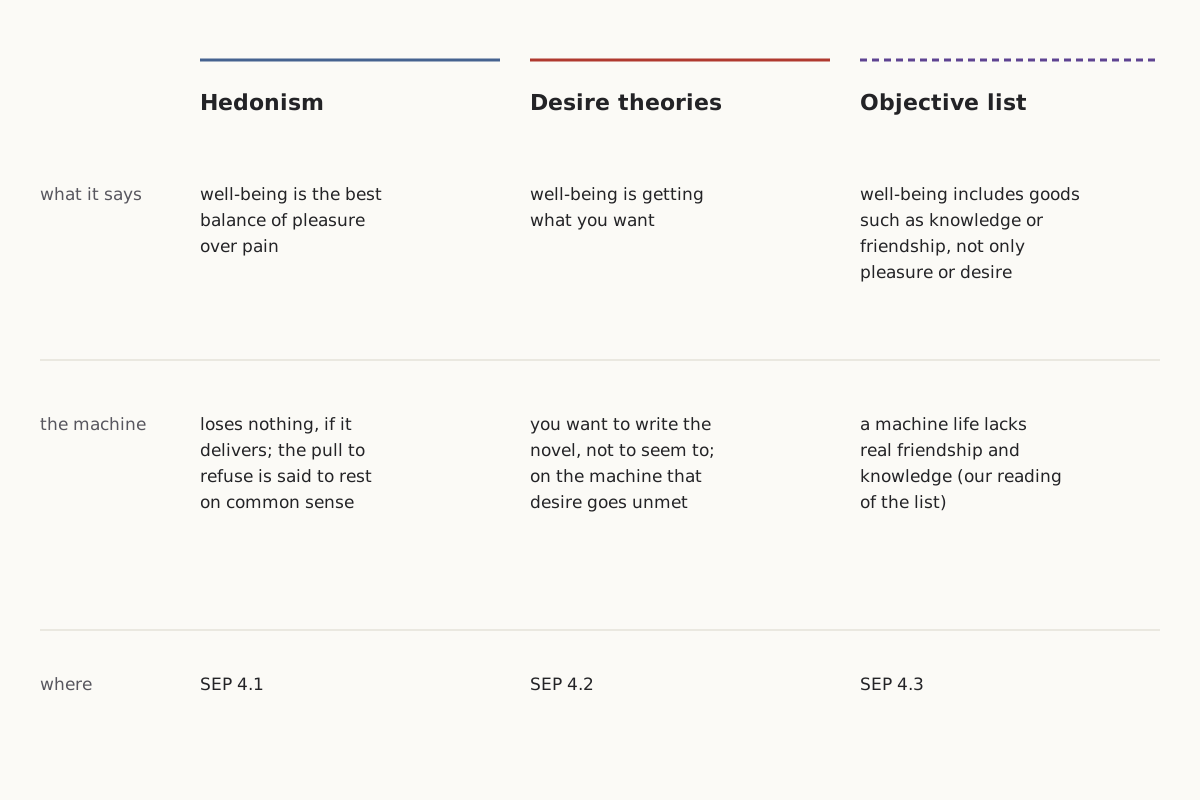
The SEP entry Well-Being sorts theories of what makes a life go well for the person living it into three families. Each gives the machine a different reading, summarized here in our words with the entry's section numbers.
Wide figure: scroll it sideways, or open it full size.
Three families of theories from the SEP entry Well-Being and what each says about the machine; wording is ours.
Diagram: Puzzles, Charts & Dilemmas, CC BY 4.0
Copy the full credit line
"Three theories of well-being and the experience machine" by Puzzles, Charts & Dilemmas, https://puzzleschartsanddilemmas.com/dilemmas/experience-machine/, licensed under CC BY 4.0 (https://creativecommons.org/licenses/by/4.0/).
| Position | What well-being consists in | What it says about the machine | Source |
|---|---|---|---|
| Hedonism | The greatest balance of pleasure over pain | The machine costs nothing if it delivers; the reply the entry rates strongest says the pull to refuse rests on common-sense intuitions | SEP, Well-Being, section 4.1 |
| Desire theories | Fulfilment of your desires | You want to write a great novel, not just to have the experience of writing one, so on the machine that desire goes unmet | SEP, Well-Being, section 4.2 |
| Objective list theories | Goods such as knowledge or friendship, not only pleasure or desire | A machine life lacks real friendship and knowledge (our application of the list) | SEP, Well-Being, section 4.3 |
Hedonists have replies, and the Hedonism entry lists them for cases like this one. One says the thing the objector points to is itself a kind of pleasure, a reply the entry judges easy to make but harder to make convincing to anyone who is not already a hedonist. Another grants that it has value but calls the value instrumental, good only for the pleasure it brings.
A more concessive reply allows it some other kind of value, such as moral value, while holding that pleasure is still needed for a life to go well for the person living it.
The Well-Being entry adds what it calls the paradox of hedonism: pleasure is best pursued indirectly. A hedonist can use it to explain why people value real activities for their own sake, since valuing them that way tends to bring more pleasure in the end.
The entry calls the machine one motivation for desire theories, and it warns against dismissing hedonism after a quick run through the machine. Its author treats the objection as an open question: the debate, on his account, may turn on whether the objection really stands.
In the 2020 PhilPapers Survey of philosophers, 1,262 of the 1,641 philosophers who answered this question (76.9%) chose “No” when asked whether they would enter the experience machine, counting those who accepted or leaned toward that answer (Bourget and Chalmers 2023, Philosophers' Imprint 23:11). The survey ran from October 15 to November 16, 2020. Those are professional philosophers, not the public, and the survey does not say which reason sat behind each no.
Push back:
The strongest objection is that the refusal is already enough. Nozick's target was the claim that experience is all that matters, and any reason inside the setup other than the experiences themselves defeats that claim; nobody needs to know which one. On this view, asking which reason is at work moves the goalposts. Sorting the reasons may help choose between desire theories and objective list theories, but it adds nothing to the case against hedonism, which the single no has already made.
- Prisoner's dilemma: Another dilemma where swapping one condition at a time can change the choice.
- Ship of Theseus: If you plugged in, would the person in the machine still be you? The identity question, asked of a ship.
Sources
- Andrew Moore, “Hedonism,” Stanford Encyclopedia of Philosophy (first published 2004-04-20; substantive revision 2013-10-17), §2.3.1 “Non-Necessity Objections.” https://plato.stanford.edu/entries/hedonism/ Read: section 2.3.1 and bibliography.
- Roger Crisp, “Well-Being,” Stanford Encyclopedia of Philosophy (first published 2001-11-06; substantive revision 2026-01-13), §§4.1–4.3. https://plato.stanford.edu/entries/well-being/ Read: opening summary, sections 4.1 to 4.3 and bibliography.
- Robert Nozick, Anarchy, State, and Utopia (Oxford: Basil Blackwell, 1974), pp. 43–44 as cited in the SEP entry Hedonism; p. 43 as cited in the SEP entry Well-Being. https://plato.stanford.edu/entries/hedonism/#Bib Read: not read; quoted only as cited in the SEP entries Hedonism and Well-Being.
- David Bourget and David J. Chalmers, “Philosophers on Philosophy: The 2020 PhilPapers Survey,” Philosophers' Imprint 23: 11 (2023), 1–53. doi:10.3998/phimp.2109. https://journals.publishing.umich.edu/phimp/article/id/2109/ Read: methods section and Table 1, rows Experience machine (would you enter?) and Newcomb's problem.
- Felipe De Brigard, “If you like it, does it matter if it's real?,” Philosophical Psychology 23(1) (2010): 43–57. doi:10.1080/09515080903532290. https://doi.org/10.1080/09515080903532290 Read: bibliographic record only.
- Dan Weijers, “Nozick's experience machine is dead, long live the experience machine!,” Philosophical Psychology 27(4) (2014): 513–535. doi:10.1080/09515089.2012.757889. https://doi.org/10.1080/09515089.2012.757889 Read: bibliographic record only.
Downloads: Swap test (CSV) (file notes: source, version and license (JSON)) · Argument validity (JSON) (file notes: source, version and license (JSON))
Cite this page
Puzzles, Charts & Dilemmas. “Experience Machine: A No to Plugging In Does Not Say Why.” Puzzles, Charts & Dilemmas. Published 2026-10-31. https://puzzleschartsanddilemmas.com/dilemmas/experience-machine/. Accessed: add the date you read it.
Dates are given as year-month-day. 31 October 2026 is the latest substantive revision.
Prisoner's Dilemma: In One Round, Betrayal Pays Each Player
Picture credit
Illustration: Puzzles, Charts & Dilemmas. Generated schematic illustration — not a photograph or historical record. Reuse: CC BY 4.0 (https://creativecommons.org/licenses/by/4.0/), to the extent Puzzles, Charts & Dilemmas holds rights in it.
Veil of Ignorance: At Most 1 of 81 Groups Chose Rawls's Rule
Picture credit
Illustration: Puzzles, Charts & Dilemmas. Generated schematic illustration — not a photograph or historical record. Reuse: CC BY 4.0 (https://creativecommons.org/licenses/by/4.0/), to the extent Puzzles, Charts & Dilemmas holds rights in it.