Veil of Ignorance: At Most 1 of 81 Groups Chose Rawls's Rule
Published · Puzzles, Charts & Dilemmas
Folded answers print open where the browser allows it; if one prints closed, open it at https://puzzleschartsanddilemmas.com/dilemmas/veil-of-ignorance/ first.
Where it lands
John Rawls's veil of ignorance asks which principles of justice you would choose if you did not know your place in society, and Rawls argued that people choosing behind it would protect the worst-off position. In a lab version reported in Choosing Justice (1992), where students knew everything except their future income, 1 of the 81 groups that chose a principle picked maximizing the lowest income, and the authors doubt even that one; roughly three in four picked the highest average with a guaranteed floor.
Sections on this sheet (5)
In 1992, Norman Frohlich and Joe Oppenheimer reported what groups of students chose behind an experimental veil of ignorance. Rawls had an answer for his own veil: the choosers would protect the worst-off position. In the lab, the principle built to stand for that answer was the least popular of the four on offer. The gap has two sources, the rule of choice and how much the veil hides, and the standard form below keeps them apart.
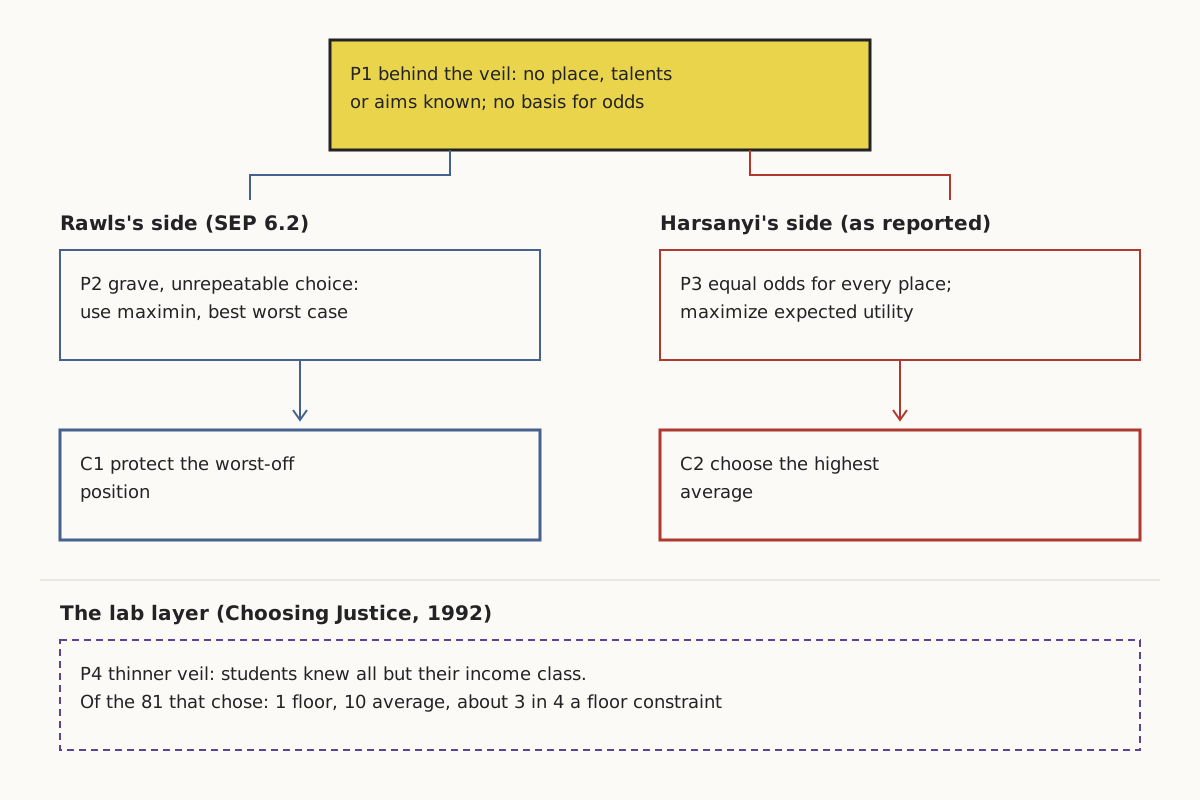
In standard form: (SEP, Original Position, sections 3 and 6.2; Choosing Justice, pp. 4, 26–27, 58–60)
- Premise 1:Behind the veil you do not know your place in society, your talents or your aims, and you have no basis for estimating the odds of landing in any one position.
- Premise 2:Rawls: for this grave, unrepeatable choice with no basis for odds, the rational rule is maximin, which picks the option whose worst outcome is best.
- Premise 3:Harsanyi, as the SEP and Choosing Justice report him: with no basis for odds, count every position as equally likely and maximize expected utility, which means choosing the highest average.
- Premise 4:In one series of lab experiments, where students knew everything except which income they would draw, 1 of the 81 groups that chose a principle picked maximizing the lowest income (a choice the authors doubt), 10 picked the highest average, and roughly three in four picked the highest average with a guaranteed floor.
- Therefore, conclusion:The veil alone does not settle the choice: P1 with P2 points to protecting the worst-off, P1 with P3 to the highest average, and the lab groups, behind a thinner veil, mostly chose a third principle that neither theorist predicted.
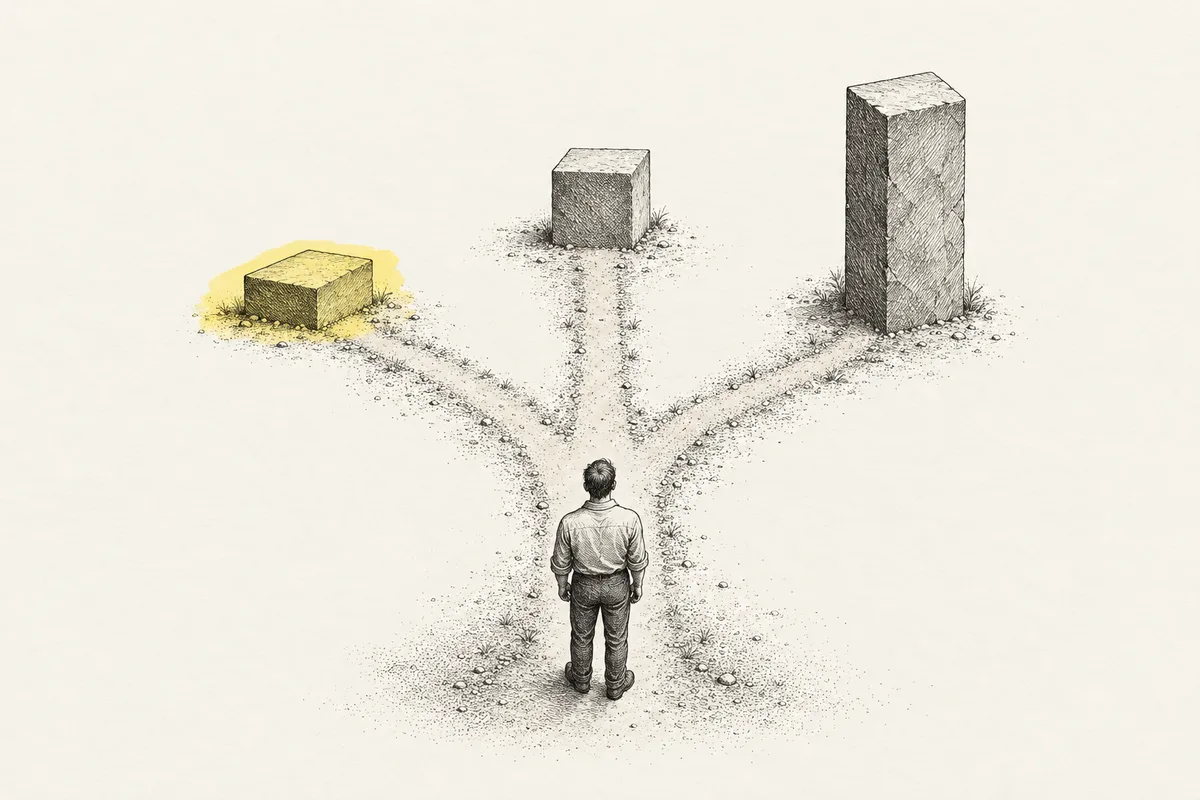
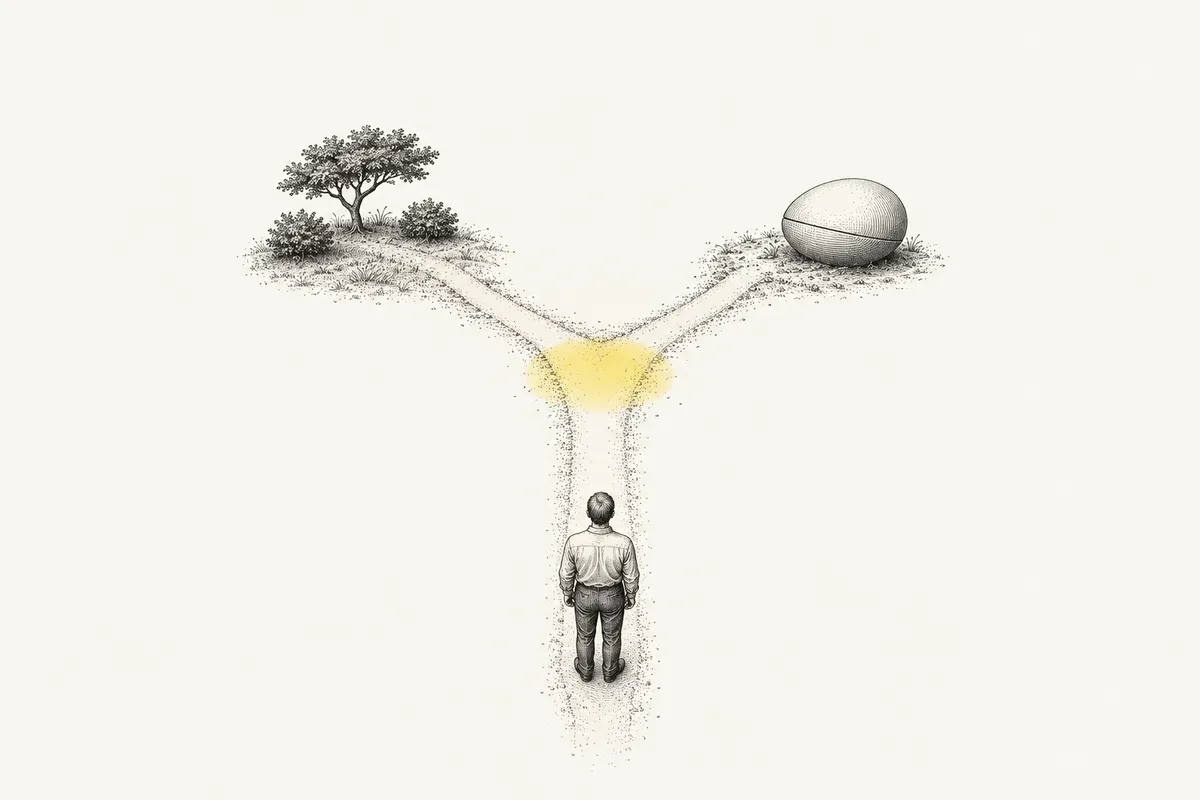
One figure where three paths part, each ending at a block of a different height.
Illustration: Puzzles, Charts & Dilemmas. Generated schematic illustration — not a photograph or historical record. Reuse: CC BY 4.0 (https://creativecommons.org/licenses/by/4.0/), to the extent Puzzles, Charts & Dilemmas holds rights in it.
Rawls and Harsanyi, in standard form
The original position, in the SEP's summary, is the point of view from which we imagine free and equal persons agreeing on principles of justice for a well-ordered democratic society. Rawls set it out in A Theory of Justice. This page is about one part of it, the veil.
The SEP entry on the original position, by Samuel Freeman, calls the veil of ignorance the main feature of that thought experiment. The parties who choose principles of justice lose all knowledge of particular facts about themselves, about one another and about their society. They keep general knowledge of economics, psychology and the other sciences. The entry places the veil at p. 12 of A Theory of Justice (1971) and p. 11 of the 1999 revised edition; we have not read the book itself.
Wide figure: scroll it sideways, or open it full size.
One shared premise and two rules of choice, with the lab layer from Choosing Justice at the bottom.
Diagram: Puzzles, Charts & Dilemmas, CC BY 4.0
Copy the full credit line
"The two arguments from behind the veil of ignorance" by Puzzles, Charts & Dilemmas, https://puzzleschartsanddilemmas.com/dilemmas/veil-of-ignorance/, licensed under CC BY 4.0 (https://creativecommons.org/licenses/by/4.0/).
Data: Norman Frohlich and Joe A. Oppenheimer, Choosing Justice (University of California Press, 1992), https://publishing.cdlib.org/ucpressebooks/public/book/choosing-justice-an-experimental-approach-to-ethical-theory.html (facts and page numbers; tables not reproduced)
Rawls's step from P1 runs through a rule of choice called maximin: pick the option whose worst outcome beats every other option's worst outcome. Rawls called it a poor guide to most choices under uncertainty, but the entry explains why he thought it fits here. The choice is grave, it cannot be repeated or renegotiated, and the parties have no basis for estimating probabilities. Under those conditions, Rawls argued, the parties would choose his principles of justice, with their guaranteed social minimum, over the principle of average utility.
The entry gives Rawls's general conditions for maximin: little or no basis for probabilities, an acceptable guaranteed minimum, and alternatives with unacceptable worst outcomes. He later called the first minor.
Harsanyi's answer, as the same entry reports it, is to treat every position as equally likely when nothing favors one over another. A chooser who maximizes expected utility under equal odds then picks the principle of average utility (Harsanyi 1975, as the SEP cites it). Choosing Justice (p. 4) traces the idea to Harsanyi's papers of 1953 and 1955, where people choose among income distributions without knowing their share. On that account he argued they would choose the distribution that “maximized the group's utility.”
The two veils are not equally thick. The SEP entry describes Harsanyi's chooser as knowing everyone's desires and the particular facts of their society, and lacking only knowledge of which person he will be. Rawls's “thick” veil also hides the society's history and the parties' own values. The entry gives Rawls's reason: knowledge of present desires would tie the principles to the very status quo they are meant to judge.
The SEP entry says Rawls relies on maximin mainly for his first principle, equal basic liberties, and for fair equality of opportunity, and that other arguments are needed for the difference principle, his rule for setting the social minimum. “Rawls's rule” in this page's title means the lab's version of that principle. Choosing Justice (p. 35) presented it to students as “maximizing the floor income.”
We checked both arguments for validity over every assignment of true and false. Each conclusion follows from its premises, and P1 alone entails neither conclusion. Validity says nothing about which rule of choice is right. That is where the two sides part.
Where the veil comes from
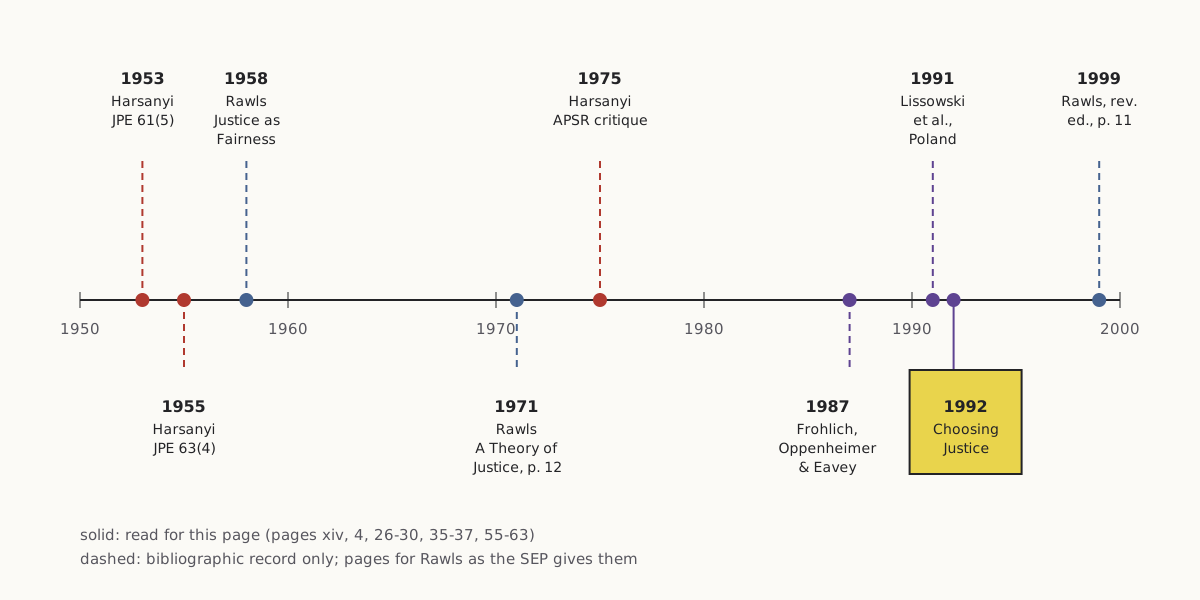
The timeline below lists the works behind this page and how far each one was read. Only Choosing Justice was read, at the pages cited here. The rest are bibliographic records, and the pages for Rawls's book are as the SEP gives them.
Wide figure: scroll it sideways, or open it full size.
Dated works on the veil and its lab version; only the 1992 book was read for this page.
Diagram: Puzzles, Charts & Dilemmas, CC BY 4.0
Copy the full credit line
"Dated works on the veil of ignorance and its lab version" by Puzzles, Charts & Dilemmas, https://puzzleschartsanddilemmas.com/dilemmas/veil-of-ignorance/, licensed under CC BY 4.0 (https://creativecommons.org/licenses/by/4.0/).
Data: Bibliographic records: Crossref (https://www.crossref.org/); Samuel Freeman, Original Position, Stanford Encyclopedia of Philosophy, https://plato.stanford.edu/entries/original-position/ (page numbers for A Theory of Justice and the Harsanyi 1975 entry); Frohlich and Oppenheimer, Choosing Justice (1992), pages 4 and xiv
| Year | Work | How far we read it |
|---|---|---|
| 1953 | John C. Harsanyi, Journal of Political Economy 61(5): 434–435 | bibliographic record only |
| 1955 | John C. Harsanyi, Journal of Political Economy 63(4): 309–321 | bibliographic record only |
| 1958 | John Rawls, “Justice as Fairness,” The Philosophical Review 67(2), from p. 164 | bibliographic record only |
| 1971 | John Rawls, A Theory of Justice; veil at p. 12 | bibliographic record only; page as the SEP gives it |
| 1975 | John C. Harsanyi, American Political Science Review 69: 594–606 | bibliographic record only, as the SEP cites it |
| 1987 | Frohlich, Oppenheimer and Eavey, British Journal of Political Science 17(1): 1–21 | bibliographic record only |
| 1991 | Lissowski, Tyszka and Okrasa, Journal of Conflict Resolution 35(1): 98–119 | bibliographic record only |
| 1992 | Frohlich and Oppenheimer, Choosing Justice | pp. xiv, 4, 26–30, 35–37, 55–63, the chapter 4 notes and the note to p. 170 |
| 1999 | John Rawls, A Theory of Justice, revised edition; veil at p. 11; section 24, pp. 118–123 | bibliographic record only; page as the SEP gives it |
Harsanyi's two papers came before Rawls's book, and Choosing Justice (p. 4) says Rawls “elaborated Harsanyi's conditions of imperfect information” but reached a different conclusion. The Polish runs were carried out by Grzegorz Lissowski, Tadeusz Tyszka and Wlodzimierz Okrasa, and the book (p. xiv) points to their own 1991 report. The experiment years are not given in the pages we read, so this page dates the results by the 1992 publication.
Four principles on one table
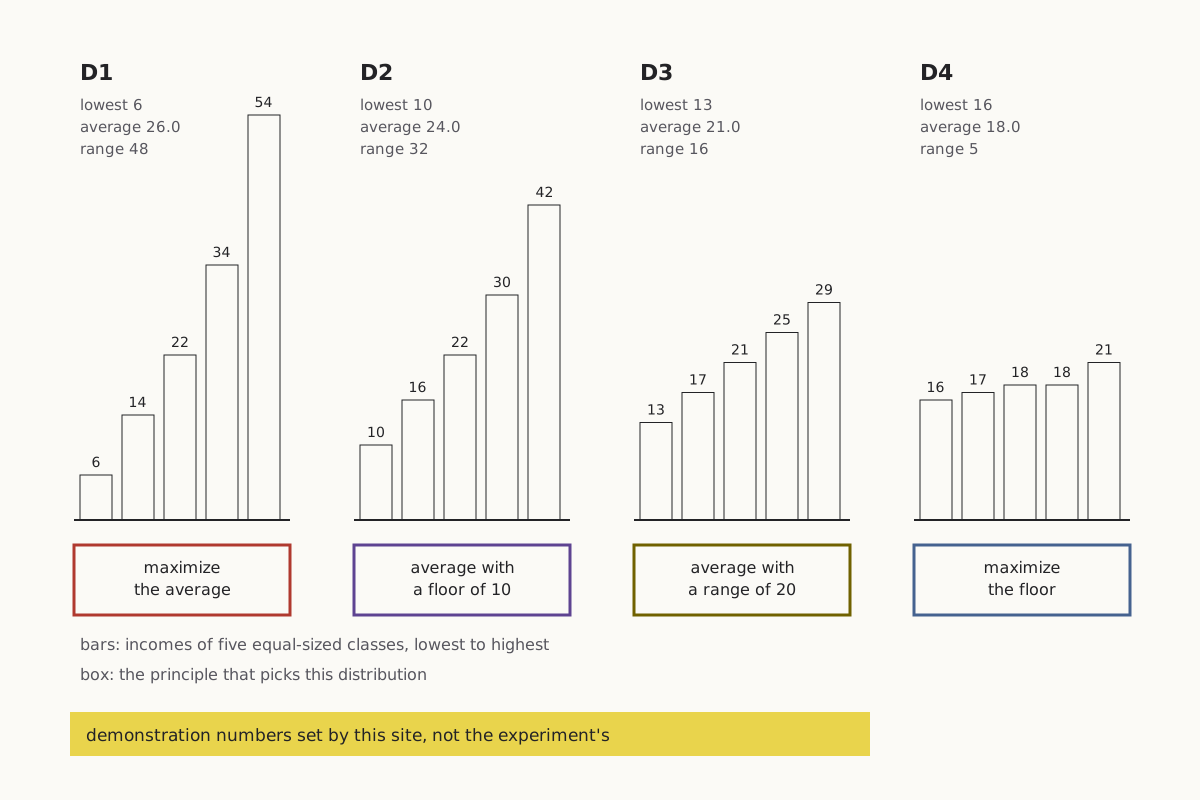
The students did not choose between two rules. Choosing Justice (pp. 35–36) gave them four. The first maximizes the floor, the lowest income; the second maximizes the average income. The third maximizes the average with a floor constraint, a guaranteed minimum that the group sets, and the fourth maximizes the average with a range constraint, a cap on the gap between the richest and the poorest.
Wide figure: scroll it sideways, or open it full size.
Four principles applied to one demonstration table, each picking a different distribution.
Diagram: Puzzles, Charts & Dilemmas, CC BY 4.0
Copy the full credit line
"Four principles applied to one demonstration table" by Puzzles, Charts & Dilemmas, https://puzzleschartsanddilemmas.com/dilemmas/veil-of-ignorance/, licensed under CC BY 4.0 (https://creativecommons.org/licenses/by/4.0/).
| Distribution | Incomes, lowest to highest | Lowest | Average | Range | Picked by |
|---|---|---|---|---|---|
| D1 | 6, 14, 22, 34, 54 | 6 | 26.0 | 48 | maximize the average |
| D2 | 10, 16, 22, 30, 42 | 10 | 24.0 | 32 | average with a floor of 10 |
| D3 | 13, 17, 21, 25, 29 | 13 | 21.0 | 16 | average with a range of 20 |
| D4 | 16, 17, 18, 18, 21 | 16 | 18.0 | 5 | maximize the floor |
To see how far apart the four can land, we built one demonstration table and applied each principle in two independent ways. Both gave the same picks. The floor rule takes D4, whose poorest class gets 16, even though its average is the lowest of the four. The average rule takes D1, whose poorest class gets 6.
A floor of 10 rules out D1 and then takes the highest average left, D2. A range of 20 keeps only D3 and D4 and takes D3.
The numbers are ours, chosen so that each principle lands on a different distribution. In the experiments, the groups set their own floor or range, and the income tables came from the experimenters. The book adds that Rawls called a floor constraint of this kind a mixed principle (note 8 to p. 59).
The two theorists' rules sit at opposite ends of the table. Maximin asks which distribution has the best worst case, so it takes D4. Equal odds over five equal classes make your expected income the distribution's average, so the average rule takes D1, which Choosing Justice (p. 58) scores as Harsanyi's, though Harsanyi measured utility, not income. The two mixed principles fall between them, and which distribution they take depends on the floor or range the group writes in.
The lab version
Choosing Justice reports 98 experiments run at the University of Manitoba, the University of Maryland, Florida State University and Warsaw University (pp. 55–56). Each group was five students recruited from university classes (p. 35). The students read about the four principles, passed a short test on them, ranked them, and earned money choosing alone before they met as a group (pp. 35–37). Then the group discussed the principles and, in most experiments, had to agree unanimously on one of them.
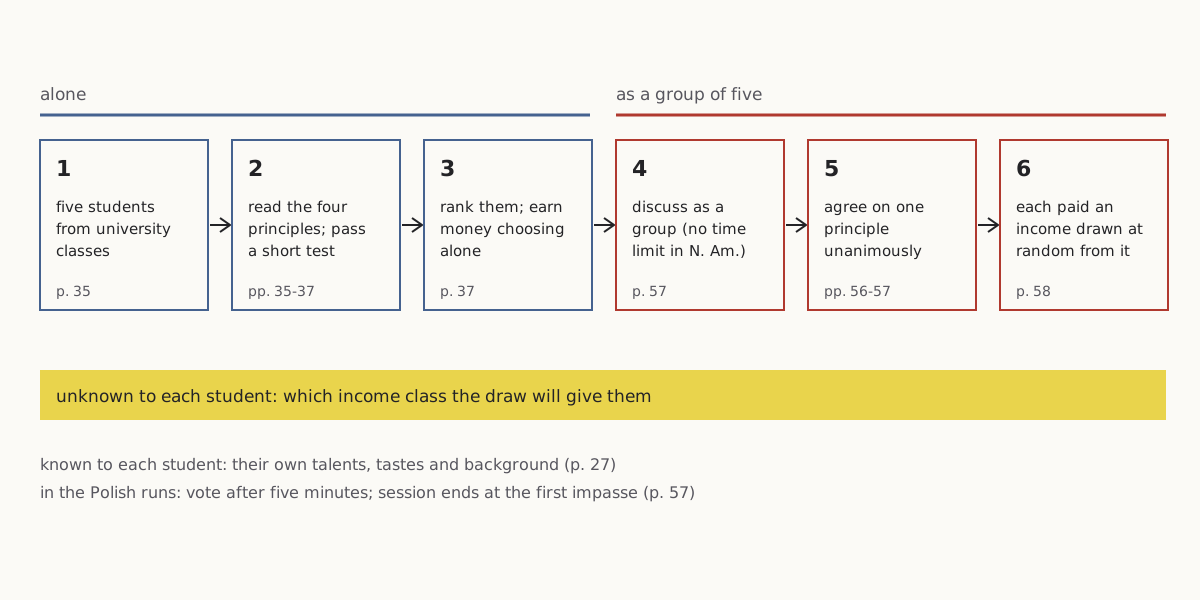
Wide figure: scroll it sideways, or open it full size.
The lab version step by step, with the pages of Choosing Justice for each step.
Diagram: Puzzles, Charts & Dilemmas, CC BY 4.0
Copy the full credit line
"The lab version of the veil, step by step" by Puzzles, Charts & Dilemmas, https://puzzleschartsanddilemmas.com/dilemmas/veil-of-ignorance/, licensed under CC BY 4.0 (https://creativecommons.org/licenses/by/4.0/).
Data: Norman Frohlich and Joe A. Oppenheimer, Choosing Justice (University of California Press, 1992), https://publishing.cdlib.org/ucpressebooks/public/book/choosing-justice-an-experimental-approach-to-ethical-theory.html (facts and page numbers; tables not reproduced)
The stake was real but small. Each student's pay for that part of the session was an income drawn at random from the distribution the group's principle picked (p. 58). The authors write that “even with such a small incentive,” almost all groups had little difficulty reaching agreement.
Of the 98 experiments, 83 required unanimity; in 10 the experimenters imposed the principle, and in 5 a majority vote was enough (p. 56 and its note 3). Only 7 of the 83 groups, or 8.4 percent, failed to agree. All 7 were in Poland, where groups had to vote after five minutes and the session ended at the first impasse (pp. 56–57). In the 76 cases where unanimity was sought and no time limit was enforced, involving 380 students, every group agreed (p. 57).
The authors had expected a result of this kind. Before reporting it, they predicted that groups would choose neither Rawls's principle nor Harsanyi's but a mixed one that weighs the poor against incentives (pp. 28–30). They tied the guess to a model by Roger Howe and John Roemer (1981) in which, for moderately risk-averse choosers, the choice centers on a floor with incomes otherwise left free. They note that Rawls himself considered two such mixed principles and rejected them (p. 30).
What the students did not know was narrow. The authors write that their subjects did not know the position they would occupy but kept “all their other information and knowledge” (p. 27), so they knew their own talents and tastes. Rawls's parties know none of that. The experience machine asks a different question, but one of its swaps also has you choose for someone whose wishes you do not know.
The swap test
The swap test changes one condition at a time, lists what else changes with it, and asks whether the judgment changes. Here the judgment is which principle a group picks, or whether it can agree at all. Only the first two rows have a published comparison behind them; the rest are your own answer or our hypothesis.
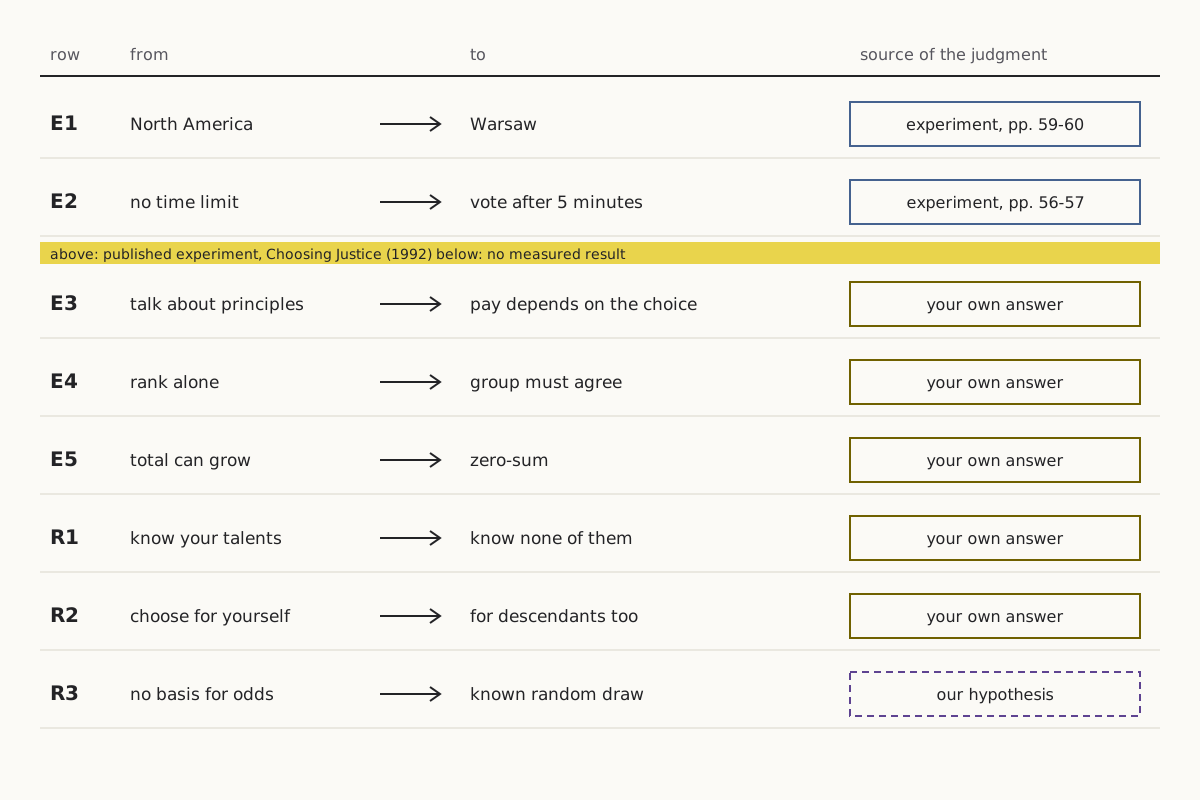
Wide figure: scroll it sideways, or open it full size.
Eight swaps sorted by the source of each judgment; only the top two rest on a published experiment.
Diagram: Puzzles, Charts & Dilemmas, CC BY 4.0
Copy the full credit line
"Veil of ignorance swap test" by Puzzles, Charts & Dilemmas, https://puzzleschartsanddilemmas.com/dilemmas/veil-of-ignorance/, licensed under CC BY 4.0 (https://creativecommons.org/licenses/by/4.0/).
Data: Norman Frohlich and Joe A. Oppenheimer, Choosing Justice (University of California Press, 1992), https://publishing.cdlib.org/ucpressebooks/public/book/choosing-justice-an-experimental-approach-to-ethical-theory.html (facts and page numbers; tables not reproduced)
| Swap | What else changes | Does the judgment change? | Source of the judgment |
|---|---|---|---|
| E1: Manitoba, Maryland and Florida → Warsaw | Language, currency and institutions; the Polish runs also had the five-minute vote | may not change: the authors report similar distributions of choices at all four locations | published experiment: Frohlich & Oppenheimer 1992, pp. 59–60, n = 81 groups |
| E2: no time limit → vote after five minutes | Time to reflect; country and organizers too | may change: all 7 failures came from the five-minute runs; all 76 untimed cases agreed | published experiment: Frohlich & Oppenheimer 1992, pp. 56–57, n = 83 groups |
| E3: talking about principles → your pay depends on the principle your group picks | The stakes become personal but stay small | may change | your own answer |
| E4: ranking alone → the group of five must agree unanimously | Discussion, persuasion and compromise enter | may change | your own answer |
| E5: total income can grow → zero-sum tables | The reason to grow the total disappears | may change | your own answer |
| R1: you know your talents and tastes, as the lab students did → you know none of them | Self-interest has less to work with | may change | your own answer |
| R2: choosing for yourself → choosing for your descendants too | Time horizon; responsibility for people not yet born | may change | your own answer |
| R3: no basis for odds → a known random draw from the chosen table, as in the lab | Expected value becomes computable; the stakes also shrink | may change | [hypothesis] |
Try it first: Before opening the results, which principle would you pick for a society you will join at random, and which rows would change your pick?
Show it worked through
Worked through
Of the 98 experiments, 81 ended with the group choosing a principle. The authors leave out the 10 where the principle was imposed and the Polish runs that ended without agreement (note 6 to p. 58). In only one of those 81 did the group choose to maximize the floor, and the authors add that even this single choice “may be in error” (note 7). Ten groups chose to maximize the average (p. 58).
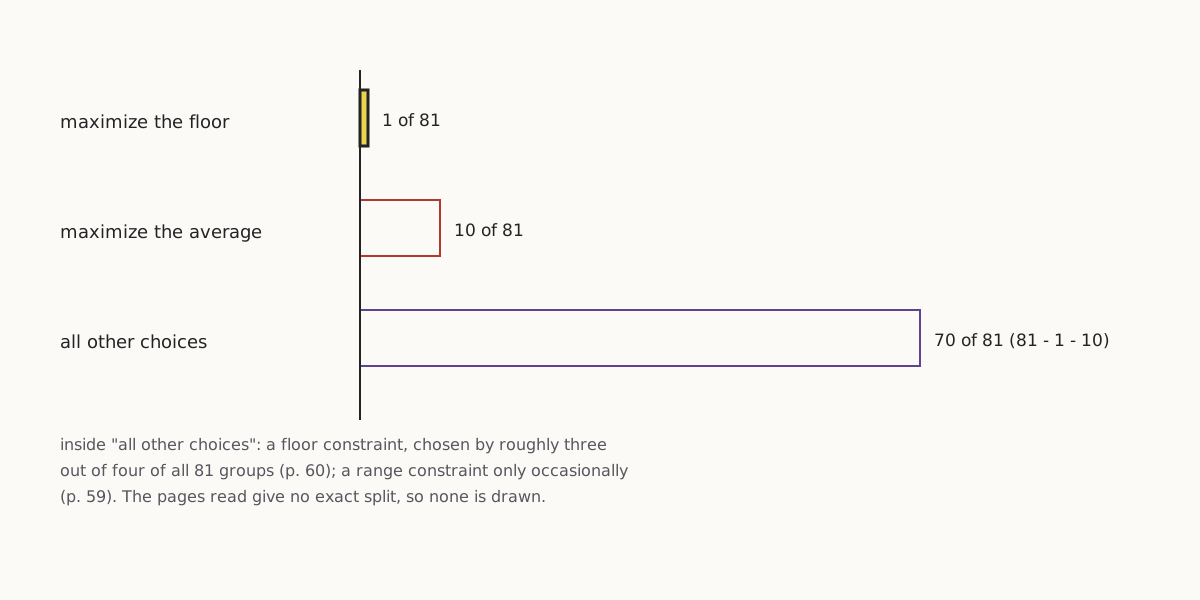
Wide figure: scroll it sideways, or open it full size.
What the 81 groups chose; the split inside the largest bar is not given in the pages read, so none is drawn.
Diagram: Puzzles, Charts & Dilemmas, CC BY 4.0
Copy the full credit line
"What the 81 groups chose" by Puzzles, Charts & Dilemmas, https://puzzleschartsanddilemmas.com/dilemmas/veil-of-ignorance/, licensed under CC BY 4.0 (https://creativecommons.org/licenses/by/4.0/).
Data: Norman Frohlich and Joe A. Oppenheimer, Choosing Justice (University of California Press, 1992), https://publishing.cdlib.org/ucpressebooks/public/book/choosing-justice-an-experimental-approach-to-ethical-theory.html (facts and page numbers; tables not reproduced)
| Choice | Groups | Out of | Where |
|---|---|---|---|
| Maximize the floor | 1 | 81 | p. 58 |
| Maximize the average | 10 | 81 | p. 58 |
| Average with a floor constraint | roughly three out of four | 81 | p. 60 |
| Average with a range constraint | only occasionally | 81 | p. 59 |
| Neither of the first two | 70 | 81 | our subtraction: 81 − 1 − 10 |
The rest went mostly one way. Groups wanted an income floor guaranteed to the worst-off and, above it, room for incentives to raise production and the average income. A ceiling on incomes drew sustained interest only occasionally (p. 59). In the aggregate, “roughly three out of four groups chose the floor-constraint principle” (p. 60), and the authors found a floor without a ceiling dominant at all four locations.
Why the groups wanted a floor
The authors sampled the recorded discussions for reasons. Most members of virtually all groups did not want anyone to fall below a minimum, out of concern both for the person and for society (p. 61). The worry on the other side was work: a floor set too high might dull the incentive to earn (pp. 61–62). One student put the tension plainly: “I want to be rich, but I don't want the feeling that there are people hungry” (p. 63).
A cap on top incomes drew little support, because students saw it as a limit on the chance to earn a lot (p. 62). In most cases, the authors write, groups settled the tension with a floor and no ceiling, a guarantee that no one would “starve” that still let luck, ambition or talent raise earnings without limit (p. 63). These are the students' reasons, recorded in one set of experiments, not a finding about human nature.
What the rows can and cannot show
Read the swap rows against these results. E1 is the one row where the choice itself was compared across a swap, and E2 bears on agreement rather than on which principle won.
E3 and E4 stay yours to answer: the pages we read report no unpaid run and no comparison of solo rankings with group choices. None of the rows tests whether a thicker veil would change the choice. R1 and R3 are the two places where the lab and Rawls's setting part ways, and the lab changes both at once, so its result cannot say which one mattered.
R1 is the row to answer slowly. If you knew you were a strong earner, a high floor costs you money; if you knew you were not, it protects you. Rawls's parties cannot run either calculation. The lab students knew their talents, but their pay was a random draw (p. 58), so talent could not move it.
R3 is our hypothesis because the lab already gave students a known random draw, which is closer to Harsanyi's equal odds than to Rawls's missing odds. Yet most groups still did not choose the plain average. R2 asks whether you would choose differently if your descendants' lives were at stake too, which Choosing Justice (p. 27) counts among the stakes Rawls and Harsanyi assume.
For E5, Choosing Justice (in a note to p. 170) reports a study by Douglas Bond and Jong Chul Park in Korea and the United States that made the income tables zero-sum. There, it says, choices “predominantly maximized the floor or specified range constraints.” We have not read that study and the book gives no sample size for it, so the row stays your own answer.
Push back:
The strongest reply stands on Rawls's side. The lab veil is too thin to test his claim: the students knew their talents and backgrounds, the authors grant that the stakes fell “far short” of what Rawls had in mind (p. 27), and each group chose from tables the experimenters wrote. The SEP entry adds that Rawls called the original position a “device of representation,” not an event among real people. On this view the experiments show what students prefer under mild uncertainty, and nothing about the difference principle.
- Newcomb's problem: Two respected rules of choice, dominance and expected value, give opposite answers once the predictor is right often enough.
- Prisoner's dilemma: A game in which, played once, each player's best reply leaves both worse off than they could have been.
Sources
- Norman Frohlich and Joe A. Oppenheimer, Choosing Justice: An Experimental Approach to Ethical Theory (Berkeley: University of California Press, 1992), pp. xiv, 4, 26–30, 35–37, 55–63 and the notes to chapter 4 and p. 170. ark:/13030/ft3f59n88z. https://publishing.cdlib.org/ucpressebooks/public/book/choosing-justice-an-experimental-approach-to-ethical-theory.html Read: full text of pages xiv, 4, 26–30, 35–37 and 55–63, the notes to chapter 4, the note to p. 170 and the reference entry for Bond and Park (1991), in the publisher's open edition.
- Samuel Freeman, “Original Position,” Stanford Encyclopedia of Philosophy (first published 2008-12-20; substantive revision 2023-10-24), opening summary, §3 “The Veil of Ignorance” and §6.2 “The Argument from the Maximin Criterion.” https://plato.stanford.edu/entries/original-position/ Read: opening summary, sections 3 and 6.2, and bibliography.
- John Rawls, A Theory of Justice (Cambridge, MA: Harvard University Press, 1971), p. 12; revised edition (1999), p. 11 and §24 “The Veil of Ignorance,” pp. 118–123. Pages as given in the SEP entry Original Position and in the Crossref record for §24. https://doi.org/10.4159/9780674042582-026 Read: bibliographic record only; page numbers as given in the SEP entry Original Position and the Crossref record.
- John C. Harsanyi, “Can the Maximin Principle Serve as the Basis for Morality? A Critique of John Rawls's Theory,” American Political Science Review 69 (1975): 594–606. As cited in the SEP entry Original Position. https://plato.stanford.edu/entries/original-position/#Bib Read: bibliographic record only, as listed in the SEP entry Original Position.
- John C. Harsanyi, “Cardinal Utility in Welfare Economics and in the Theory of Risk-taking,” Journal of Political Economy 61(5) (1953): 434–435. doi:10.1086/257416. https://doi.org/10.1086/257416 Read: bibliographic record only.
- John C. Harsanyi, “Cardinal Welfare, Individualistic Ethics, and Interpersonal Comparisons of Utility,” Journal of Political Economy 63(4) (1955): 309–321. doi:10.1086/257678. https://doi.org/10.1086/257678 Read: bibliographic record only.
- John Rawls, “Justice as Fairness,” The Philosophical Review 67(2) (1958), from p. 164. doi:10.2307/2182612. https://doi.org/10.2307/2182612 Read: bibliographic record only.
- Norman Frohlich, Joe A. Oppenheimer and Cheryl L. Eavey, “Laboratory Results on Rawls's Distributive Justice,” British Journal of Political Science 17(1) (1987): 1–21. doi:10.1017/s0007123400004580. https://doi.org/10.1017/s0007123400004580 Read: bibliographic record only.
- Grzegorz Lissowski, Tadeusz Tyszka and Wlodzimierz Okrasa, “Principles of Distributive Justice,” Journal of Conflict Resolution 35(1) (1991): 98–119. doi:10.1177/0022002791035001006. https://doi.org/10.1177/0022002791035001006 Read: bibliographic record only.
Downloads: Swap test (CSV) (file notes: source, version and license (JSON)) Data: Norman Frohlich and Joe A. Oppenheimer, Choosing Justice (University of California Press, 1992), https://publishing.cdlib.org/ucpressebooks/public/book/choosing-justice-an-experimental-approach-to-ethical-theory.html (facts and page numbers; tables not reproduced) · Group choices (CSV) (file notes: source, version and license (JSON)) Data: Norman Frohlich and Joe A. Oppenheimer, Choosing Justice (University of California Press, 1992), https://publishing.cdlib.org/ucpressebooks/public/book/choosing-justice-an-experimental-approach-to-ethical-theory.html (facts and page numbers; tables not reproduced) · Demonstration table (CSV) (file notes: source, version and license (JSON)) · Timeline (CSV) (file notes: source, version and license (JSON)) Data: Bibliographic records: Crossref (https://www.crossref.org/); Samuel Freeman, Original Position, Stanford Encyclopedia of Philosophy, https://plato.stanford.edu/entries/original-position/ (page numbers for A Theory of Justice and the Harsanyi 1975 entry); Frohlich and Oppenheimer, Choosing Justice (1992), pages 4 and xiv · Argument validity (JSON) (file notes: source, version and license (JSON))
Cite this page
Puzzles, Charts & Dilemmas. “Veil of Ignorance: At Most 1 of 81 Groups Chose Rawls's Rule.” Puzzles, Charts & Dilemmas. Published 2026-10-31. https://puzzleschartsanddilemmas.com/dilemmas/veil-of-ignorance/. Accessed: add the date you read it.
Dates are given as year-month-day. 31 October 2026 is the latest substantive revision.
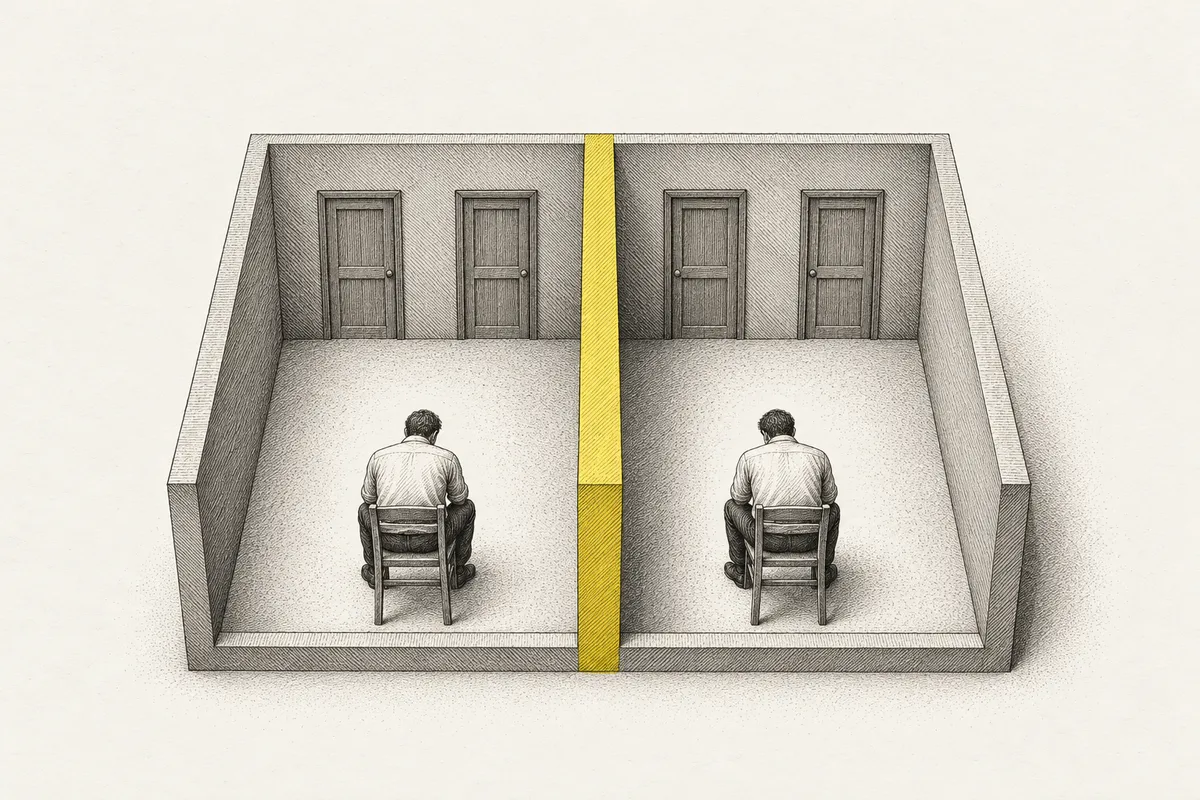
Prisoner's Dilemma: In One Round, Betrayal Pays Each Player
Picture credit
Illustration: Puzzles, Charts & Dilemmas. Generated schematic illustration — not a photograph or historical record. Reuse: CC BY 4.0 (https://creativecommons.org/licenses/by/4.0/), to the extent Puzzles, Charts & Dilemmas holds rights in it.
Experience Machine: A No to Plugging In Does Not Say Why
Picture credit
Illustration: Puzzles, Charts & Dilemmas. Generated schematic illustration — not a photograph or historical record. Reuse: CC BY 4.0 (https://creativecommons.org/licenses/by/4.0/), to the extent Puzzles, Charts & Dilemmas holds rights in it.